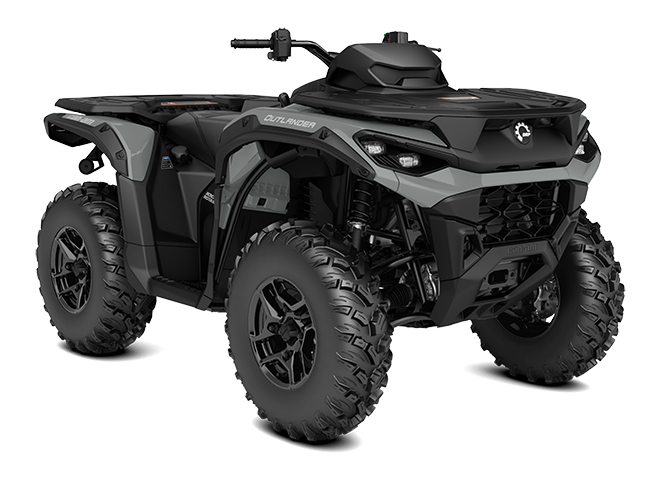
The 2026 Can-Am Outlander Electric brings a full-size battery powertrain to utility ATVs. Its Rotax E-Power system combines an 8.9 kWh battery, 47 hp and direct drive with a 1,830 lb tow rating. At 875 lb and $12,999, it sits beside big-bore gasoline flagships on weight and price. Its appeal depends on whether quiet direct drive, local charging and up to 50 miles of range fit the work. Our guide to reading ATV and UTV specs explains how to evaluate those figures.
Electric powertrain: 47 hp and direct drive
The Outlander Electric uses a liquid-cooled Rotax E-Power system with an 8.9 kWh battery. Output is about 47 hp, close to the 50 hp gasoline Outlander 700. Power reaches the selectable 2WD and 4WD system through single-speed direct drive rather than an automatic CVT.
There is no CVT belt or stepped gearbox in the dataset configuration. The trade is dependence on battery charge. A gasoline ATV can be refueled from a can, while the electric model needs electricity and enough time to restore its range.
Range: up to 50 miles
The dataset lists up to 50 miles of range. That can cover a compact property or planned loop, but the word up to matters. Terrain, towing, rider weight, temperature and speed change energy use. Buyers should compare the maximum with their longest realistic day.
Charging time is not included in the model data, so this review does not assign a figure. The practical question is whether the ATV returns to a location with power between uses. A farm, resort or managed property with predictable routes may suit electric operation well. Remote riding without charging access requires more conservative range planning.
Work capability: the strongest Outlander tow rating
The 1,830 lb tow rating is one of the electric model’s best numbers. It exceeds the 1,650 lb ratings of the Outlander 700, 850 and 1000R XT in the dataset. That makes the Electric a real utility ATV rather than a low-capacity technology showcase.
Heavy towing will affect available range, and the published maximum does not remove the need to consider tongue load, grades and loose surfaces. Still, the rating gives property owners useful capacity. Electric operation may also appeal where reduced engine noise is valuable around animals, guests or early-morning work.
Size and weight
The Outlander Electric is 48 inches wide with a 51-inch wheelbase and 11 inches of ground clearance. Those dimensions place it squarely in the full-size utility class. It remains narrow enough for typical ATV trails, although local width rules still need checking.
Weight is 875 lb, 165 lb more than the Outlander 700 and 80 lb more than the Outlander 850. It is almost identical to the 880 lb Outlander 1000R XT. Riders will feel that mass when loading a trailer, crossing soft ground or recovering the machine. An appropriate trailer and tow vehicle remain important even though the ATV itself uses no gasoline.
Who it’s for
The Outlander Electric suits owners with predictable daily distances, reliable charging access and a reason to value quiet direct drive. Farms, managed properties, hunting land and resort operations may fit that pattern. It also makes sense for early adopters who want a full-size electric ATV without giving up towing capability.
It is less suitable for remote multi-day riding, unpredictable long routes or buyers who need rapid refueling away from power. Riders focused on maximum horsepower can buy much stronger gasoline machines for the same price. If you are still choosing between an ATV and a side-by-side for property work, our ATV versus UTV guide covers the practical differences.
How it compares
The Outlander 700 is the most revealing comparison. It makes 50 hp, weighs 710 lb and costs $8,999. The Electric gives up 3 hp, weighs 165 lb more and costs $4,000 more, but tows 180 lb more and replaces the gasoline engine and CVT with direct drive. Compare them directly.
The Outlander 1000R XT costs the same $12,999 and weighs only five pounds more. Its 976cc V-twin makes 91 hp, nearly double the Electric’s output, while towing 180 lb less. The gasoline flagship is the performance choice. The Electric answers with its direct-drive experience and advertised range. See the full comparison. The Polaris Sportsman XP 1000 S also costs $12,999 and makes 90 hp. It is seven inches wider, 61 lb heavier and has 3.5 inches more clearance, while towing 80 lb less. Compare the Can-Am and Polaris.
Where it sits in the Can-Am lineup
The Electric is not a simple replacement for one gasoline Outlander. Its 47 hp aligns closely with the Outlander 700, while its $12,999 price matches the 91 hp Outlander 1000R XT. The Outlander 850 sits between them at $10,799 with 78 hp. Buyers wanting two seats should choose the Outlander MAX 700, because the Electric seats one. The new model occupies its own branch for buyers prioritizing the powertrain rather than maximum horsepower.
Price and value
At $12,999, the Outlander Electric charges a $4,000 premium over the similarly powerful Outlander 700. It also competes directly on price with two gasoline ATVs making about 90 hp. The value case therefore cannot rest on horsepower per dollar.
Its case is quieter direct drive, no conventional CVT belt, a 1,830 lb tow rating and the ability to recharge at a suitable home base. Operating costs depend on electricity prices, use and long-term service needs, none of which should be guessed from purchase price alone.
Pros and cons
The good: a full-size electric ATV with 47 hp, an 8.9 kWh battery, up to 50 miles of range, direct drive, selectable 2WD and 4WD, and a strong 1,830 lb tow rating.
The catch: a $12,999 price, 875 lb weight and range that varies with conditions. It seats one, requires charging access and gives up substantial power to gasoline ATVs costing the same amount.
The verdict
The 2026 Can-Am Outlander Electric is significant because it keeps the utility part of the equation intact. Its 1,830 lb tow rating, full-size dimensions and 47 hp make it a real working ATV with an electric powertrain, not a novelty.
The purchase still requires a specific use pattern. Predictable routes and reliable charging make its quiet direct drive compelling. Remote travel and maximum performance favor gasoline. Buyers who can answer the range and charging questions confidently now have a credible electric option instead of a compromised one.
Want to compare it with another utility ATV? Add it to the comparison tool, or browse the full database by power, towing capacity and price.