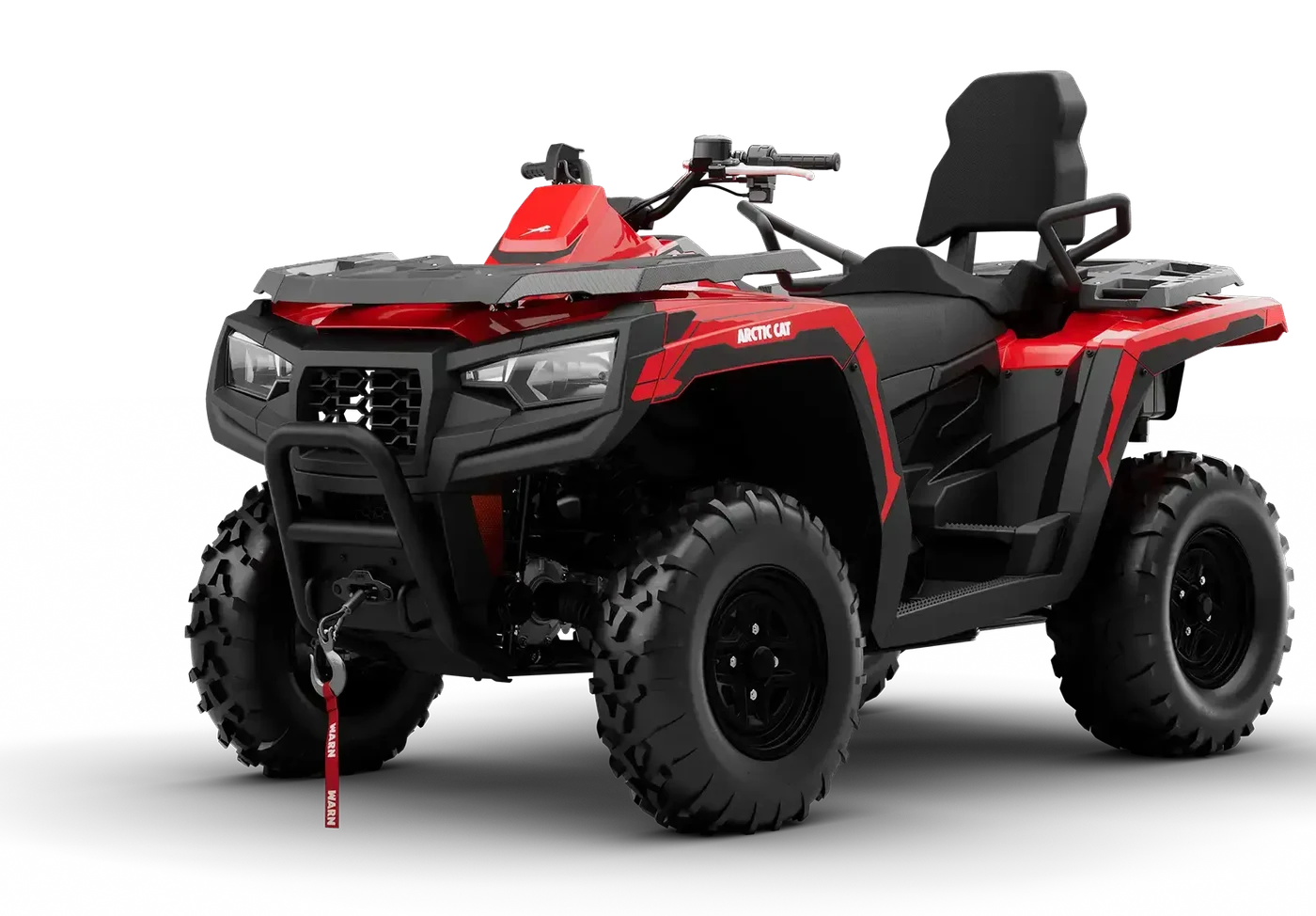
The 2025 Can-Am Outlander MAX 700 takes the useful middleweight Outlander formula and makes room for a real passenger. This is not a solo ATV with a pad strapped to the rear rack. It has two seats, passenger grips and a longer chassis designed around two-up riding. The same 50 hp Rotax single and 1,650 lb tow rating keep it useful when the trip involves work instead of sightseeing. That blend is appealing, but the extra seat also adds weight, length and cost. Here is where the MAX 700 earns its premium, and where a simpler machine may suit you better. If the numbers on ATV spec sheets feel disconnected from real use, start with our guide to reading ATV and UTV specs.
Despite the 700 name, the Outlander MAX 700 uses a 650cc liquid-cooled Rotax single-cylinder engine. Can-Am’s model number describes its market class, not exact displacement. Output is about 50 hp, sent through an automatic CVT, so operation is straightforward and there is no manual clutch to manage.
Fifty horsepower is a sensible fit for trail riding and useful pulling strength. The tradeoff is refinement. A single generally feels busier than the twin-cylinder engines used in higher-powered touring quads.
Two-up design: the reason to buy the MAX
The passenger package is the point of this model. Can-Am gives the second rider a dedicated seat and hand grips. Its 57-inch wheelbase is six inches longer than the single-seat Outlander 700, creating the needed room. The cost is a larger turning footprint. At 775 lb, the MAX is also 65 lb heavier than the regular 700.
Drivetrain and ride: useful clearance, more length
Selectable 2WD and 4WD let you keep the steering lighter on firm ground, then bring in the front wheels when mud, snow or a rough climb calls for more traction. Ground clearance is 11 inches, a practical amount for ruts and common trail obstacles. The 46-inch width remains friendly to tighter ATV routes even though the wheelbase has grown.
The longer chassis takes more planning in sharp switchbacks and crowded work areas. With a passenger, smooth inputs matter too because the extra body weight changes braking and cornering.
Work capability: serious towing for a two-seater
The 1,650 lb tow rating is one of the MAX 700’s strongest numbers. It matches the single-seat Outlander 700 and gives this touring ATV genuine utility value for a small trailer, yard work or moving supplies around a property. Its 5.4-gallon fuel tank also matches the regular 700, although carrying a passenger or pulling a load can reduce real-world range.
Trailer balance, tongue load, hills and loose ground can all matter before the published maximum is reached. Still, the rating makes the MAX more than a recreational two-seater.
Who it’s for
The Outlander MAX 700 makes the most sense for couples, landowners and touring riders who expect to share the seat. It provides factory two-up accommodations without forcing the buyer into a much heavier machine. The narrow body also preserves access to trails that may feel cramped in a side-by-side. Our ATV versus UTV guide explains the practical differences.
It is less convincing for a solo rider. The regular Outlander 700 has the same power and tow rating for $1,300 less, while weighing less and turning within a shorter wheelbase.
How it compares
The closest rival is the 2026 CFMoto CForce 800 Touring. It also seats two, but its 799cc V-twin makes 70 hp. At $9,499 it costs $800 less, though it weighs 970 lb and tows 1,500 lb. The CFMoto makes a strong power case. Can-Am answers with less weight and a more established dealer and resale record in North America. Compare them directly.
Without a passenger, the Yamaha Kodiak 700 EPS offers 47 hp and a well-regarded Ultramatic CVT for $9,699. Compare it with the MAX. The solo Polaris Sportsman 570 is cheaper at $7,499, but its 44 hp and 1,225 lb tow rating trail the Can-Am. Compare those models.
Where it sits in the Can-Am lineup
The MAX shares its engine, 50 hp output and tow rating with the Outlander 700. The standard model costs $8,999 and seats one. The Outlander 500 lowers the price to $7,199 with 40 hp. Above them, the Outlander 850 brings a 78 hp V-twin for $10,799, but it is a single-seater. The MAX 700 is the passenger-focused choice, not simply the next engine step.
Price and value
At $10,299, the Outlander MAX 700 asks a meaningful premium over the standard 700. The value depends almost entirely on using that second seat. Regular two-up riders get a purpose-built setup while keeping strong towing capacity and manageable width. Occasional passengers may not justify paying more for a heavier, longer ATV every day.
Pros and cons
The good: a proper two-up layout with passenger support, useful 50 hp output, a strong 1,650 lb tow rating, selectable 2WD and 4WD, 11 inches of ground clearance, and a 46-inch width that still fits typical ATV trails.
The catch: it costs $1,300 more and weighs 65 lb more than the mechanically similar single-seat Outlander 700. The longer wheelbase needs more room in tight turns, and the Rotax single is less refined than a V-twin. A value rival also offers more power for less money.
The verdict
The 2025 Can-Am Outlander MAX 700 is easy to understand once the passenger seat enters the equation. It gives two riders a purpose-built place to sit, keeps the regular 700’s 50 hp and 1,650 lb tow rating, and stays narrow enough for traditional ATV trails. Those are meaningful advantages for touring partners or owners who work together around a property.
Solo riders should choose the regular 700, while power shoppers should consider the CForce 800 Touring. For a lighter two-up ATV with real work ability, the MAX 700 lands in a useful middle ground.
Want to compare it with another ATV? Put it into the comparison tool, or browse the full database by power, towing capacity and price.