
UTVUtility
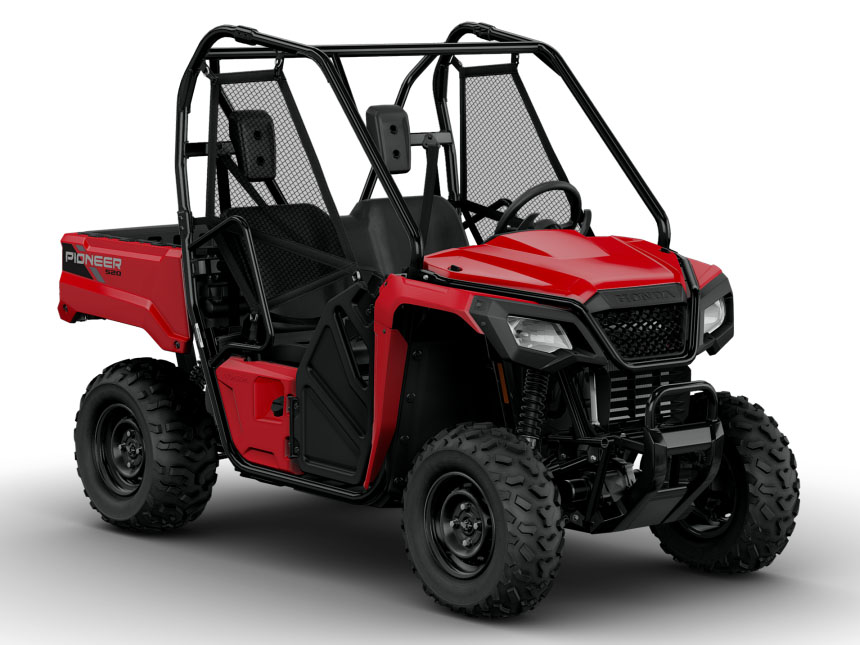
2026 Honda Pioneer 520
518cc Single-cylinder (OHV), liquid-cooled
$10,999
View full specs2026 Honda Pioneer 520 vs 2025 Yamaha Viking EPS: 35 vs 47 hp, 518 cc vs 686 cc, 1060 lb dry vs 1431 lb dry, $10,999 vs $15,499. Full side-by-side specs: powertrain, drivetrain, dimensions, towing and price.
518cc Single-cylinder (OHV), liquid-cooled
$10,999
View full specs686cc Single-cylinder, liquid-cooled
$15,499
View full specsAcross measured specs the Pioneer 520 leads in 2 categories and the Viking EPS in 6. Comparing two utility UTVs, the Pioneer 520 uses a 518 cc single-cylinder (ohv) with about 35 hp, while the Viking EPS uses a 686 cc single-cylinder with about 47 hp. The Viking EPS has the power edge (47 hp vs 35 hp). The Pioneer 520 is lighter at 1060 lb (vs 1431 lb). At $10,999 the Pioneer 520 is the more affordable of the two.
Pioneer 520 Honda · 2026 View | Viking EPS Yamaha · 2025 View | |
|---|---|---|
| Engine | ||
| Displacement | 518 cc | 686 cc |
| Engine configuration | Single-cylinder (OHV) | Single-cylinder |
| Cylinders | 1 | 1 |
| Cooling | Liquid | Liquid |
| Power (approx.) | 35 hp | 47 hp |
| Fuel system | EFI | EFI |
| Starter | Electric | Electric |
| Drivetrain | ||
| Transmission | 5-speed automatic with AT/MT modes | Ultramatic CVT |
| Drive system | Selectable 2WD/4WD with locking front differential | Selectable 2WD/4WD |
| Dimensions & capacity | ||
| Seating | 2 seats | 3 seats |
| Dry weight | 1060 lb (481 kg) | 1431 lb (649 kg) |
| Overall width | 50 in (127 cm) | 61.8 in (157 cm) |
| Wheelbase | 73 in (185.4 cm) | 84.1 in (213.6 cm) |
| Ground clearance | 8.5 in (21.6 cm) | 11.8 in (30 cm) |
| Fuel capacity | 4.1 gal (15.5 L) | 9.7 gal (36.7 L) |
| Towing capacity | 1,000 lb (454 kg) | 1,500 lb (680 kg) |
| Pricing | ||
| MSRP (base) | $10,999 | $15,499 |
| Model year | 2026 | 2025 |
Highlighted figures indicate the stronger spec in each row. Power is approximate crank output; confirm exact numbers with the manufacturer.