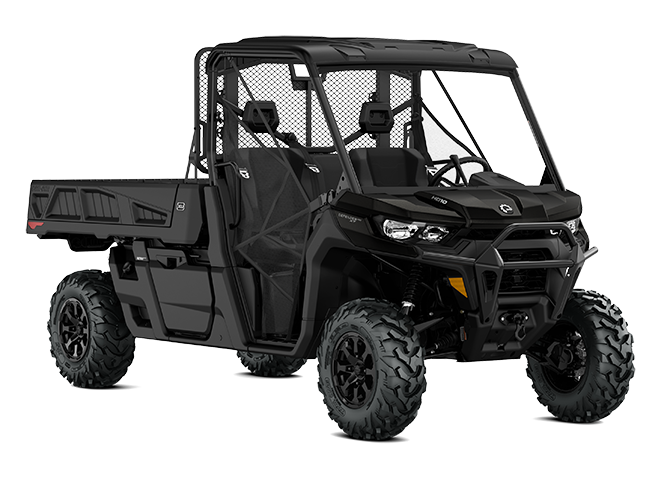
The 2027 Can-Am Defender XU PRO XT HD10 is a long-bed utility side-by-side for jobs that run out of space before they run out of horsepower. Its cargo box measures 72 inches long and has hydraulic power tilt, a metal headache rack and mounted tool holders. The factory package also includes a roof, winch and protective skid plate. Starting U.S. MSRP is $25,399 before transportation and preparation.
There is an easy catalog mistake to avoid. Can-Am puts the XU PRO and XU 6x6 on one family page, but this XU PRO XT HD10 has four wheels. It also uses an 82 hp, 976cc V-twin, not the 80 hp triple in the separate Gen 2 Defender XT HD10. The figures in this review follow Can-Am’s 2027 XU PRO XT HD10 specification sheet. This is a researched specification review, not a claimed ride test.
Why the long bed is the point
The XU PRO’s 72 by 54.5 by 10-inch bed is far longer than the 38 by 54.5 by 12-inch box on the 2027 Defender XT HD10. That length can matter for fencing supplies, long tools, feed runs or property-maintenance equipment that does not sit neatly in a conventional short dump box. The hydraulic tilt is also a meaningful convenience when unloading bulk material, though the machine still needs to be positioned safely and loaded within its ratings.
Longer does not mean heavier-rated. Can-Am gives this box a 959 lb limit, compared with 1,000 lb for the shorter XT HD10 box. The XU PRO is rated for 1,530 lb total payload, 250 lb on its tailgate and 2,500 lb of towing. Those are separate ceilings, not a promise that you can max every one simultaneously. California’s cargo-box rating is lower still at 559 lb. Buyers planning regular heavy loads should use the actual job’s load dimensions and weight rather than choosing solely by bed size. Our guide to reading ATV and UTV specs explains why tow, box and payload numbers should not be merged.
Can-Am fits a metal headache rack behind the cab and two LinQ tool holders. A trailer hitch ball mount comes with the package. These are the details that distinguish the XU PRO from a standard Defender with accessories added later. They keep tools organized and put protection between cargo and occupants, but loose material still needs to be secured properly.
V-twin power and four-wheel drive
The liquid-cooled Rotax V-twin makes a factory-rated 82 hp and 69 lb-ft from 976cc. It sends power through a PRO-TORQ CVT with Quick Response System, high-airflow belt ventilation and Electronic Drive Belt Protection. An extra-low range is listed alongside high, neutral, reverse and park. That is relevant to slow work and trailer maneuvering, where using the appropriate range is kinder to a belt drive than trying to creep in high.
Selectable Turf Mode, 2WD and 4WD give the operator choices for maintained ground and slippery approaches. The specification sheet lists an auto-locking QE front differential, Dynamic Power Steering, CVT engine braking, ECO and Work modes, and a speed limiter. None of that turns the vehicle into a 6x6. The separate XU 6x6 has a different drivetrain, tire and load specification; copying its traction or 3,000 lb towing number onto this four-wheel PRO would be wrong.
The XU PRO’s 27-inch XPS Trail King tires ride on 14-inch cast-aluminum wheels. Suspension travel is 11 inches at each end, with double A-arms up front and TTA rear suspension. Twin-tube gas-charged shocks and a 13-inch ground-clearance figure suggest a load-conscious utility setup, not a high-speed sport suspension. Use the published clearances as a planning aid, then check the actual ruts, rocks and loaded vehicle in front of you.
At 159.7 inches long, 64 inches wide and 115.5 inches between axles, the XU PRO needs more trailer and shed space than the standard three-seat Defender. Estimated dry weight is 1,947 lb before fuel, occupants and cargo. A longer wheelbase is part of what makes that 72-inch bed possible; it also makes tight turns and breakover situations worth checking on a property with narrow lanes or abrupt crests.
The three-seat VERSA-PRO bolster bench has an adjustable driver’s position and flip-up passenger sections. A hard roof is standard, but this is still an open-cab package, not the climate-controlled Limited trim. Protection includes the XT front bumper and full HMW plastic skid plate. A 4,500 lb synthetic-cable winch is fitted at the factory. Can-Am also lists a brake holding mechanism, a 4.5-inch display, USB ports and a 10.6-gallon fuel tank. Useful equipment is already included, but a windshield or enclosed doors would be additional spending if year-round weather protection is required.
Price it against the actual job
The Defender XT HD10 starts at $19,799, $5,600 below the XU PRO XT. It brings a newer Gen 2 chassis and 80 hp triple, plus a roof and 4,500 lb winch, but its shorter bed changes the job it can do comfortably. Compare their specifications before assuming the more expensive machine is a straightforward upgrade in every column.
The Defender DPS HD9 is much cheaper at $16,399 and keeps a three-seat work layout with 2,500 lb towing. It gives up the XU PRO’s long power-tilt bed, factory roof and winch, and its 65 hp engine is less powerful. If you mostly carry people and a few tools, the HD9 may be enough. If long loads and unloading are routine, the XU PRO makes a clearer case for its price.
Verdict
Buy the XU PRO XT HD10 for its long, power-tilt bed and integrated work equipment, not because the PRO name sounds tougher. The four-wheel V-twin has useful low-speed gearing and familiar Defender tow capacity, but the box’s 959 lb limit and California exception deserve as much attention as its 72-inch length. Measure your loads and storage space, price the delivered vehicle, and keep the XU 6x6 and Gen 2 XT specifications separate. Browse the ATVPedia catalog or build a shortlist in the comparison tool.