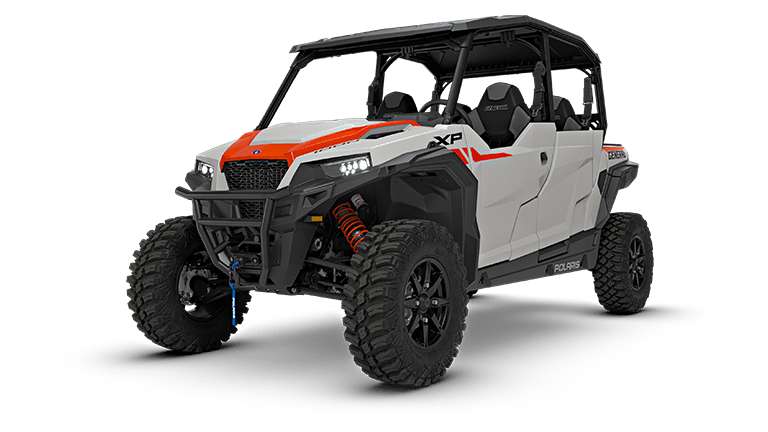
The name is awkward, but the purpose is not. The 2027 Polaris GENERAL XP 4 1000 Sport is the four-seat version of Polaris’s 100-hp crossover side-by-side. It keeps a 600-lb dumping bed, 1,500-lb tow rating, roof, half doors, and factory 4,500-lb winch, then adds a second row without widening the 64-inch chassis. For a household that wants four proper seats and a useful cargo box, that is a more relevant combination than a bigger horsepower headline.
Polaris’s exact naming matters here. The two-seat version is the GENERAL XP 1000 Sport. The four-seat version is the GENERAL XP 4 1000 Sport. This entry covers the latter, in Ghost Gray, at $25,999 U.S. MSRP. It is also the Sport trim, not the four-seat Ultimate. The touchscreen, rear camera, and Rockford Fosgate audio shown elsewhere on the model family’s marketing page are not standard on the Sport.
This is a specification-based review, not a claim of hands-on seat time. Its strengths and constraints emerge from the official dimensions and ratings: a genuine crew cabin, trail-oriented suspension, and a working bed, but also a 150.2-inch overall length and a total payload that has to serve four people before it serves firewood.
2027 price and the trim actually covered
The four-seat GENERAL XP 4 1000 Sport starts at $25,999. Polaris lists a separate $1,395 destination charge, bringing the published subtotal to $27,394. That excludes dealer preparation, tax, title, registration, financing, and accessories. Ask for a written out-the-door quote tied to the exact four-seat Sport VIN, because a model-family page can easily lead shoppers to the cheaper two-seat price at the top.
The two-seat Sport starts $3,000 lower at $22,999, with $1,295 destination. At the other end, the four-seat Ultimate starts at $29,999 plus $1,395 destination. The Ultimate’s $4,000 premium buys the factory seven-inch RIDE COMMAND display and integrated rear camera, Rockford Fosgate audio, and cabin upgrades. The Sport’s case is that it retains the useful chassis, suspension, winch, roof, doors, and box without making you pay for that technology bundle.
The 2027 four-seat Sport is a carryover in the areas that matter mechanically: Polaris publishes the same 100 hp, 115-inch wheelbase, 64-inch width, 13.5-inch clearance, 600-lb box, 1,100-lb payload, and 1,500-lb tow rating as it did for 2026. The model-year change that stands out is price. The 2026 Sport was listed at $26,999 plus $1,295 destination; the 2027 MSRP is $1,000 lower while destination is $100 higher. The published MSRP-plus-destination subtotal therefore falls $900. Actual leftover-2026 and new-2027 dealer quotes may differ more or less than that.
Polaris lists a one-year limited factory warranty for the model family. The written warranty delivered with the vehicle determines coverage, exclusions, and timing. Confirm accessories and installation on the actual purchase order rather than trusting a photo, since Polaris’s marketing imagery may show equipment beyond the standard trim.
What the “4” changes—and what it does not
Compared with the 2027 two-seat GENERAL XP 1000 Sport, the XP 4 adds two rated occupant positions and 32 inches of wheelbase: 115 inches versus 83. Overall length grows by the same 32 inches, from 118.2 to 150.2. Estimated dry weight rises from 1,685 to 1,998 lb, a 313-lb difference. Curb weight is 2,077 lb for the four-seat U.S. specification.
Width remains 64 inches. So do the published 100 hp, 13.5-inch ground clearance, 9.5-gallon fuel tank, 600-lb dumping box, 1,100-lb payload, and 1,500-lb tow rating. The crew machine does not receive a bigger cargo allowance merely because it is longer. That is the detail to remember when a family trip also involves coolers, tools, and a trailer.
The longer wheelbase can help settle a full cabin over choppy ground, but it also increases the space needed to turn, cross a sharp crest, and load a trailer. Polaris publishes a 19.5-foot turning radius for the four-seat Sport. Its 150.2-inch body is about 12 feet 6 inches long before allowing for tie-down clearance. Measure garage depth, trailer deck, ramp angle, and the narrowest gate rather than relying on a generic “four-seat UTV” fit.
A 64-inch published width makes this a different proposition from a 50-inch trail machine. Some routes accept 64-inch vehicles; others do not. Access rules may depend on measured width, vehicle class, tires, or local restrictions, and installed accessories can add width. Confirm the actual trails you intend to use before treating the crew layout as a universal upgrade.
100-hp ProStar engine and driveline
The liquid-cooled, fuel-injected ProStar twin displaces 999cc and uses dual overhead cams. Polaris rates it at 100 hp. An automatic PVT supplies park, reverse, neutral, low, and high ranges. The drivetrain offers on-demand true AWD, 2WD, and VersaTrac Turf Mode, with engine deceleration assist for slowing under closed throttle.
There is enough published output here to make a full-cabin trip plausible in hilly country, but the four-seat version carries more of its own weight before anyone climbs aboard. It should not be evaluated as if the 100-hp two-seat machine and the 100-hp four-seat machine have identical power-to-weight ratios. Four adults and gear will further widen that real-world difference.
Low range deserves regular use for slow climbing, towing, plowing, and heavy work. A powerful engine can mask the wrong range choice while the belt builds heat. The owner’s manual controls break-in, range selection, belt inspection, water exposure, and severe-duty maintenance. Engine deceleration assist helps manage downhill momentum, but it does not replace the hydraulic disc brakes or a conservative entry speed.
On-Demand AWD is useful on loose climbs, wet tracks, and uneven surfaces. Select it before the vehicle loses forward motion rather than asking it to rescue a stalled machine. VersaTrac Turf Mode is useful when turning across maintained ground because it reduces the tendency of the rear tires to scrub. It does not turn aggressive 30-inch off-road tires into lawn tires; soft turf can still be marked, especially by a loaded vehicle.
The 9.5-gallon fuel tank is unchanged from the two-seat Sport. Polaris does not publish one trustworthy range figure for every crew load and terrain. A full cabin, stop-and-go work, sand, mud, temperature, tire pressure, and elevation can alter consumption. For remote loops, plan fuel around the actual route and a margin, not a single owner’s best-case mileage post.
Suspension and tires: trail hardware with crew mass
The XP chassis uses high-clearance, long-travel dual A-arms and independent rear suspension, both with stabilizer bars. Polaris specifies 14 inches of travel front and rear, Walker Evans Velocity Series shocks, and 13.5 inches of ground clearance. The wheel-and-tire set consists of 30x10-15 Pro Armor Crawler XGF tires in front and Crawler XG tires at the rear, all eight-ply, on 15-inch aluminum wheels.
That is a serious package for a crossover with a dumping bed. The shocks and travel give it more headroom for rough recreational trails than the work-first layout of a basic utility UTV. High-clearance arms improve room near obstacles. Neither travel nor clearance is a guarantee against contacting the center of the chassis on a sharp ridge; the 115-inch wheelbase makes breakover line choice especially important.
Load changes how much suspension reserve is left. A four-seat vehicle driven with only a driver and a toolbag sits in a different part of its travel from the same machine carrying four adults and a full box. The stated 14 inches is travel available in the design, not a promise that every loaded configuration can absorb the same bump at the same speed. Tire pressure and suspension setup should follow Polaris’s guidance for load and terrain.
The longer chassis also changes recoveries. A narrow two-seat UTV can sometimes pivot around an obstacle where the XP 4 must back up and choose a wider line. The four-seat Sport retains useful 64-inch width, but its rear tires trace a different path through a tight bend. Check the back half of the vehicle as carefully as the front when threading through trees or around a gatepost.
Four seats, safety, and the real payload calculation
Polaris rates the XP 4 for four occupants and supplies bolstered bucket seats, a driver-seat slider, height-adjustable seat belts, premium half doors, a ProFit sport roof, high-output electronic power steering, and tilt steering. The roof and doors offer protection from spray and branches, but this is an open cabin. Windshields, rear panels, and full enclosure parts are accessory decisions, not standard Sport equipment.
Total vehicle payload is 1,100 lb. That number includes occupants, their gear, cargo, installed accessories, and trailer tongue load. Four 200-lb adults in riding gear could use roughly 800 lb before a cooler, tools, or hitch load are counted, leaving about 300 lb of theoretical allowance. Actual occupants and gear should be weighed or estimated honestly. The box may be rated for 600 lb, but a fully occupied crew cabin can leave far less than 600 lb available for it.
Seat belts and doors should be used as designed, and every passenger needs a helmet and appropriate protective gear. The vehicle’s long wheelbase and weight do not make a side slope or a quick turn safe at any speed. Load should be secured, kept as low as possible, and distributed in line with the owner’s manual. If four occupants plus heavy cargo is a regular mission, the published payload may be a reason to shop a more work-oriented crew platform.
The front and rear brakes are four-wheel hydraulic discs with dual-bore calipers. Park is in the transmission. Polaris warns that the vehicle can roll when the selector is not in park, particularly on grades. Do not mistake a level-looking trail for a parking brake; follow the parking procedure and avoid leaving an unattended vehicle where it can move.
Bed, hitch, and winch: the working half
The rear Lock & Ride dumping box measures 27.5 by 43.1 by 11.6 inches and is rated for 600 lb. That is enough for supplies, tools, firewood, or camp gear within the vehicle’s total payload. It is not an extra 600 lb added to the 1,100-lb figure. Long objects, shifting material, and loads piled above the sides can change handling even before a weight limit is reached.
A standard two-inch receiver supports Polaris’s 1,500-lb tow rating. The figure is subject to appropriate trailer setup and the owner’s manual’s operating limits. Trailer tongue weight takes away from the same 1,100-lb payload used by passengers and bed cargo. A loaded trailer also asks more of the brakes on a descent, so the maximum tow number is not the default target for every trail.
The factory Polaris HD 4,500-lb winch uses synthetic rope, an aluminum fairlead, and a rubber isolator. Together with the low-profile front bumper, it saves an early accessory installation for owners who work with downed timber or travel where self-recovery matters. Winch rating is not a blanket promise of recovery from deep mud; anchor quality, pull angle, rope layers, terrain suction, and line safety still govern the job. Inspect the rope and read the winch instructions before relying on it away from help.
The Sport includes LED headlights with accents and LED taillights. A DC outlet is listed. For frequent night work, check where the stock lamps actually throw light on your property before ordering an accessory bar. Accessories add cost, load to the electrical system, and sometimes width or height that matters on trailers and wooded routes.
Sport versus Ultimate: don’t buy from the hero photos
The model-family page promotes navigation and audio, but Polaris’s four-seat Sport specification lists no touchscreen, rear camera, factory audio, connected-vehicle services, security system, electronic suspension, HVAC, or Ride Control. The driver gets dual analog dials and a four-inch LCD information center. That simpler setup is not a defect, provided you are pricing the right trim.
The four-seat Ultimate starts at $29,999, $4,000 above the Sport, and includes a seven-inch RIDE COMMAND display with an integrated rear camera and Rockford Fosgate audio. Buyers who need a rear camera to manage the long crew body, or who want built-in navigation and music, should price that trim against a Sport with the specific accessories they would actually install. A phone mount and portable speaker are not identical to an integrated factory system, but neither should the buyer pay $4,000 for features that will sit unused.
The Sport’s lack of a touchscreen does not remove its core value. It keeps the same 100-hp engine, 14-inch suspension, 30-inch tires, box, tow rating, roof, doors, and winch. For a household primarily buying space and mechanical capability, that is a defensible place to stop in the trim ladder.
Alternatives worth a close look
The two-seat GENERAL XP 1000 Sport is the cleanest comparison. It costs $3,000 less at MSRP, weighs 313 lb less dry, and is 32 inches shorter in both length and wheelbase. It shares the width, power, cargo-box capacity, total payload, towing, suspension travel, tires, winch, roof, and doors. If rear seats would be occupied only a few times a year, the smaller Sport buys easier storage, loading, and turning without sacrificing the working hardware.
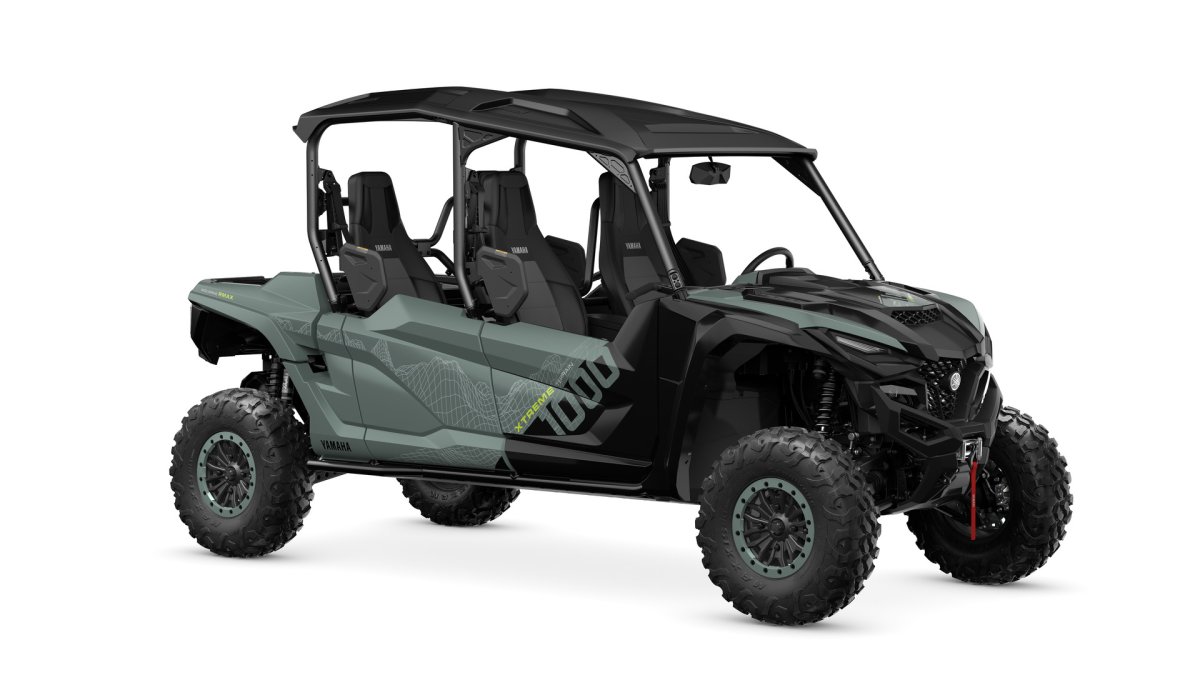
The 2026 Yamaha Wolverine RMAX4 1000 XT-R is a four-seat, full-size recreational rival listed at the same $25,999 MSRP in ATVPedia. Yamaha publishes 108 hp, a 600-lb bed and a 2,000-lb tow rating, with an integrated Adventure Pro display, audio, and a winch. It is wider and heavier than the Polaris, and model-year, destination, warranty, and dealer quotes need comparison. The useful question is whether Yamaha’s additional towing and electronics outweigh the GENERAL’s 64-inch footprint and Polaris-specific accessory ecosystem for your routes.
The 2027 Polaris XPEDITION ADV is another four-plus-person option, but it moves into a much more expensive, enclosed adventure category. It makes sense when weather protection and extended travel dominate the brief. The GENERAL XP 4 Sport is better aligned with riders who want an open trail machine that can still haul and tow.
A work-first crew UTV may carry more people, a heavier box, or a larger trailer rating for less money. It will usually give up some of the GENERAL’s recreational suspension and sportier cockpit. Make the choice around the heaviest job and the most demanding trail you genuinely do, not a list of uses the machine might see once.
Ownership, fit, and verdict
Before buying, sit in both rows with the people who will use them. Check helmet clearance under the roof, knee and shoulder room, seat-belt fit, entry through the half doors, and how easily the driver can use the slider and tilt wheel. A four-seat rating says how many positions exist; it does not guarantee that four adults of your particular sizes will be equally comfortable all day.
Measure the garage and trailer with margin. The vehicle is 150.2 inches long, 64 inches wide, and 77 inches high in Polaris’s specification. Curb weight is 2,077 lb before people, loose cargo, and accessories. Verify trailer payload, axle rating, tire rating, ramp rating, tie-down locations, and tow-vehicle limits against the actual equipped machine.
Routine maintenance includes oil, air filtration, cooling, CVT belt and intake, driveline fluids, suspension joints, brakes, tires, battery, and winch rope. Dust, water, mud, towing, and slow loaded work can create severe-service conditions. Use the current owner’s manual for intervals and procedures, and confirm that dealer-installed accessories do not obstruct routine service.
The 2027 GENERAL XP 4 1000 Sport is a strong answer to a specific problem: four factory seats without surrendering the dumping bed, tow receiver, roof, winch, and trail suspension. Its 100-hp twin, 64-inch width, 30-inch tires, and 14 inches of travel make the mechanical case. The $27,394 published MSRP-plus-destination subtotal, 150-inch length, and unchanged 1,100-lb payload define the cost of adding the second row.
Buy the four-seat Sport if those rear seats will be used often and you value the working hardware more than a factory screen. Buy the two-seat Sport if cabin space would mostly become empty weight and length. Step to the four-seat Ultimate only if its camera, navigation, and audio are worth the $4,000 difference to you.