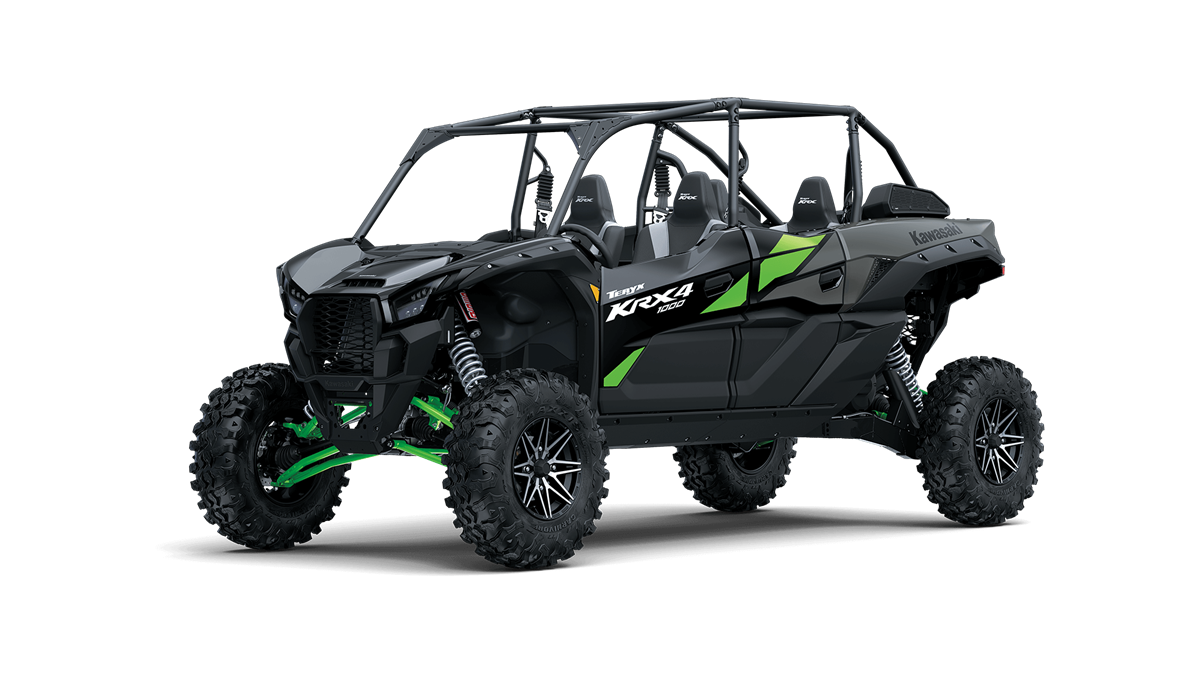
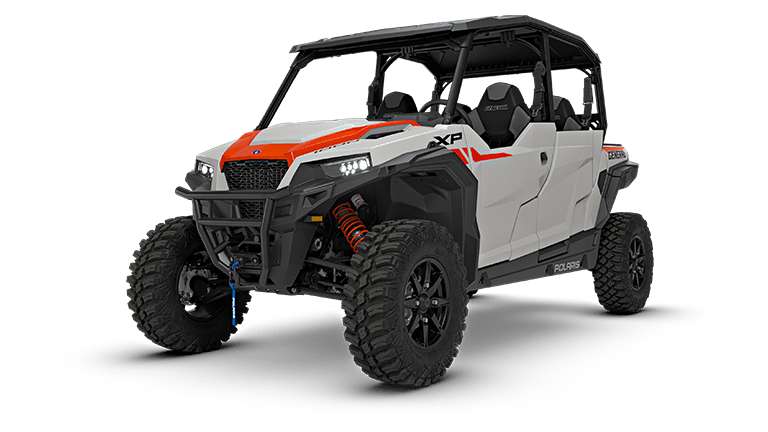
The standard 2027 Kawasaki Teryx KRX4 1000 is the four-seat KRX for people whose trails and trailer can take its 68.1-inch width. It starts at $25,199 U.S. MSRP and uses the same 110 hp parallel twin as the narrower KRX4 1000 TR. The extra $1,000 buys a wider stance and more wheel travel, not more engine power. That is the useful distinction in Kawasaki’s 2027 lineup.
This review covers the base KRX4 1000 in Smoky Gray / Super Black, not the TR, eS, Blackout Edition, Teryx4 S LE or supercharged Teryx4 H2. It is based on Kawasaki’s 2027 U.S. model listing and 2027 factory specification sheet, not a first-hand drive.
Price: allow for the full purchase, not just MSRP
Kawasaki lists a separate $1,420 destination charge. Add that to MSRP and the published subtotal is $26,619 before dealer setup, tax, registration and accessories. Ask for a written out-the-door quote if you are comparing this model with the TR or another four-seater. A $1,000 gap in base price can be swallowed by a roof, windshield, winch or dealer charges.
The base trim is not stripped of trail hardware. It has electric power steering, a locking front differential, adjustable Showa shocks, 31-inch tires, LED lighting and steel skid plates. Kawasaki’s specification sheet calls the wheels alloy; it does not identify the base model’s wheels as beadlocks. Check the precise wheel package with a dealer if bead retention at low pressure is important to you. Do not assume equipment from the TR or an accessory-equipped showroom machine is standard here.
Four seats change the geometry
This KRX4 has a 125.8-inch wheelbase and is 157.3 inches long. The two-seat Teryx KRX 1000 has a 98.8-inch wheelbase. The second row therefore brings a real packaging cost: more room is needed to turn, crest a sharp breakover and park on a trailer. A four-seat machine is a sensible answer when four people regularly ride, but an empty back row is a lot of vehicle to carry through a tight switchback.
The estimated dry weight is 1,997.7 lb for the standard non-California model. Curb weight is 2,099.2 lb. Kawasaki lists slightly higher numbers for California-spec machines. Neither figure includes the weight of your passengers and gear. Four adults can consume the 1,001 lb payload quickly, especially after a spare, tools, recovery gear and cooler are added. The bed itself is limited to 351 lb and measures 14.6 by 33.1 by 9.1 inches. This is a sport side-by-side with useful luggage space, not a substitute for a work UTV.
Kawasaki does not publish a towing capacity for the KRX4 1000. Treat its towing entry of N/A as just that. The bed rating and payload do not establish a safe trailer weight, even if an aftermarket hitch is available.
Why the standard chassis is wider than the TR
The standard KRX4 is 68.1 inches wide. Its Showa 2.5 piggyback shocks work with 18.6 inches of front wheel travel and 21.1 inches at the rear. Preload is fully adjustable, and compression damping has 24 positions at both ends. The long rear travel is especially relevant when the second row is occupied and the trail gets broken up, though suspension setup still needs to match the actual load.
The 2027 KRX4 1000 TR narrows to 63.8 inches. It gives up 1.6 inches of front travel and 2.5 inches at the rear. That is a meaningful exchange, not a cosmetic trim difference. If local trails enforce a 64-inch limit, the standard KRX4 is too wide on paper and the TR is the relevant model to investigate. Even the TR’s 0.2-inch nominal margin deserves careful checking after tires, wheels or side accessories are changed. Compare the two KRX4 trims before choosing on price alone.
Kawasaki quotes 14.2 inches of standard ground clearance, rising to 14.8 inches at maximum preload. The stock 31x10R15 Maxxis Carnivore eight-ply tires are substantial for a family-sized sport machine. Steel skid plates with drain holes provide underside protection, but ground clearance cannot erase the breakover consequences of a 125.8-inch wheelbase. Approach ledges and crests with the longer chassis in mind.
Engine and driveline
The liquid-cooled 999cc parallel twin has dual overhead cams, eight valves and fuel injection through two 50mm throttle bodies. Kawasaki rates it at 110.0 hp at 8,500 rpm under ISO 4106 and 75.2 lb-ft at 7,000 rpm. The same rating appears across the standard and TR four-seat versions. It is enough to make the standard KRX4 a serious recreational machine, but the figure should not be treated as a direct on-trail speed guarantee when four people and their luggage are aboard.
An automatic CVT with a centrifugal clutch provides high, low, neutral and reverse. Drive can be switched between 2WD and 4WD, with a locking front differential when traction is scarce. Engine braking helps on descents. Low range is the appropriate starting point for sustained slow climbing or crawling, particularly with passengers, rather than asking the belt to work hard in high range. The 10.6-gallon fuel tank does not translate into a fixed range; terrain, pace and load all matter.
Braking uses two 258mm hydraulic discs at each end, with two-piston front calipers and single-piston rear calipers. Kawasaki’s speed-sensitive EPS helps with steering effort, but it cannot make a four-seater as nimble as a short two-seat KRX. Expect to plan turns early and leave more stopping room when carrying a full load.
Which KRX4 should you buy?
Choose the standard-width KRX4 if your routes are comfortably wider than 64 inches and you value the added suspension travel. It is the stronger match for open, rough trails where the width is an asset rather than an access problem. Choose the TR if a 64-inch-class gate is part of your regular riding. Its lower price is welcome, but the access benefit is the reason to buy it. If the second row rarely gets used, the two-seat KRX 1000 is shorter, lighter and costs less.
The standard 2027 Teryx KRX4 1000 is a convincing four-person trail machine on its own terms: long-travel suspension, a proven naturally aspirated twin, 31-inch tires and a genuine second row. Its limits are equally concrete. It is too wide for a regulated 64-inch trail, too long to behave like a two-seater, and not factory-rated for towing. Make those three checks before getting distracted by the 110 hp number. Our guide to reading ATV and UTV specs can help put the numbers in context.