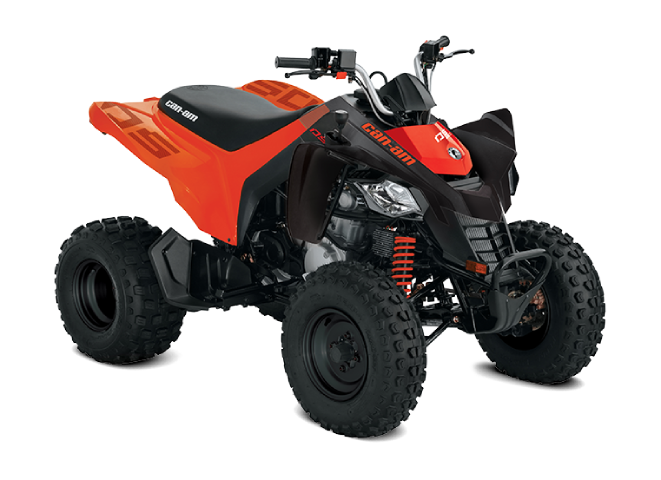
The 2027 Can-Am DS 250 occupies an awkward but useful space: bigger than a typical 110cc youth quad, yet still sold as a youth model rather than a full-size utility ATV. It starts at $5,149 U.S. MSRP before transportation and preparation. You get a 250cc liquid-cooled engine, an automatic transmission with reverse and hydraulic disc brakes. You also get a 429 lb machine that demands a serious fit check. This is not a casual upgrade for a child who has outgrown the paint scheme on a smaller ATV.
This review covers the Black & Can-Am Red DS 250 shown on Can-Am’s 2027 U.S. model page. Specifications come from its 2027 North American spec sheet. It is a researched buyer’s review, not a first-hand ride test.
A bigger engine, but not EFI
Can-Am uses a liquid-cooled, four-stroke 250cc single with a carburetor. That distinction matters if you are comparing it with the 2027 Renegade 110 EFI. The Renegade’s electronic fuel injection removes carburetor maintenance from the equation. The DS 250 gives the rider a much larger engine and chassis instead. Can-Am does not publish a horsepower rating for the DS 250. The 17 hp value in ATVPedia’s catalog is an estimate, not an official specification or test measurement.
The automatic CVT has forward, neutral and reverse. Electric start is listed on the exact DS 250 package. Drive is by chain to a solid rear axle, so this is a 2WD sport-style ATV. The transmission removes manual gear selection, but the larger, heavier machine still asks more of the rider in turns and when stopping. Reverse is helpful when a trail end or parking spot proves tighter than expected; it is not a reason to take a young rider somewhere they cannot safely turn around.
Can-Am’s broader DS page advertises a speed limiter, while the model-specific 2027 spec sheet does not explain its adjustment or list it among the DS 250 package highlights. Ask the dealer to demonstrate the actual 2027 machine’s limiting mechanism before treating it as a purchasing feature. The same caution applies to the page’s claim of preload-adjustable shocks: the package description says yes, but the technical table identifies them only as twin-tube units.
Chassis and brakes: what the extra size buys
The DS 250 has double A-arm front suspension with 5.5 inches of travel and a swingarm rear with 6.7 inches. Kenda tires measure 22 x 7 x 10 inches in front and 20 x 11 x 9 inches at the rear, on black steel wheels. Front braking comes from two hydraulic discs, with one hydraulic disc behind. Those brakes are a meaningful equipment step over the smaller Renegade 110 EFI’s drums, although stopping distance still depends on surface, tires, speed and rider technique.
At 72 inches long with a 31.5-inch seat and 47-inch wheelbase, the DS 250 is considerably more substantial than the 110. Estimated dry weight is 429 lb, which is 134 lb more than the Renegade 110 EFI’s published dry figure. Width, interestingly, is almost identical: 40.5 inches for the DS versus 40.4 for the Renegade. Width alone is a poor proxy for how large the ATV will feel to the rider. Sit the intended rider on the real DS with the engine off, then check reach to the controls, foot placement, ability to shift body position and whether the rider can handle the vehicle’s mass.
Can-Am lists 10.2 inches of clearance at the center and only 4.5 inches under the rear axle. The smaller number is the one to remember around ruts and rocks. The 3.3-gallon fuel tank is more than twice the 110’s 1.6 gallons, but Can-Am does not publish a fixed range. There are no rated rack, towing, storage or bed capacities. It is a one-person recreational ATV, not a small workhorse or passenger carrier. Our guide to reading ATV and UTV specs explains why these ratings cannot be inferred from engine size.
Resolve the age warning before discussing price
Can-Am markets the 2027 DS 250 for riders 14 and up. The safety footer on the same manufacturer’s North American spec sheet says ATVs with engines over 90cc are recommended only for those 16 and older. This DS is 250cc. The two statements conflict. It would be irresponsible to present the 14+ line as an unqualified safety approval, or to pretend that an automatic transmission makes a 429 lb ATV suitable for every teenager.
Before buying for anyone under 16, inspect the age warning label on the exact vehicle and the current operator’s guide. Ask Can-Am or its dealer to explain the discrepancy and check local age and training rules. Fit, judgment and instruction matter even when the rider meets a printed minimum age. Can-Am recommends ATV training in its spec sheet, plus a helmet, eye protection and other protective clothing. The beginner ATV guide covers the broader shopping decision, but the vehicle’s current warning and operator guidance should settle this one.
DS 250 or Renegade 110 EFI?
The 2027 Renegade 110 EFI starts at $3,899, a $1,250 gap. It has EFI, a lower seat and a much lighter dry weight. The DS 250 brings larger tires, a longer wheelbase, hydraulic discs and a substantially bigger engine. These are not two colors of the same youth ATV. Compare their published figures side by side, then judge which, if either, actually fits the intended rider. An older 2025 DS 90 also remains in our catalog for historical comparison, but its listed MSRP is not a current 2027 quote.
The DS 250 makes sense for a suitably sized, properly trained rider who needs more chassis and braking than a 110, once its age guidance has been clarified. It makes less sense as a future-proof purchase for a smaller rider or as a stand-in for a utility ATV. Get a written out-the-door quote and look at the actual warning label before putting down a deposit. Browse the ATVPedia catalog or use the comparison tool for alternatives.