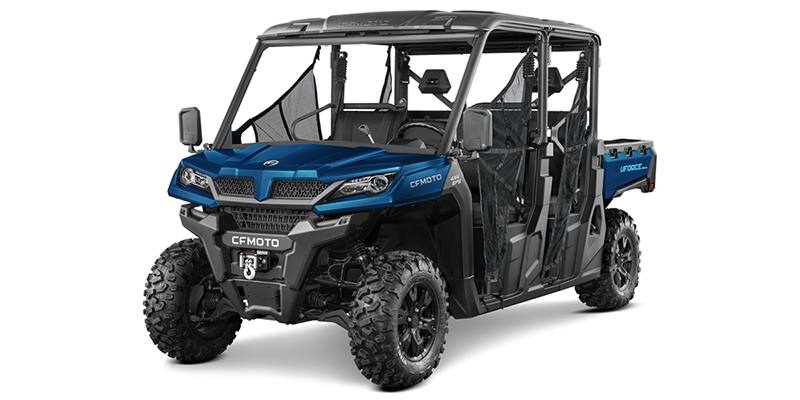
The 2026 CFMOTO UForce 1000 XL is easy to understand once you look past CFMOTO’s increasingly crowded naming system. This is the six-seat version of the familiar 963cc UForce 1000—not the newer, more powerful UForce U10 XL Pro. It costs $15,999, makes 71 hp and keeps the same 1,000 lb bed and 2,500 lb tow rating as the three-seat UForce 1000.
That places it in a useful part of the market. The 1000 XL is a full-size crew UTV with a roof, power steering, 4,500 lb winch, aluminum wheels and two proper bench seats already included. It is $3,500 less than the U10 XL Pro before freight and setup, yet it gives up none of the headline work ratings.
The trade is refinement and chassis capability. The newer U10 has 17 more horsepower, larger tires, more suspension travel, an electric hydraulic bed lift, a larger screen and standard audio. The older 1000 XL uses a gas strut to help tip its bed and rides on simpler nine-inch-travel suspension. For buyers who want six seats and strong utility numbers without paying for the newest dashboard, that restraint is the point.
A genuine six-seat crew layout
The XL body carries two three-person vinyl bench seats, and CFMOTO lists a fold-up center console. When the center position is not needed, the console provides an armrest and a place for small items. That arrangement is more flexible than a fixed pair of buckets when the vehicle alternates between weekday chores and weekend passengers.
Six seats on paper still deserve a showroom test. Three adults in work jackets can use every inch of a bench, and the rear row needs to accommodate boots as well as knees. Bring the people who will ride most often, sit three across and check how naturally each person can reach a handhold and keep clear of the controls. A nominal sixth seat is only useful if the intended sixth passenger fits safely.
The standard roof, side mirrors and side nets cover the basics, but this is an open-cab UTV. A windshield, wiper, solid doors and climate control are not included. That makes it easy to enter, ventilate and wash out in warm weather. It also means dust, wind and rain remain part of the experience.
Owners planning a full enclosure should price it before buying. Accessory doors, glass, wipers, cab heaters and installation can narrow the gap to a factory-enclosed model. If the machine works through winter every day, a purpose-built cab may be worth more than a lower starting price. If it spends most of its life in moderate weather, the open XL avoids carrying expensive cab equipment it does not need.
CFMOTO lists the UForce 1000 XL at 148 inches long, 63.5 inches wide and 73 inches high. The wheelbase measures 112 inches, and the turning radius is 18 feet. Ground clearance is 12 inches.
Against the three-seat 2026 UForce 1000 in CFMOTO’s brochure, the XL adds 32 inches of overall length and 31.3 inches between the axles. Dry weight rises from 1,537 to 1,853 lb. Width stays at 63.5 inches, so the extra row changes maneuverability and breakover behavior rather than the path the tires need through a gate.
An 18-foot turning radius is the number to remember around barns, fenced lanes and dense woods. The standard-wheelbase machine is listed at 13.4 feet. That 4.6-foot difference can turn a clean U-turn into a three-point maneuver, especially with a trailer attached.
The long wheelbase can feel settled over rolling terrain, but it also leaves more chassis between the axles. Sharp crests, ditch crossings and abrupt trailer ramps deserve a diagonal approach where conditions allow. Twelve inches of static clearance does not guarantee that the middle of a 112-inch wheelbase will clear every breakover.
Transport needs the same realism. The 1,853 lb figure is dry, before fuel, accessories, tools and passengers. A roof and winch are already accounted for in the published configuration, but a windshield, doors, spare tire and cargo add quickly. Use the loaded vehicle’s real weight and length when selecting a trailer, tow vehicle, ramps and tie-downs.
At 63.5 inches wide, this is a full-size machine. It does not belong on routes restricted to 50 or 60 inches. Published width also should not replace a physical measurement when access is tight; tire pressure, wheel choice and manufacturing tolerance can change the number that reaches a gate.
The 963cc V-twin favors useful output over bragging rights
The engine is a liquid-cooled, single-overhead-cam 963cc V-twin with eight valves and Bosch electronic fuel injection. CFMOTO rates it at 71 hp at 7,000 rpm and 54 lb-ft at 6,500 rpm.
Seventy-one horsepower is no longer a class-leading figure, but a work UTV is not judged by peak output alone. Throttle calibration, low-range gearing and traction determine whether power can be applied cleanly while moving a trailer or easing through a rough pasture. The 1000 XL has enough factory-rated output to support its work ratings without pretending to be a sport side-by-side.
Bosch electronic throttle provides Work and Normal modes. Work mode softens the relationship between pedal movement and engine response, which is useful when backing to an implement, crossing broken ground or carrying people who would rather not have their heads tossed at every launch. Normal mode restores the more direct everyday response. Neither mode changes the 71 hp maximum; it changes how deliberately the driver can request it.
The 10.6-gallon fuel tank matches the three-seat 1000. CFMOTO does not publish an official range, and a crew vehicle is especially difficult to reduce to one number. Low-range work, frequent starts, deep mud, elevation, temperature, passenger load and towing all affect consumption. Buyers working far from fuel should establish their own conservative range rather than extrapolate from a light test ride.
The newer U10 XL Pro’s 88 hp triple will accelerate harder and has more reserve under a full load. The 1000 XL’s argument is different: it supplies the same seating, bed capacity and tow rating for less money and with fewer electronic cabin features. That is a rational trade when top-end performance is not the job.
CVTech CVT, low range and selectable traction
A CVTech continuously variable transmission provides park, reverse, neutral, high and low. Drive choices are 2WD, 4WD and locked 4WD, and the rear differential can be locked as conditions require.
That range of settings lets the operator protect both the machine and the ground. Two-wheel drive with the rear differential unlocked reduces tire scrub on firm turf. Locking the rear axle helps when both rear tires need to pull. Four-wheel drive adds front traction, and locked 4WD is the final step for a genuinely slippery or uneven obstacle.
Locks should be released when the difficult section ends. A locked axle resists the different wheel speeds required in a turn, so steering effort increases and tires disturb more soil. Power steering makes the wheel lighter in the driver’s hands; it does not eliminate driveline wind-up or make locked differentials appropriate for dry, high-grip surfaces.
Low range is equally important. A CVT can move slowly in high, but doing heavy work there may create unnecessary belt heat. Select low before towing on a grade, crawling with a full bed or moving repeatedly at walking speed. Waiting until the belt smells hot is not a strategy.
CFMOTO fits electronic power steering and a tilt-adjustable steering wheel. The assistance is valuable on a 1,853 lb machine, particularly at low speed and with the front differential locked. The steering system still communicates through 27-inch utility tires rather than trying to give the UForce sport-UTV reactions.
Nine inches of travel and sensible 27-inch tires
The front uses high-clearance independent A-arms; the rear uses independent double A-arms with a sway bar. CFMOTO publishes nine inches of wheel travel at both ends. The oil-damped shocks allow spring-preload adjustment.
This is straightforward utility suspension. Preload can help restore ride height when the normal load changes, but it does not make the damper more sophisticated or increase wheel travel. Set it evenly, note the original position and evaluate the vehicle with the passengers and equipment it usually carries.
Six adults can change the ride more than a solo dealership loop suggests. Added mass consumes suspension travel and raises stopping demands. A test drive with only the salesperson may reveal noise and control placement, but it cannot show how the rear row behaves when occupied. If a dealer permits it, evaluate the machine with a representative load and at modest speed over the kind of surface it will actually use.
Tires are 27 x 9-14 at the front and 27 x 11-14 at the rear, mounted on 14-inch cast-aluminum wheels. The sizes are common enough to offer replacement choices without the cost and rotating mass of the U10’s 29-inch package. They also contribute to the 12-inch ground-clearance figure.
Larger aftermarket tires can improve obstacle clearance, but the gains are not free. They change effective gearing, increase steering and driveline loads and may contact body or suspension parts at full lock or compression. Additional wheel offset can widen the machine and add leverage at the wheel bearings. On a long crew UTV, changes should solve a measured need.
Four-wheel hydraulic disc brakes handle stopping, with a parking brake for stationary use. Loaded stopping distance is the practical concern. Passengers, bed cargo and trailer tongue weight all add to the work the tires and brakes must do, especially on loose descents.
Bed, towing and winch capacity
The cargo box is rated for 1,000 lb and uses gas assistance for dumping. Integral tie-down points make it easier to restrain tools, feed or firewood. Unlike the U10 XL Pro’s electric hydraulic mechanism, the gas strut still requires the operator to release and raise the bed by hand.
That simplicity will suit some owners. There is no bed-lift switch or electric actuator to wait for, and a moderate load should be manageable when distributed properly. A full 1,000 lb of dense material is a different proposition. Load position affects the initial lifting effort, and the capacity rating should not be interpreted as a promise that every possible 1,000 lb load will tip effortlessly.
Towing capacity is 2,500 lb through the receiver hitch. It matches the newer U10 XL Pro and many full-size competitors. Safe towing still depends on trailer brakes where required, tongue weight, terrain, speed, total vehicle loading and local rules. A published maximum under controlled conditions is not a recommendation to pull that weight down every slope.
The bed rating, tow rating and six seats are individual limits. They should not be stacked without consulting the owner’s manual and payload information. Six occupants already place a large load on the chassis; bed cargo and tongue weight then affect rear suspension position, steering response and braking at the same time.
The standard 4,500 lb winch uses synthetic rope. That is 1,000 lb more winch rating than the three-seat UForce 1000 receives, and it is appropriate equipment for a heavy crew machine. A winch rating is the first layer of a recovery system, not the whole system. Anchors, shackles, soft shackles, tree protection and vehicle recovery points must be rated and used correctly, with bystanders clear of the line.
Useful technology without the U10’s dashboard bill
A five-inch color TFT display presents the main vehicle information, and CFMOTO lists RideSync app compatibility through its T-Box connection. USB and 12-volt outlets are standard, as are LED headlights, taillights and backup lights.
The display is smaller than the U10 XL Pro’s eight-inch RideSync MMI touchscreen. There is no standard Apple CarPlay interface or MB Quart audio package on the 1000 XL. That is not necessarily a loss on a work machine. Physical controls and a compact instrument panel can be easier to live with when gloves, dust and washdowns are routine.
Buyers should still try the interface outdoors. Check whether the screen remains legible in direct light, whether common warnings are clear and which app functions require a phone connection or subscription. Technology has value when it answers a useful question quickly; it should not be counted twice merely because both a screen and an app are listed.
Other standard equipment includes side mirrors, side nets, the hard roof, a skid plate, under-seat storage and a removable storage box. Those items make the base price more representative of a usable machine than a stripped MSRP that needs immediate accessories.
2026 CFMOTO UForce 1000 XL specifications
| Specification |
UForce 1000 XL |
| Engine |
963cc liquid-cooled SOHC eight-valve V-twin |
| Output |
71 hp at 7,000 rpm; 54 lb-ft at 6,500 rpm |
| Fuel system |
Bosch electronic fuel injection and throttle |
| Drive modes |
Work and Normal |
| Transmission |
CVTech automatic CVT; P/R/N/H/L |
| Drive system |
2WD / 4WD / locked 4WD; locking rear differential |
| Steering |
Electronic power steering; tilt wheel |
| Front suspension |
High-clearance independent A-arms; 9 in travel |
| Rear suspension |
Independent double A-arms; sway bar; 9 in travel |
| Shocks |
Oil-damped; spring-preload adjustable |
| Brakes |
Four-wheel hydraulic discs; parking brake |
| Tires |
27 x 9-14 front; 27 x 11-14 rear |
| Wheels |
14-inch cast aluminum |
| Length x width x height |
148 x 63.5 x 73 in |
| Wheelbase |
112 in |
| Turning radius |
18 ft |
| Ground clearance |
12 in |
| Dry weight |
1,853 lb |
| Fuel capacity |
10.6 gal |
| Seating |
Six; two three-person benches |
| Cargo-bed capacity |
1,000 lb; gas-assisted dump |
| Towing capacity |
2,500 lb |
| Winch |
4,500 lb with synthetic rope |
| Display |
5-inch TFT; RideSync app compatible |
| Warranty |
One-year factory warranty |
| Base MSRP |
$15,999 |
UForce 1000 XL versus UForce 1000
The standard 2026 UForce 1000 is the same basic mechanical package arranged around one bench. It uses the same 963cc V-twin, 63.5-inch width, 10.6-gallon tank, nine inches of suspension travel, 1,000 lb bed and 2,500 lb tow rating.
The XL costs $2,000 more and adds three seats. Length grows from 116 to 148 inches, wheelbase from 80.7 to 112 inches, turning radius from 13.4 to 18 feet and dry weight from 1,537 to 1,853 lb. The XL also gains half an inch of listed clearance and a 4,500 lb winch instead of the short model’s 3,500 lb unit.
This is a frequency decision. If four to six people ride most weeks, the XL earns its size. If the rear bench would be occupied a handful of times per year, the standard UForce 1000 is easier to store, transport and turn every day. A crew machine is poor value when it carries empty seats through every gate.
UForce 1000 XL versus UForce U10 XL Pro
The 2026 UForce U10 XL Pro costs $19,499, or $3,500 more. Both models are 148 inches long, seat six, carry 1,000 lb in the bed, tow 2,500 lb and include a 4,500 lb winch.
The U10 earns its premium with an 88 hp 998cc inline-three, 29-inch tires, 13 inches of clearance, 11 inches of front travel and 10.4 inches at the rear. Its bed has an electric hydraulic tilt, while the cabin gets an eight-inch touchscreen, Apple CarPlay, an NFC key and MB Quart audio. The 1000 XL is half an inch narrower, one inch lower, one inch closer to the ground and 208 lb lighter on CFMOTO’s dry figures.
Choose the U10 when performance, suspension, powered dumping and integrated technology will be used. Choose the 1000 XL when the work ratings and second row matter more than those upgrades. Saving $3,500 is meaningful precisely because the basic hauling and towing capacities do not fall. Compare the UForce 1000 XL and U10 XL Pro.
UForce 1000 XL versus Polaris Ranger Crew XP 1000
ATVPedia’s 2025 Polaris Ranger Crew XP 1000 record lists six seats, 82 hp, a 62.5-inch width, 116-inch wheelbase, 13 inches of clearance, 1,900 lb dry weight, 2,500 lb towing and a 1,500 lb bed at $19,999.
On those recorded base prices, the CFMOTO costs $4,000 less and weighs 47 lb less, while the Polaris makes 11 more horsepower and carries 500 lb more in its bed. Towing is equal. The Ranger is one inch narrower but uses a wheelbase four inches longer than the UForce.
The Polaris is the stronger specification for buyers who regularly approach the bed limit. The CFMOTO’s standard winch, roof and lower price can be more compelling when 1,000 lb of bed capacity is already enough. Compare written, similarly equipped quotes and local parts support rather than assuming the badge or base MSRP settles the ownership question. Compare the UForce 1000 XL and Ranger Crew XP 1000.
UForce 1000 XL versus Honda Pioneer 1000-6 Deluxe Crew
The 2025 Honda Pioneer 1000-6 Deluxe Crew is another six-seat utility UTV. ATVPedia records it at $23,999 with a 999cc parallel-twin, six-speed dual-clutch transmission, 64-inch width, 116.4-inch wheelbase, 13 inches of clearance, 2,010 lb weight and 2,500 lb tow rating.
Honda’s defining difference is the geared DCT. It has no drive belt and gives the driver fixed ratios rather than a continuously variable transmission. The CFMOTO uses the familiar CVT approach, costs $8,000 less in the recorded model years and carries 2.7 gallons more fuel. The Honda is 157 lb heavier on the published figures.
The Pioneer suits a buyer who specifically values Honda’s transmission and dealer network. The UForce makes the value case: six seats, the same tow rating and a standard recovery package for substantially less money. Because these ATVPedia records cover different model years, obtain current quotes and specifications before treating the price gap as an exact 2026 showroom comparison. Compare the UForce 1000 XL and Pioneer 1000-6.
Who should buy the 2026 UForce 1000 XL?
The 1000 XL fits a farm, ranch, large property, hunting camp or family that routinely moves four to six people and still needs a useful bed. Its strongest argument is not one spectacular number. It is the combination of six seats, 1,000 lb bed, 2,500 lb tow rating, 4,500 lb winch, roof and power steering at $15,999.
It is less convincing when the rear bench is rarely occupied. The shorter 1000 costs less and turns in much less space. Buyers who want fast acceleration, rough-trail suspension and an integrated infotainment system should budget for the U10 XL Pro. Those who work through severe weather should evaluate a factory cab rather than casually adding enclosure parts later.
Before buying, sit six people in it, measure the trailer and storage area, and test the turning space at home. Ask the dealer for a written out-the-door price separating MSRP, freight, setup and document fees. Confirm the service schedule, CVT inspection requirements, parts lead times and the exact coverage under the one-year factory warranty.
Verdict
The 2026 CFMOTO UForce 1000 XL is the practical crew choice in CFMOTO’s utility range. It does not chase the U10 XL Pro’s power or dashboard technology. Instead, it stretches a proven 963cc package, keeps the work capacities intact and includes the accessories most owners would add first.
Its compromises are visible: an 18-foot turning radius, nine inches of suspension travel, a hand-raised gas-assist bed and an open cabin. None is hidden by the price. Buyers who need six seats more than they need the newest hardware will find a coherent machine here.
At $15,999, the value is real. The 1000 XL delivers the crew layout and the headline utility ratings for $3,500 less than the U10 XL Pro, while remaining 208 lb lighter. That is enough separation to make the older platform feel like a deliberate option rather than yesterday’s model. Browse more CFMoto models, explore utility UTVs, visit the 2026 model-year hub, or build another matchup in the comparison tool.