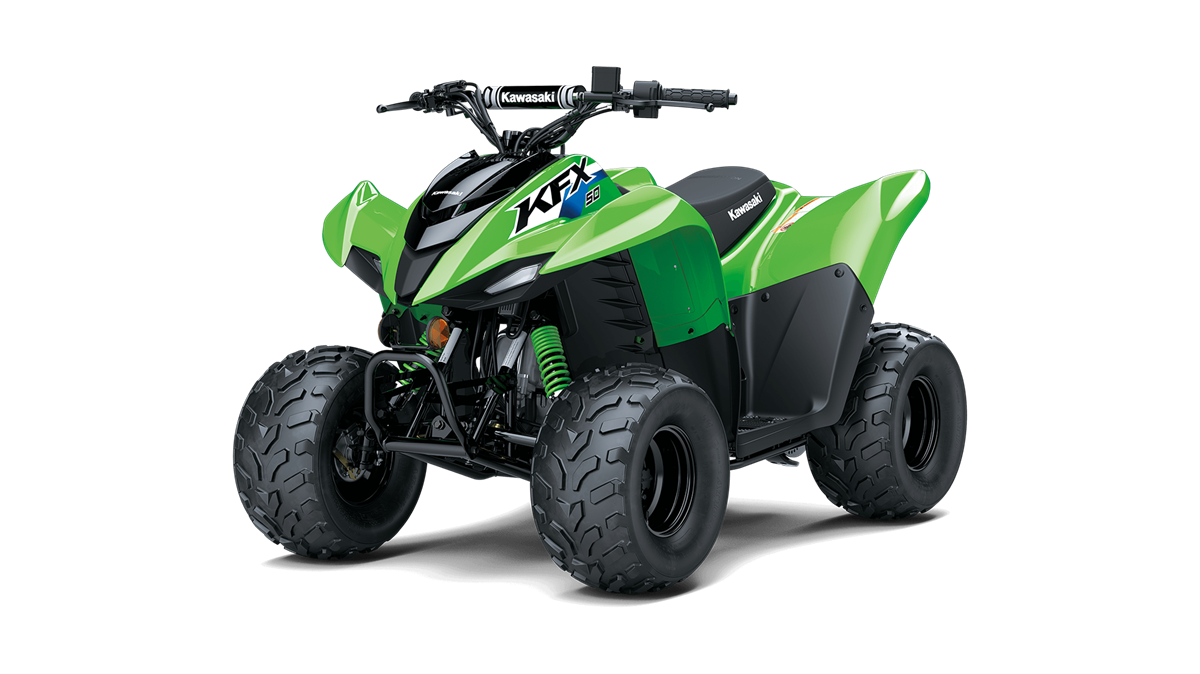
The 2027 Kawasaki KFX50 is the small green ATV in Kawasaki’s youth lineup, intended for riders age 6 and older. Its 49.5cc four-stroke engine, automatic CVT and adult-adjustable speed controls make sense for early supervised practice. The price is $2,699 U.S. MSRP, plus a separately listed $415 destination charge. Before buying one, though, look past the 50cc label. This ATV weighs 249.2 lb ready to ride, and the child still has to fit it and operate it with an adult close by.
This review covers the Lime Green 2027 KFX50 shown on Kawasaki’s U.S. model page. Dimensions and equipment are checked against its 2027 specification sheet and youth-model announcement. This is a researched buyer’s review, not a claim that we rode the ATV.
Engine, starting and speed controls
Kawasaki uses an air-cooled, single-cylinder 49.5cc four-stroke with a Keihin PTE16 carburetor. Electric starting is backed up by a kick-starter, useful when a battery is weak. The automatic CVT removes gear selection from the child’s immediate workload. It drives the rear wheels through a chain, so this is a small 2WD sport ATV, not an all-wheel-drive trail machine. Kawasaki does not list a reverse gear in the 2027 specifications; ask to see the exact machine’s controls rather than assuming it has one.
Parents have two distinct ways to restrict performance. The throttle-limiting screw caps how far the throttle can open, while Kawasaki also describes a CVT speed-control collar. There is a keyed ignition to discourage unsupervised starting and an engine-stop lanyard. Set these according to the current owner’s manual and have the dealer show how they work before the first ride. A limiter is useful only if the adult actually checks the setting, and a lanyard cannot help if it is not used correctly.
Kawasaki’s U.S. 2027 page does not publish horsepower. Our catalog shows about 4.7 hp because Kawasaki Australia rated a 2025 KFX50 with the same 39.0 x 41.4mm bore and stroke and PTE16 carburetor at 3.5 kW. Converted to mechanical horsepower, that is about 4.7. It is a cross-year, cross-market reference, not a confirmed output for this 2027 U.S. ATV. Engine displacement, fit and the available limiting controls are more useful shopping facts than a proxy horsepower number.
Is the KFX50 the right size for your child?
The seat stands 25.0 inches high. Overall width is 34.1 inches, wheelbase is 38.0 inches, and length is 55.1 inches. These are small-ATV dimensions, but a photo cannot tell you whether the intended rider can reach both brakes and the throttle comfortably while keeping both feet on the full-coverage floorboards. Take the child to the dealer and check reach with the engine off. Do not buy a larger machine simply in the hope that the child will grow into it.
Kawasaki lists 249.2 lb curb weight. That includes operating fluids and a near-full 1.4-gallon fuel tank. It is not a dry-weight number. When comparing another youth ATV, look at the measurement basis before calling one lighter by a precise amount. The KFX50 has a single seat, no factory tow rating and just 3.3 inches of ground clearance. It belongs in a suitable practice area and on terrain matched to the rider, not in deep ruts or on an adult ATV route.
Front suspension uses a single A-arm with twin shocks and 2.8 inches of wheel travel. The swingarm rear has a single shock and 2.9 inches. Both ends wear 16 x 8-7 tubeless tires. Kawasaki fits two mechanical front drum brakes and a hydraulic rear disc. The front LED elements are accent lights, with LED taillights at the back; do not mistake the styling lights for permission to ride at night.
Supervision is part of the equipment
Kawasaki says the KFX50 is intended only for people 6 or older and requires direct adult supervision for all riders under 16. A six-year-old can be too small or not yet ready to follow directions. Start on level, closed private ground where the adult can see the rider continuously. Use the most conservative limiter settings and progress only after repeated, controlled starts, stops and turns. Kawasaki recommends an ATV training course.
Helmet, eye protection and protective clothing are non-negotiable. The manufacturer also warns against carrying a passenger or riding on public roads or pavement. A small engine and an automatic transmission do not make an ATV a toy. Read the current warning labels and owner’s manual with the child, then make a clear rule that the key stays with the adult outside supervised sessions.
KFX50 versus other beginner ATVs
The 2025 Yamaha YFZ50 in our catalog is another 6+ automatic youth ATV. Its factory-listed width is 32.3 inches and its wheelbase is 32.7 inches, both smaller than the KFX50’s 34.1 and 38.0 inches. Yamaha publishes a 220 lb wet weight, while Kawasaki calls its 249.2 lb figure curb weight. Both include operating fluids, but the labels and included equipment should still be checked before making a precise weight claim. Compare their specifications, paying attention to the year difference.
The 2025 KFX90 is a larger Kawasaki youth model in the historical catalog, not an automatic next step for a child who has learned to start the 50. Kawasaki’s current KFX range gives the 90 a different age recommendation, but rider size, training and judgment still matter more than reaching a birthday. Compare the actual model-year warning labels before changing classes.
The KFX50’s strength is its controlled learning setup: automatic drive, two speed-limiting methods, a stop lanyard and a compact single-rider chassis. Its limits are the modest clearance, no listed reverse or towing capability, and the fact that curb weight is not trivial for a child. Get a full quote that includes destination and setup, then have the intended rider sit on the machine before deciding. The beginner ATV guide offers broader context, but the child’s fit and the actual warning label should settle this purchase.