The 2025 Yamaha YFZ50 is Yamaha’s smallest ATV and its entry point for young riders age 6 and older. A 49cc engine and automatic CVT keep the learning curve focused on steering, throttle and braking rather than shifting. Yamaha lists a 220 lb wet weight, an adjustable engine limiter and a power cut-off tether. None of those features make riding risk-free: fit, protective gear and direct adult supervision still decide whether this is the right first machine. Our best beginner ATVs guide covers the wider youth market, while the guide to reading ATV and UTV specs explains the numbers used here.
Engine and controls: deliberately modest
The YFZ50 uses a 49cc air-cooled single-cylinder engine with a carburetor. Its automatic CVT means the rider does not need to operate a clutch or select gears. Power goes only to the rear wheels, which is normal for a small youth sport ATV. Our database uses about 3 hp as an estimate; Yamaha does not publish a U.S. 2025 horsepower rating.
The engine is modest compared with 90cc and 110cc youth machines. Yamaha’s limiter features let an adult restrict performance further during the earliest sessions. Open the setting only as the child consistently demonstrates smooth throttle use, controlled braking and reliable steering.
Safety and rider fit
The YFZ50 carries a 6+ age label, but age alone does not prove that a child is ready. The rider must reach every control comfortably, keep both feet on the footrests and understand instructions. Practice should take place in a closed, level area away from roads, traffic, passengers and adult machines.
A properly fitted full-face helmet, eye protection, gloves, over-the-ankle boots, long sleeves and long pants are essential. Yamaha lists a power cut-off tether as well as engine limiting features. Have the dealer demonstrate both controls, then use them on every appropriate ride. Neither device replaces training or supervision.
Size and limitations
At 220 lb wet, 32.3 inches wide and 32.7 inches between the axles, the YFZ50 is substantially smaller than Yamaha’s 110-class youth ATVs. Ground clearance is 3.5 inches, which suits a prepared riding area better than rough, deeply rutted terrain. The fuel tank holds 1.5 gallons. Wet weight includes operating fluids; compare another model’s weight only after checking its stated basis.
There is one seat and no tow rating. Children should never carry a passenger, use the ATV for work or ride an adult machine because they have become comfortable on the YFZ50. Progress should be based on physical fit and demonstrated skill, not pressure to move up quickly.
How it compares
The Can-Am DS 90 is a larger youth machine that carries a 10+ label. The YFZ50 is intended for a younger age group; these are not interchangeable choices simply because both have automatic transmissions. Check each maker’s weight basis before comparing the numbers. Compare their specifications.
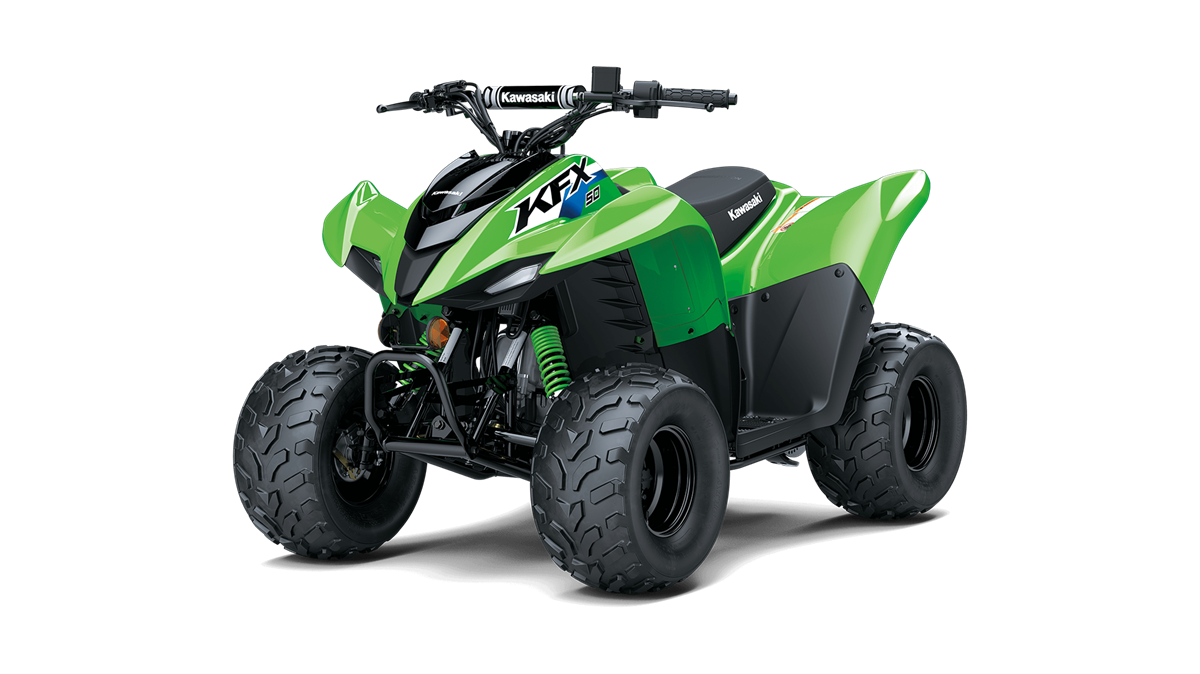
The Kawasaki KFX90 costs $3,199 and makes about 6 hp. It is 278 lb and carries a 12+ label, so it is not a suitable substitute for a six-year-old simply because both models use an automatic CVT. The Yamaha is smaller and gentler, while the Kawasaki is sized for an older rider. See the direct comparison.
Where it sits in Yamaha’s lineup
The Yamaha Raptor 110 is the next sport-styled youth step. It makes about 7 hp, weighs 278 lb and is labeled for age 10 and older. It also includes reverse and electric start in the dataset. The Raptor is not merely a faster YFZ50. Its larger dimensions and higher age label mean the child must be ready physically and behaviorally before moving up. Compare both Yamaha youth ATVs.
Price, pros and cons
At its 2025 U.S. MSRP of $2,349, the YFZ50 offers a 6+ youth size, automatic CVT, adjustable engine limiting features and power cut-off tether. It has electric start with a kick-start backup.
The catch: 3.5 inches of clearance and modest suspension travel keep it in its element on mild, prepared riding areas. A growing rider may outgrow it, but buying oversized equipment to avoid that outcome is not a safe compromise.
The verdict
The 2025 Yamaha YFZ50 is a sensible first ATV for a properly sized child age 6 or older. Its small chassis, automatic transmission and throttle limiter support gradual learning without introducing unnecessary performance.
The adult remains responsible for every session. Match the ATV to the child, begin with a conservative limiter setting, insist on full protective gear and supervise directly. Use the comparison tool to check other youth models, or browse the full database by age class, power and price.