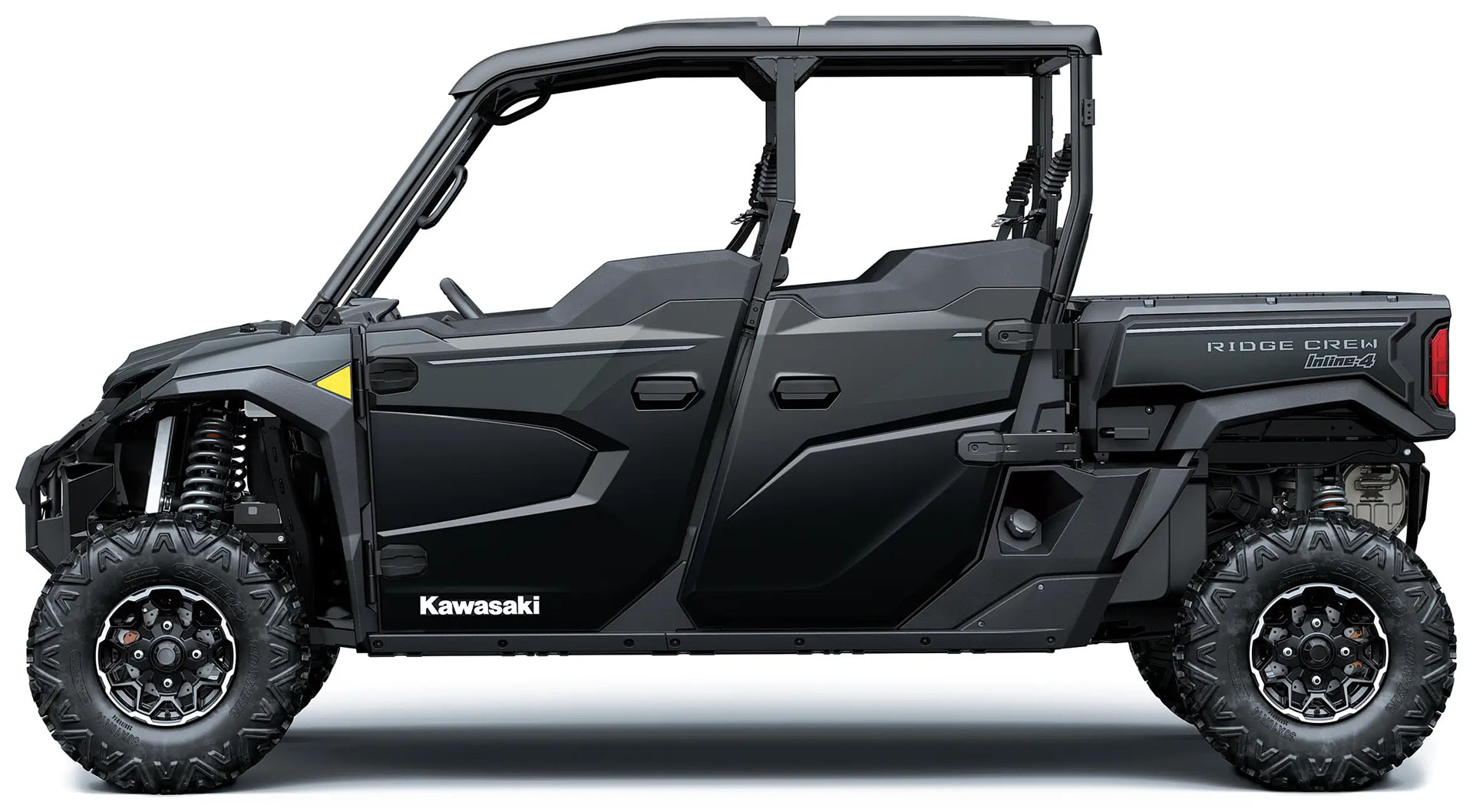
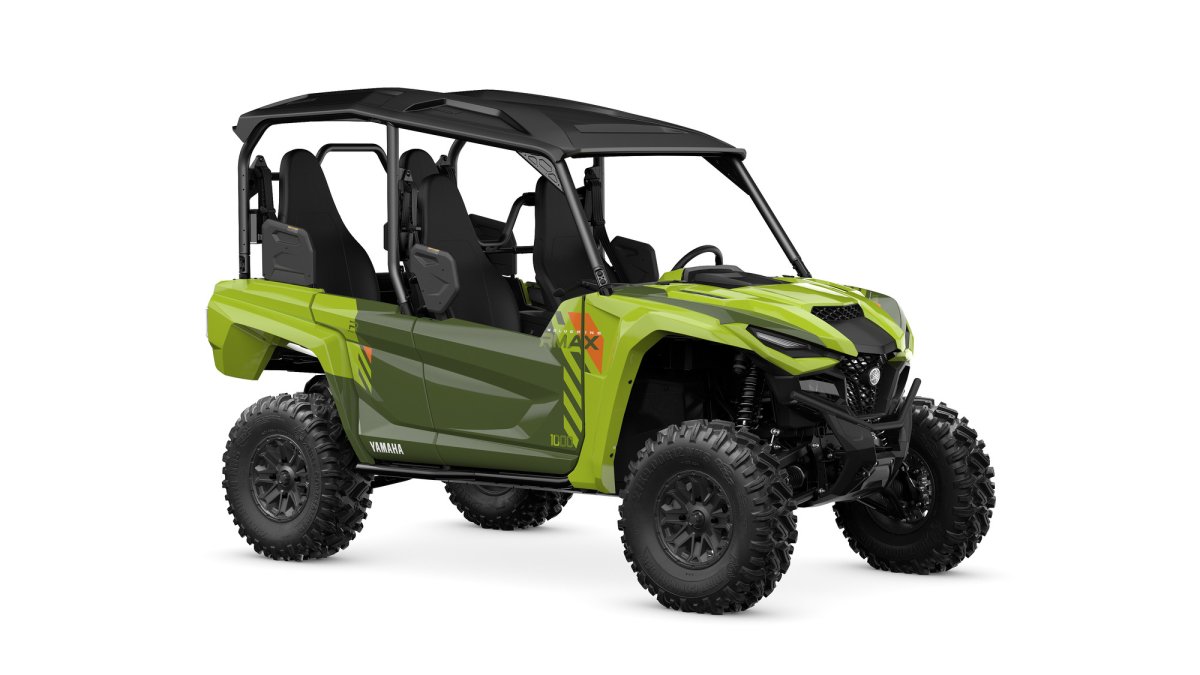
The 2027 Kawasaki RIDGE CREW is a six-seat utility UTV for buyers who want a real work platform without accepting a low-output work engine. Its 999cc liquid-cooled inline-four is rated at 116 hp and 73.8 lb-ft, figures that put it far beyond the traditional crew-cab utility class. Kawasaki backs that engine with six seats, a 1,000 lb cargo bed, 2,500 lb towing rating, 30-inch tires and a 64-inch-wide chassis that is intended to do property work as well as carry a full group.
The base Crew starts at $23,599, plus Kawasaki’s listed $1,580 destination charge. It is an open-cab model in Metallic Carbon Gray/Super Black—not an HVAC, Lifted Edition or Platinum package. That distinction is important because Kawasaki’s higher Crew trims add roofs, enclosed cabs, air conditioning, winches and other equipment. The base model’s value is its drivetrain and capacity, not a promise that it contains every feature shown across the Ridge Crew range.
For the right owner, that is a good trade. A ranch, large property, hunt camp or jobsite may need to move six people and a loaded trailer, then travel fast enough that a 45- to 70-hp work UTV becomes frustrating. For a buyer whose crew rarely fills the second row, who needs climate control immediately or who uses narrow trails, the base Ridge Crew is less compelling. Its 156.7-inch length, 122.2-inch wheelbase and 2,247 lb dry weight are substantial commitments.
What changes for 2027
Kawasaki carries the base Ridge Crew into 2027 with the same basic proposition as the 2026 model: a 116 hp inline-four, two-row six-seat cabin, 30-inch tires, 1,000 lb bed and 2,500 lb tow rating. The base MSRP rises from $23,499 for 2026 to $23,599 for 2027, while Kawasaki’s listed destination charge remains $1,580. The manufacturer does not identify a new engine, transmission or chassis redesign for the base model.
That makes this a specification-and-price decision, not a model-year revolution. A discounted 2026 Crew deserves a direct comparison if the color, warranty start date and installed equipment match the 2027. Conversely, a shopper who wants heat, air conditioning, doors, powered windows, a factory winch or a more premium interior should compare the actual 2027 Crew variants. Do not buy the base Crew expecting HVAC equipment to be included later by implication.
The 999cc inline-four is the reason to consider it
The Ridge Crew uses a 999cc, liquid-cooled, DOHC, 16-valve inline-four with EFI, electronic throttle control and TCBI ignition. Kawasaki rates it at 116.0 hp at 8,500 rpm and 73.8 lb-ft at 8,000 rpm. Kawasaki also explains that its horsepower is measured under ISO 4106, which uses a different method than the SAE standard commonly seen on cars. That caveat is worth retaining whenever the number is compared outside the UTV category.
Within its intended class, the output is still the story. An inline-four normally delivers smoother, more sustained power than the slower-revving singles, twins and triples common in work UTVs. That can be genuinely useful with a full cabin, loaded bed or long road section—not just entertaining when the vehicle is empty. It should also change how the driver treats a six-passenger machine. A Crew with six occupants is not a sport UTV; acceleration, braking distance, side-slope behavior and cargo restraint all demand more judgment than the engine’s headline encourages.
Power passes through a CVT with high, low, neutral and reverse ranges, engine braking and shaft final drive. The drive system offers 2WD, 4WD and 4WD with front and rear differentials locked. Low range and the locking settings are useful for a carefully managed heavy pull or a slow technical section. They are not permission to exceed the tow, payload or terrain limits. Match the range and differential setting to the ground before it becomes difficult, and avoid using a locked differential simply because it is available.
Six-seat space, without pretending it is compact
The fixed two-row bench layout seats six. That is the correct answer for a property owner who regularly moves a family, a work team or a group of guests. It does not have the Mule PRO-FXT’s convertible rear-cab arrangement; the Crew always gives you the second row. In return, every passenger gets a conventional crew-cab position rather than a space that has to be converted from cargo use.
The dimensions make the cost of that convenience clear. The Ridge Crew is 156.7 inches long, 64 inches wide and 83.3 inches high, with a 122.2-inch wheelbase and 19-foot turning radius. It is shorter in wheelbase than some large crew UTVs, but it is still a long machine for a workshop, trailer or tight timber. Measure storage depth, trailer deck, gates and turning areas before purchase. The 64-inch width can also exclude it from routes with 50- or 60-inch restrictions.
Kawasaki’s adjustable driver’s seat, ERGO-FIT driving position, electric power steering, front stabilizer bar and 8-inch TFT should make the long cabin more manageable. The display includes RIDEOLOGY THE APP POWERSPORTS smartphone connectivity, while all-LED lighting, USB ports and KQR compatibility make the Crew easier to configure for real work. None of this makes the base model weatherproof. It is an open-cab vehicle, so dust, rain, cold and summer heat remain part of the ownership decision unless you choose an HVAC trim.
Work ratings that deserve to be treated separately
Kawasaki rates the base Crew’s cargo bed at 1,000 lb and its towing capacity at 2,500 lb. The bed measures 34.6 x 49.0 x 12.8 inches, has a detachable tailgate and can be loaded from three sides. Payload is rated at 1,290 lb. Those are strong figures, especially when paired with the engine, but the numbers are not interchangeable.
Six occupants, their gear, bed cargo and trailer tongue weight all affect the vehicle differently. Start with Kawasaki’s manual, calculate people and equipment honestly, use an appropriately balanced trailer, keep heavy loads low and secure the bed before moving. A 2,500 lb trailer on level, firm ground is a different job from the same trailer on a wet slope with six people onboard. The rating is a limit, not a target.
The 12.9-gallon fuel capacity supports a long workday, and the 85-amp alternator provides useful electrical headroom for approved accessories. The base Crew is not equipped with the 4,500 lb synthetic-rope winch fitted to many of the other Ridge Crew versions. Price a winch, mirrors, roof, windshield, storage and any cab enclosure as deliberate additions, not surprises after delivery.
Ride, traction and durability
Long-travel double-wishbone suspension provides 12.7 inches of travel front and rear. The base Crew uses SUNF 30 x 10-14 tires on 14-inch aluminum wheels, plus 14.4 inches of standard ground clearance; Kawasaki lists 15.7 inches at maximum preload. This is enough clearance and tire to travel uneven property or rough access roads with confidence, while the 64-inch width and front stabilizer bar should help keep the heavy crew chassis composed.
It is not a substitute for careful driving. Kawasaki lists an estimated 2,246.9 lb dry weight and 2,354.9 lb curb weight for the non-California model, before adding passengers and cargo. That mass needs room to stop and turn, and it does not disappear when four-wheel drive and both differential locks are selected. Use all six seatbelts, keep limbs inside the vehicle and manage terrain with the entire cabin—not just the driver’s seat—in mind.
Braking is handled by 249 mm front hydraulic discs with two-piston calipers and 249 mm rear hydraulic discs with single-piston calipers. Engine braking helps on descents, but it will not hold an overloaded trailer by itself. Downshift early, use low range when appropriate and do not learn the limits of a six-seat UTV at the bottom of a hill.
2027 Kawasaki RIDGE CREW specifications
| Specification |
RIDGE CREW |
| Engine |
999cc liquid-cooled, DOHC, 16-valve inline-four |
| Output |
116.0 hp at 8,500 rpm; 73.8 lb-ft at 8,000 rpm (ISO 4106 rating) |
| Fuel system |
EFI with electronic throttle control |
| Transmission |
CVT with H/L/N/R and engine braking |
| Drive system |
Selectable 2WD/4WD; locking front and rear differentials; shaft final drive |
| Front / rear suspension |
Long-travel double wishbone; 12.7 in travel front and rear |
| Tires |
SUNF 30 x 10-14 front and rear |
| Wheels |
14-inch aluminum |
| Brakes |
249 mm front discs with 2-piston calipers; 249 mm rear discs with 1-piston calipers |
| Length x width x height |
156.7 x 64.0 x 83.3 in |
| Wheelbase |
122.2 in |
| Ground clearance |
14.4 in standard / 15.7 in at maximum preload |
| Estimated dry weight |
2,246.9 lb (2,249.1 lb California model) |
| Curb weight |
2,354.9 lb (2,357.1 lb California model) |
| Fuel capacity |
12.9 gal |
| Cargo bed |
34.6 x 49.0 x 12.8 in; 1,000 lb capacity |
| Towing capacity |
2,500 lb |
| Payload capacity |
1,290 lb |
| Seating |
Six, two-row bench seats |
| Display |
8-inch full-color TFT with RIDEOLOGY THE APP POWERSPORTS connectivity |
| Base MSRP |
$23,599, plus $1,580 destination charge listed separately |
Ridge Crew alternatives worth comparing
The 2025 Polaris Ranger Crew XP 1000 is the value-focused six-seat work rival in the current database. It is listed at $19,999 with 82 hp, 2,500 lb of towing, a 1,500 lb box and a shorter 116-inch wheelbase. The Kawasaki costs more, makes 34 more hp and has larger tires and more clearance; the Ranger offers greater bed capacity for less money. Compare the Ridge Crew and Ranger Crew.
The 2025 Can-Am Defender MAX HD10 Limited approaches the question from the comfort side. It is an enclosed, air-conditioned six-seat UTV with 82 hp, 2,500 lb towing and a $29,999 price in ATVPedia’s existing data. The Can-Am’s cab is the reason to pay the premium; the Kawasaki’s powerful four-cylinder and lower base price make sense for a buyer who does not need factory HVAC. See the Crew and Defender MAX comparison.
The 2025 Honda Pioneer 1000-6 Deluxe Crew uses a six-speed DCT instead of a CVT and is listed at $23,999. Its 72 hp twin, 2,500 lb tow rating, 64-inch width and 116.4-inch wheelbase make it a closer price match than its output suggests. Pick the Honda for its DCT and shorter wheelbase; pick the Kawasaki for 116 hp, a larger bed and the extra ground clearance. Compare the two six-seat crews.
The 2025 Kawasaki Mule PRO-FXT 1000 is the practical same-brand alternative. Its Trans-Cab switches from three to six seats, costs much less in the existing data and has a compact 92.3-inch wheelbase, but it gives up substantial output, clearance and towing. Choose the Mule when flexibility and lower-speed property work matter; choose the Ridge Crew when a permanent six-seat cabin and fast, capable travel are the actual mission. Compare the two Kawasakis.
Price and buying advice
The $23,599 MSRP plus a $1,580 destination charge is a competitive starting point for the base Crew, but it is only the vehicle’s starting cost. Get an itemized out-the-door quote that separates destination, setup, title, registration, financing and every accessory. If the machine needs to be useful year-round, price the HVAC Crew instead of attempting to make an open-cab base model behave like a factory enclosed vehicle.
Buy the base Ridge Crew if you need six permanent seats, 2,500 lb towing, a 1,000 lb bed and a strong inline-four for property, ranch or jobsite work. It makes the most sense when the group will actually use the second row and the driving area has the room to accommodate a 156.7-inch machine.
Choose another UTV if six seats are rare, your routes are width-restricted, you need a climate-controlled cab from day one or your work is slow enough that a cheaper crew machine will do it. The Ridge Crew’s power is useful, but its size, mass and fuel use are costs that should earn their place in the plan.
Verdict
The 2027 Kawasaki RIDGE CREW is one of the most capable open-cab six-seat utility UTVs on paper. It combines a 116 hp inline-four with meaningful work ratings, 30-inch tires, locking differentials, 14.4 inches of clearance and a full-sized second row. The base trim avoids the price of the HVAC and Platinum models without compromising its core engine, suspension and cargo capability.
Its best use is clear: carrying people and equipment across a large property without settling for a slow, basic crew cab. It is not a compact trail machine and it is not an enclosed all-weather vehicle. For buyers who understand those boundaries, the base Ridge Crew is the sharpest way into Kawasaki’s high-performance crew-utility platform. Browse more Kawasaki UTVs, visit the 2027 model-year hub, explore utility UTVs, or add the Ridge Crew to the comparison tool.