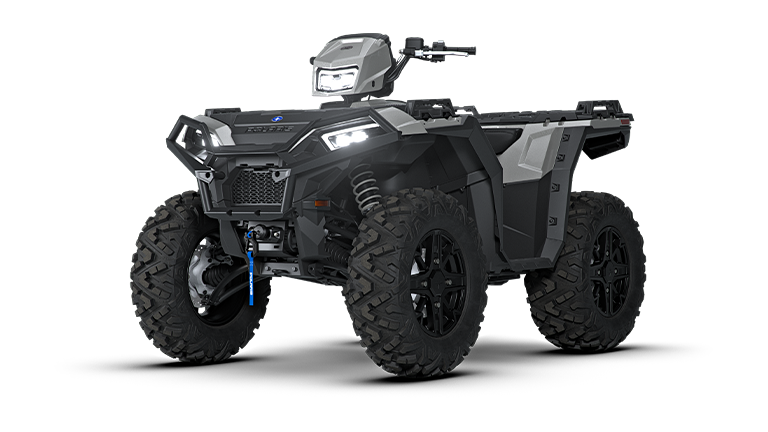
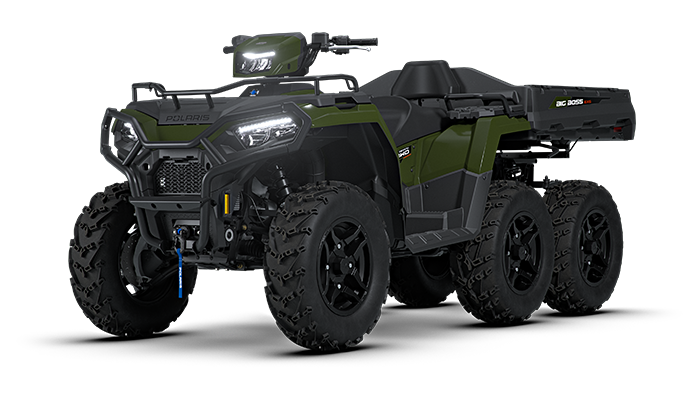
The 2027 Polaris Sportsman XP 1000 Ultimate is the one-seat Sportsman for a rider who wants the expensive parts fitted at the factory. Ninety horsepower, a 3,500-lb winch, 27-inch tires, arched suspension arms, LED lighting, a seven-inch navigation display, and connected-vehicle features all come on the Turbo Silver machine. It is 47.6 inches wide, not the 55-inch XP 1000 S that often appears beside it in search results.
That distinction is central to the buying decision. The Ultimate keeps the footprint of a conventional trail ATV while supplying big-twin power and a long equipment list. It also costs $15,999 before destination. If a winch, onboard mapping, and connected services are not on your shopping list, a less expensive Sportsman can do much of the same riding. If a passenger is on your shopping list, this is simply the wrong chassis.
This is a specification-based review, not a claimed trail test. Polaris’s published dimensions, capacities, and standard equipment tell a clear story; ride quality, tire grip, and real fuel range still depend on terrain, loading, weather, setup, and the person at the bars.
Price, trim, and what “Ultimate” buys
Polaris lists one current U.S. configuration: the 2027 Sportsman XP 1000 Ultimate in Turbo Silver. MSRP is $15,999, plus a separately published $700 destination charge. The resulting $16,699 manufacturer subtotal is not an out-the-door quote. Dealer preparation, taxes, title, registration, financing, and accessories can add to it. Confirm the VIN, exact equipment, and written price with the selling dealer, because the factory site notes that specifications and availability can change.
Polaris does not present this as a ground-up redesign. Its published 90 hp, 904-lb estimated dry weight, 12-inch clearance, display, and winch match the 2026 Ultimate specification. The published starting MSRP rises $500 from $15,499 for 2026, and destination rises from $595 to $700. A leftover 2026 machine could therefore be worth comparing on actual selling price, condition, warranty start, and equipment—not merely the model year on the title.
The extra equipment is not just trim paint. The Ultimate includes a 7-inch RIDE COMMAND display, RIDE COMMAND+ connected services, a 3,500-lb synthetic-rope winch with Auto Stop, an Ultimate Series front bumper, high-output LED pod and bumper lights, PIN-activated P.A.S.S. security, a premium saddle, 14-inch aluminum wheels, and six movable Lock & Ride tie-down points. High-clearance arched A-arms, multi-select electronic power steering, Engine Braking System, and Active Descent Control round out the mechanical package.
There are omissions worth noticing too. Polaris explicitly lists Ride Control and speed limiting as not equipped on this trim. Plow Mode appears in the display specification only when properly equipped; the published vehicle price does not include a plow. It is easy to turn a technology feature into an assumed accessory if the build sheet is not read carefully.
Engine: a 952cc twin, not a literal 1,000cc
The ProStar four-stroke is a liquid-cooled, fuel-injected, single-overhead-cam parallel-twin. Actual displacement is 952cc and Polaris rates it at 90 hp. The automatic PVT has park, reverse, neutral, low, and high. One-touch On-Demand AWD lets the rider select two-wheel drive on firm ground and bring front-wheel assistance into play when conditions require it.
Ninety horsepower is a large amount for a single-seat utility ATV. The payoff is reserve when a climb steepens, the trail becomes soft, or the machine carries legal cargo. The cost is that throttle mistakes happen more quickly. Smooth inputs, body position, good tires, and judgment still do more for progress than the peak output figure.
The transmission’s low range matters in this power class. Slow crawling, towing, plowing, repeated stop-and-go work, and heavy grades put heat into a belt-drive system. The engine may pull through those jobs in high range, but that does not mean high is the appropriate choice. Follow Polaris’s owner’s manual for range use, belt break-in, service, and water or mud procedures.
The 5.25-gallon tank is familiar Sportsman hardware rather than an extended-range feature. Polaris does not give a reliable miles-per-tank promise for this trim. A powerful twin at trail speed, in mud, or under load can have very different consumption from an easy gravel-road ride. Plan remote loops with fuel margin rather than translating tank size into a fixed route distance.
Width, clearance, and the difference from XP 1000 S
At 47.6 inches wide, 83.25 inches long, and 50.75 inches high, the Ultimate is a standard-width ATV. Wheelbase is 53 inches, seat height is 37 inches, and ground clearance is 12 inches. That 47.6-inch published width gives theoretical margin under a 50-inch trail designation, but it is no blanket access guarantee. Land managers may apply rules about vehicle class, measured width, tires, gates, weight, or seasonal closures. Aftermarket guards and cargo can also change the real-world envelope.
Do not confuse this with the 2027 Sportsman XP 1000 S. The S is a 55-inch-wide performance ATV with substantially more published clearance. The standard-width Ultimate is the more plausible choice where narrow trails or tight trailer dimensions matter; the S is aimed at riders who can use its wider stance. They are not two names for the same machine.
Polaris lists an estimated dry weight of 904 lb and curb weight of 950 lb for the Ultimate. The heavier curb figure is more useful when judging a trailer or loading ramp, then installed accessories, mud, tools, and fuel carried outside the tank must be considered. An ATV can be narrow enough for a gate and still be a substantial mass to brake or recover on a slope.
Suspension, tires, and trail behavior
Sealed, high-clearance arched dual A-arms front and rear distinguish this chassis from simpler straight-arm Sportsman trims. Front wheel travel is nine inches; the rolled independent rear suspension offers 10.25 inches. Polaris publishes 12 inches of ground clearance and fits 27x9-14 Duro front tires and 27x11-14 Duro rears on 14-inch aluminum wheels.
The arms create useful room around rocks and ruts near the wheel path. They do not make the full underside twelve inches high at every point, and a 53-inch wheelbase can still hang up at a sharp crest. Pick lines with the center of the ATV in mind, not just the tallest obstacle a tire can straddle.
Those 27-inch tires help set the machine’s clearance and gearing. Fitting larger or heavier aftermarket tires without a reason can alter steering effort, braking, CVT heat, suspension response, and driveline stress. The factory package is the reference for the published numbers. Tire pressure, tread condition, and load will have more immediate effects on grip than an extra inch printed on a sidewall.
Multi-select electronic power steering lets the rider change the level of assistance. More help is welcome when maneuvering a loaded ATV at low speed; less may feel more natural when moving quickly. Neither mode adds traction. The 90-hp twin and assisted steering can make the vehicle feel effortless, but it still needs deliberate weight transfer and conservative speed on side hills.
AWD, engine braking, and descents
Polaris’s On-Demand AWD detects rear-wheel slip and engages the front drive as needed when AWD is selected. On predictable, high-grip ground, two-wheel drive avoids asking the front end to help when it does not need to. On loose climbs, snow, wet roots, or a loaded exit, select AWD before momentum disappears rather than waiting to get stuck.
Engine Braking System helps slow the ATV when the throttle closes. Active Descent Control adds support to keep the driveline involved on grades. Both are valuable on a machine that can easily reach 950 lb curb weight before rider and gear. They are not hill-descent autopilots. Low range, sensible entry speed, good tires, and proper brake use still decide the outcome.
Polaris specifies a single-lever four-wheel hydraulic-disc brake system plus a hydraulic rear foot brake. Parking uses the transmission’s park position and a lockable hand lever. The manufacturer’s rollaway warning is worth taking literally: shift to park whenever stopping or leaving the vehicle, especially near a grade, and follow the manual’s parking instructions.
The screen is useful; the subscription deserves scrutiny
The factory seven-inch display runs RIDE COMMAND with built-in GPS navigation and topographic mapping. Polaris lists ride tracking, waypoints, configurable gauges, Group Ride, help alerts, and USB smartphone connectivity. Its current marketing advertises access to more than 1.3 million miles of trail maps, including navigation features that can work without cell service. Actual map coverage and trail legality should be checked for the places you ride. A digital line on a map is not permission to enter a closed route.
RIDE COMMAND+ is a separate connected-services layer. The specification lists real-time vehicle location, security alerts, remote ignition lockout, health diagnostics, and maintenance reminders. Polaris says a free three-year subscription is included when factory installed. A shopper planning to keep the ATV longer should ask what functions remain after that period, what renewal costs, and whether a particular feature needs cellular service in their area. The local GPS display and network-dependent connected services are not the same promise.
The PIN-activated P.A.S.S. system adds a useful deterrent, not an excuse to leave the ATV unsecured. If remote lockout matters to you, test how it behaves at your property and how the ATV can be recovered if the account, phone, or network is unavailable. This is a strong equipment set, but ownership of a connected vehicle includes account management.
Plow Mode can automate blade movement through compatible controls when the proper plow equipment is installed. It is a good example of a feature that becomes valuable only after another purchase. The factory winch is standard; a plow blade and mounting hardware are not established as standard equipment by Polaris’s model page.
Winch, towing, racks, and payload arithmetic
The factory winch has a 3,500-lb rating, synthetic rope, and Auto Stop. It provides recovery and work capability without an immediate electrical or mounting project. Rated pull is not a guarantee that a buried ATV will come free in one straight pull. Anchors, direction, line layers, snatch blocks, and ground conditions all change the effective load. Read the winch instructions, keep bystanders clear, and inspect rope damage before use.
Towing capacity is 1,500 lb via a standard 1.25-inch receiver. The number is a maximum under the manufacturer’s conditions, not a recommendation to tow that weight on every hill or descent. Trailer brakes, hitch compatibility, terrain, speed, cooling, and the tow vehicle’s own manual matter. Polaris rates total vehicle payload at 575 lb; hitch tongue weight counts against it.
The front rack is rated for 120 lb and the rear for 240 lb, a combined 360 lb. That 360 lb is inside the 575-lb payload allowance, not on top of it. A 200-lb rider in gear leaves 375 lb of theoretical payload before accessories, cargo, and tongue weight. Reaching the full rack rating in that example would leave almost no allowance for anything else. Distribute load according to the manual and keep heavier items low and secure.
Lock & Ride storage totals six gallons: four up front and two at the rear. Six movable tie-down points help secure gear. Storage volume and rack capacity answer different questions: a compartment can be full of light clothing, while a small toolbox can consume a meaningful share of the weight allowance.
This is a one-person ATV. Polaris lists person capacity as one. The rear rack’s 240-lb rating does not make it a passenger platform, and an add-on cushion cannot create a factory two-up chassis. That is the most important limitation for a buyer tempted by the Ultimate’s equipment but who rides with a partner.
The closest alternatives
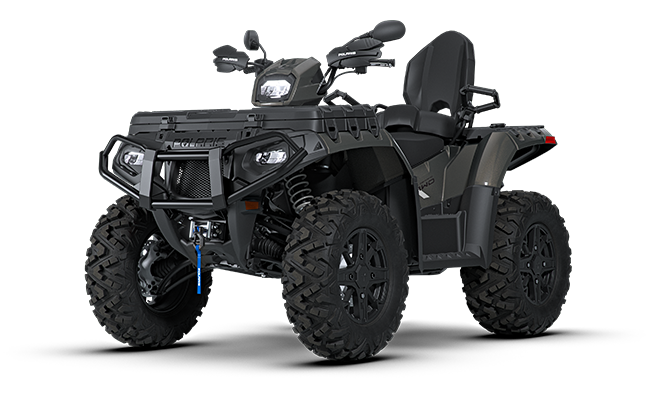
The 2027 Sportsman Touring XP 1000 Trail has the same $15,999 MSRP but answers a different need. Its factory two-person chassis adds a supported passenger saddle, backrest, and handholds. It makes 88 rather than 90 hp, is 48.2 inches wide, has a 57-inch wheelbase, and clears 11.25 inches. It keeps the 1,500-lb tow rating, 575-lb payload, winch, arched arms, and 27-inch tires. It does not include the Ultimate’s touchscreen, connected services, or P.A.S.S. system. If you routinely bring a passenger, choose the Touring even if the Ultimate’s screen is attractive.
The 2027 Sportsman Touring 850 Premium is $2,200 less at MSRP and also carries two people. It retains a 1,500-lb tow rating and 360-lb combined rack rating, but its 78-hp twin, straight A-arms, 26-inch tires, and simpler electronics make it a less aggressive trail package. A buyer who mostly works a property and rides moderate paths may have more use for the second seat and the money saved than for 12 extra horsepower.
Polaris’s current 2027 XP 1000 S is worth examining if the priority is wide-stance performance rather than narrow-trail access. Its 55-inch width is the disqualifier on many restricted routes. Check your actual riding area before treating the S’s extra width as an automatic upgrade.
The Ultimate also competes against a cheaper single-seat Sportsman fitted with selected accessories. Price the exact winch, bumper, screen or navigation solution, installation labor, and warranty implications before assuming a custom build is cheaper. Conversely, do not pay for factory connectivity you know you will never use.
Ownership checks before signing
The standard lighting, charge ports, battery access, and front bumper are practical touches, but the purchase inspection should be physical. Verify the winch spool and synthetic rope, display boot-up and GPS, RIDE COMMAND+ activation terms, PIN setup, AWD operation, brake feel, rack latches, and every item listed on the dealer invoice. Confirm that any plow or cargo accessory shown in a photo is actually included.
Service planning is ordinary big-ATV work: engine and driveline fluids, air filter, cooling system, CVT belt and intake, tires, suspension joints, brakes, battery, and winch rope. Dust, mud, water, towing, and repeated low-speed work can require more attention than a gentle trail schedule. The current owner’s manual and the VIN-specific warranty paperwork are the authorities for intervals and coverage.
The premium saddle, generous power, and electronic aids could make long days easier, but no specification sheet proves comfort for your body. Sit on the ATV and check the 37-inch seat height, bar reach, foot room, standing posture, and control feel. Load it on the actual trailer if dimensions are close. The factory 47.6-inch width does not include everything a dealer or owner might bolt on later.
Verdict
The 2027 Sportsman XP 1000 Ultimate makes the most sense for a solo rider who wants strong power, a conventional-width chassis, useful recovery hardware, onboard mapping, and security features without assembling an accessory catalog. Its 90-hp twin, 12-inch clearance, arched arms, and 27-inch tires make a persuasive mechanical base; the winch and display make “Ultimate” more than a badge.
The trade-offs are clear. At $16,699 with published destination, it is expensive for a one-seat ATV. Its 5.25-gallon tank is not unusually large, connected services may carry a cost after the included period, and the rear rack cannot take a passenger. The Touring XP 1000 Trail buys a legitimate second seat for the same MSRP, while cheaper Sportsmans cover basic trail and property work.
Buy this exact model if the combination of standard width, solo use, power, winch, and integrated electronics matches the way you ride. Do not buy it thinking it is the wide XP 1000 S, or a Touring machine with a smaller saddle.