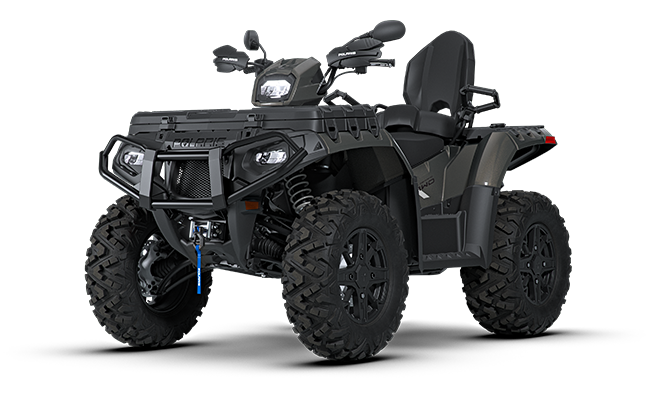
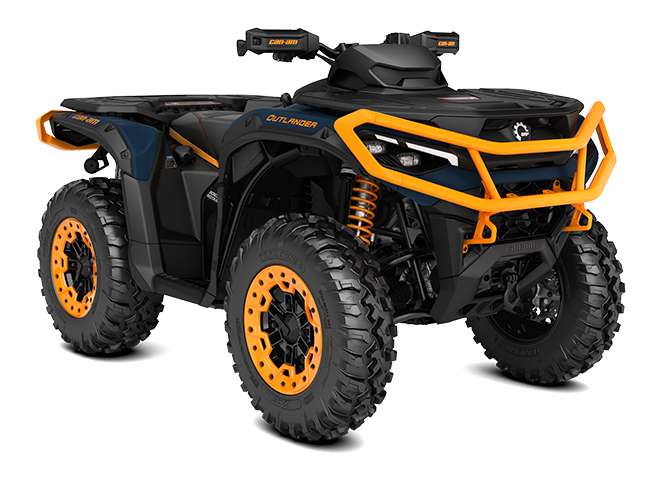
The 2027 Polaris Sportsman Touring XP 1000 Trail is the high-output two-person Sportsman for riders who want useful trail hardware installed before delivery. It combines an 88-hp twin with a proper passenger chassis, narrow 48.2-inch stance, arched suspension arms, 27-inch tires, a 3,500-lb winch, and the braking aids that matter when a second person adds weight behind the rider.
That specification is more coherent than the name is concise. “Touring” means the chassis is designed for two people. “XP 1000” identifies the large-bore 952cc platform, not literal displacement. “Trail” brings the protection, recovery equipment, tires, and driveline details missing from a basic touring ATV. The result is a well-equipped machine, but one that still asks $15,999 before destination and omits the touchscreen electronics found on some similarly priced Polaris trims.
There is one important correction for shoppers comparing Polaris pages or dealer advertisements: this two-up model makes 88 hp, not 90. The current standard-width, one-seat Sportsman XP 1000 Ultimate is the 90-hp machine. Two horsepower will not decide whether this ATV works for a buyer, but the distinction matters in a reference database and in any honest comparison.
Polaris presents the 2027 Touring XP 1000 Trail as a continuing model, not a ground-up redesign. Its engine rating, dimensions, capacities, suspension travel, and principal equipment match the published 2026 version. MSRP also remains $15,999. The current color changes to Heavy Metal, while the published destination charge rises from $595 to $700. In practical terms, this is an established package wearing a new model-year label.
2027 price and exact configuration
ATVPedia’s entry covers the Heavy Metal configuration shown on Polaris’s current U.S. site. Base MSRP is $15,999. Adding the manufacturer-listed $700 destination charge creates a $16,699 subtotal. Dealer preparation, tax, registration, title, freight variations, finance costs, and installed accessories can push the out-the-door figure higher.
The standard Trail equipment is substantial: a 3,500-lb synthetic-rope winch, front bumper, driver handguards, mirrors, high-clearance arched A-arms, 27-inch Duro tires, 14-inch aluminum wheels, multi-select power steering, Engine Braking System, Active Descent Control, close-ratio On-Demand AWD, LED lighting, and a full digital gauge.
There is only one color displayed for the current U.S. configuration, so there is less trim ambiguity than usual. The equipment list still deserves a line-by-line check on the purchase order. Accessories such as a windshield, heated grips, larger cargo boxes, or an accessory display can materially change both price and electrical demand.
Polaris lists a one-year limited warranty. The written warranty supplied with the purchased ATV controls actual coverage, exclusions, and start date; a marketing-page summary is not a substitute for that document.
The engine is a liquid-cooled 952cc ProStar four-stroke parallel-twin with single overhead cams and electronic fuel injection. A 400 CCA battery supports starting and the standard electrical system. The automatic PVT provides park, reverse, neutral, low, and high ranges in an inline shift pattern.
Eighty-eight horsepower is ample for a two-up utility ATV. It gives the Touring XP 1000 Trail 10 hp more than the Sportsman Touring 850 Premium and 44 hp more than the Sportsman Touring 600. The extra output is most relevant when climbing with two adults, accelerating from low speed, or carrying a legal load at elevation. It is reserve, not permission to ignore traction or payload limits.
The engine number can be confusing. “XP 1000” is a model-family designation; actual displacement is 952cc. The second potential trap is assuming every current XP 1000 has the same tune. Polaris publishes 88 hp for this Touring model and 90 hp for the single-seat Sportsman XP 1000 Ultimate. The touring chassis, calibration, and purpose are different enough that the catalog figures should remain separate.
Low range is appropriate for slow technical ground, steep grades, heavy pulling, and repeated work where belt heat matters. High range suits normal trail speeds. The engine has enough torque to conceal a poor range choice for a while, but output does not prevent CVT heat. The owner’s manual should govern range selection, belt break-in, towing practice, and maintenance.
Fuel capacity is 5.25 gallons. That is smaller than the 6.75-gallon tank in the Touring 600 and the 6.9-gallon tank in the CFMOTO CForce 1000 Touring. Tank size alone cannot predict range, but a powerful twin carrying two people can make planning important on remote loops. Terrain, throttle use, elevation, temperature, load, and tire pressure all change consumption.
A real two-person ATV
The Touring XP 1000 Trail is rated for two occupants from the factory. Its 57-inch wheelbase supports a raised passenger position with a bolstered seat, ergonomic backrest, integrated hand grips, and intended foot locations. That is fundamentally different from installing a padded box on the rear rack of an ATV designed for one.
The passenger still changes how the vehicle behaves. Their mass sits high and behind the driver, increasing pitch over bumps and affecting steering, braking, climbing, and side-slope stability. An experienced solo rider should not expect the machine to respond identically with someone aboard. The sensible first two-up ride is on easy ground, at low speed, with clear communication.
Both riders need suitable protective equipment. The passenger must be able to reach and hold the grips, keep their feet in the intended positions, and move with the ATV. Passenger eligibility, tire pressures, loading, and riding restrictions belong to the owner’s manual, not guesswork based on seat size.
The dedicated rear seat also shapes cargo use. The machine retains a 240-lb rear rack, but it is not an open one-up cargo platform or a dumping box. Buyers who routinely need a passenger and bulky material on the same trip should compare a six-wheel Sportsman or a utility side-by-side rather than assuming a touring saddle can do every job.
Arched suspension and 27-inch Duro tires
High-clearance arched dual A-arms distinguish the Trail chassis from the straight-arm Touring 850 Premium. Front travel is nine inches. The rolled independent rear suspension provides 10.25 inches, and published ground clearance is 11.25 inches.
Arched arms create more clearance near obstacles than a straight member running lower across the wheel path. They do not raise every point under the machine or make the center of the chassis immune to contact. Line choice still determines whether a rock meets a tire, an A-arm, or the underside.
The extra rear travel is useful with a passenger, but suspension travel is not payload. As load increases, the ATV rides deeper in its stroke and has less reserve for the next hole or ledge. Preload, if adjusted under the owner’s manual, can help set ride height for load; it cannot remove mass or increase the 575-lb rating.
Polaris fits 27x9-14 front and 27x11-14 rear Duro tires to 14-inch aluminum wheels. They add one inch of nominal tire diameter over the Touring 850 Premium’s 26-inch CST set and suit the Trail’s protection-and-clearance brief. Their aggressive tread should help in loose surfaces, but actual grip depends on pressure, soil, wear, and temperature.
Larger or heavier aftermarket tires can change effective gearing, steering load, braking, belt temperature, suspension response, and driveline stress. The standard 27-inch package is already integrated with the published specification. A tire change should solve a real terrain problem, not simply chase appearance.
Dry weight is 929 lb and curb weight is 974 lb. A loaded example can pass 1,500 lb once two occupants, accessories, and cargo are aboard. That is why the vehicle can feel composed over chatter yet still carry serious momentum into a corner or descent. Suspension cannot cancel physics.
Dimensions and narrow-trail access
Overall dimensions are 84.3 inches long, 48.2 inches wide, and 48.8 inches high. Wheelbase is 57 inches, seat height is 35.75 inches, and ground clearance is 11.25 inches.
The 48.2-inch width is a genuine advantage against 50-inch-wide rivals, especially in wooded areas and on older access tracks. It leaves theoretical space inside a 50-inch opening, but it does not guarantee that every “50-inch trail” is legal or physically passable. Land managers may regulate measured width, vehicle type, weight, passenger use, tires, or seasonal access. Gates and bridge rails can also be less forgiving than a map legend.
Mirrors, handguards, cargo, and the riders themselves need consideration at narrow gates. The published number describes the machine according to Polaris’s measurement, not every installed accessory. Measure the actual ATV after setup if a route or trailer has little margin.
The 57-inch wheelbase gives the passenger useful space and should settle the chassis compared with a short single-seat ATV. It also increases turning radius and changes breakover behavior. A sharp crest can contact the middle of a long chassis even when the ground-clearance number looks generous.
Close-ratio AWD, EBS, and Active Descent Control
The Trail specification uses high-performance, close-ratio On-Demand AWD with selectable 2WD. When AWD is selected, the system monitors rear-wheel slip and brings the front wheels into the task. There is no conventional manual front differential-lock lever to manage.
Two-wheel drive is appropriate on firm ground where front assistance is unnecessary. AWD should be selected before mud, snow, loose climbs, or other low-traction sections rather than after the ATV has stopped. The system can distribute drive, but no AWD logic can create grip on polished rock or deep clay.
Engine Braking System maintains driveline deceleration when the throttle closes. Active Descent Control works with the driveline to help control all four wheels on grades. These systems have particular value on a touring ATV because a passenger and cargo add momentum and can make abrupt braking inputs more disruptive.
They remain aids. Low range, sensible speed, service brakes, tire condition, load placement, and a deliberate line still decide whether a descent is controlled. The factory specification lists a single-lever four-wheel hydraulic-disc system plus a hydraulic rear foot brake, with park in the transmission and a lockable hand lever.
Multi-select electronic power steering allows the rider to tailor assistance. More help can reduce fatigue during slow, loaded maneuvering; less help can preserve steering feel at trail speed. EPS cannot improve front-tire grip, shorten stopping distance, or stabilize an incorrectly loaded rear rack.
Payload, racks, storage, and the math buyers should do
The front rack is rated for 120 lb and the rear for 240 lb, creating a 360-lb combined rack figure. Six movable Lock & Ride tie-down points make those surfaces easier to use. Sealed storage totals six gallons: four at the front and two at the rear.
The critical number is 575 lb of total payload. Driver, passenger, protective gear, cargo, permanent accessories, and trailer tongue weight all consume it. The 360-lb rack rating is not an additional allowance. If both racks somehow carry their maximum combined load, only 215 lb remains for two occupants and everything else.
Real planning should start with the people. Subtract both riders in gear, then installed accessories and expected hitch load, from 575 lb. The remainder is the usable cargo allowance, still subject to the separate front- and rear-rack limits. For many adult pairs, the practical cargo number will be far below 360 lb.
Position matters as much as arithmetic. A dense load high on the rear rack reduces the weight available at the front tires and raises the loaded center of gravity. Secure cargo against movement and keep it clear of the passenger, exhaust, lighting, steering, and brakes.
Six gallons of dry storage is useful for straps, gloves, a compact tool kit, first-aid supplies, and small items that should stay clean. It is not large touring luggage. Boxes and bags add weight and can make the ATV wider or taller, so they belong in both the payload and access calculation.
Winch, towing, and work use
The factory winch is rated for 3,500 lb and uses synthetic rope. Having it installed from the start is one of the Trail package’s clearest advantages over the Touring 850 Premium. It can support self-recovery and utility tasks without an immediate accessory purchase.
The 3,500-lb label is not a blanket safe-recovery rating. Line angle, drum layers, anchor strength, recovery-point design, vehicle suction, slope, and rigging all affect load. Use rated equipment, follow the winch instructions, damp the line where directed, and keep people outside the recoil zone. A snatch block changes forces at the anchor as well as line pull.
Polaris rates the ATV to tow 1,500 lb through a standard 1.25-inch receiver. The engine can start a substantial trailer, but starting is the easy part. Tongue weight, trailer balance, surface grip, grades, turning room, cooling, and stopping distance determine whether the task is controlled.
Tongue weight is part of the 575-lb payload. Two occupants may leave little headroom for cargo and hitch load even when the trailer remains below 1,500 lb. The rating is a ceiling under manufacturer-defined conditions, not a recommendation to tow maximum weight on every trail.
The front bumper and handguards provide useful protection from brush and minor contact. They should not be treated as indestructible recovery points unless the owner’s and accessory instructions identify an approved attachment location.
What the $15,999 specification leaves out
The all-digital gauge reports the useful basics, and the steerable LED pod light follows handlebar direction. LED bumper lights and dual brake lights complete a sensible trail-lighting package. The controls are conventional and focused on the ride.
There is no factory touchscreen, connected-vehicle service, Ride Control, speed limiting, or PIN-based P.A.S.S. security on the published configuration. An accessory display may be offered, but it is not part of the base price represented here.
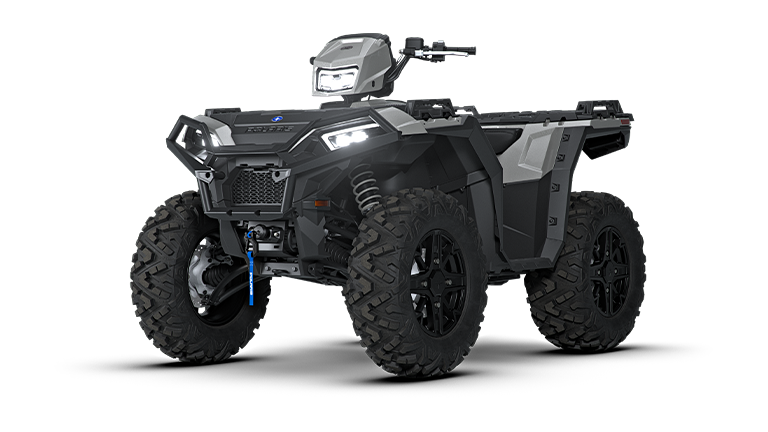
That omission matters because the standard-width one-seat Sportsman XP 1000 Ultimate starts at the same $15,999 MSRP and advertises a seven-inch Ride Command display, connected services, plow mode, and additional electronic functions. The Touring Trail spends its price on a second-person chassis and physical trail hardware instead. Buyers need to decide whether the regular passenger or the screen is more valuable.
Touring XP 1000 Trail versus Touring 850 Premium
The 2027 Sportsman Touring 850 Premium is the closest internal alternative. It costs $13,799, or $2,200 less. Both share a 57-inch wheelbase, 48.2-inch width, 11.25-inch clearance, 5.25-gallon tank, 575-lb payload, 360-lb rack capacity, 1,500-lb towing rating, two-person accommodation, EBS, ADC, and multi-select EPS.
The XP 1000 Trail makes 88 hp rather than 78 and weighs 929 lb dry rather than 860. Its $2,200 premium therefore buys 10 hp while adding 69 lb. More important, it adds the 3,500-lb winch, front bumper, handguards, mirrors, arched A-arms, close-ratio AWD, and 27-inch Duro tires.
The 850 is the more efficient purchase if those accessories are unnecessary and 78 hp is sufficient. The 1000 Trail makes sense when its protection and recovery equipment would otherwise be installed after purchase, or when two-up climbing makes the extra power worthwhile. Compare delivered prices with identical equipment rather than MSRP alone.
Touring XP 1000 Trail versus Touring 600
The 2027 Sportsman Touring 600 starts at $11,499, a full $4,500 less. Its 567cc single produces 44 hp, exactly half the Touring XP 1000 Trail’s published output. It tows 1,350 lb, carries 270 lb on its racks, and uses a 56-inch wheelbase.
The smaller machine has practical counters. Its 6.75-gallon tank is 1.5 gallons larger, sealed storage totals 11 gallons rather than six, and it also includes a 3,500-lb winch. ATVPedia’s current records list the Touring 600 at 932 lb dry—three pounds heavier than the larger machine—so its advantage is price, range, and storage rather than published mass.
Choose the 600 for relaxed two-up riding, longer intervals between fuel stops, and value. Choose the XP 1000 Trail when sustained climbs, quicker acceleration, larger racks, or a stronger tow rating justify spending substantially more.
Touring XP 1000 Trail versus CFMOTO CForce 1000 Touring
The 2026 CFMOTO CForce 1000 Touring costs $10,499 in ATVPedia’s current record. It makes 84 hp, weighs 975 lb dry, measures 50 inches wide, uses a 58-inch wheelbase, clears 12 inches, carries 6.9 gallons of fuel, and tows 1,800 lb.
The Polaris costs $5,500 more and makes four additional horsepower. It is 46 lb lighter, 1.8 inches narrower, and one inch shorter between the axles. The CFMOTO counters with 300 lb more towing, 1.65 gallons more fuel, a seven-inch TFT, ride modes, adjustable EPS, and fully adjustable piggyback shocks. Both include 27-inch tires and 3,500-lb synthetic-rope winches.
On paper, the CFMOTO is the equipment-and-price leader. The Polaris argument is its narrower packaging, lower mass, familiar controls, and whatever advantage a specific local dealer, parts supply, accessory network, or resale market can demonstrate. Those ownership factors vary by location and should be verified rather than assumed from the badge.
Touring XP 1000 Trail versus Sportsman 6x6 600
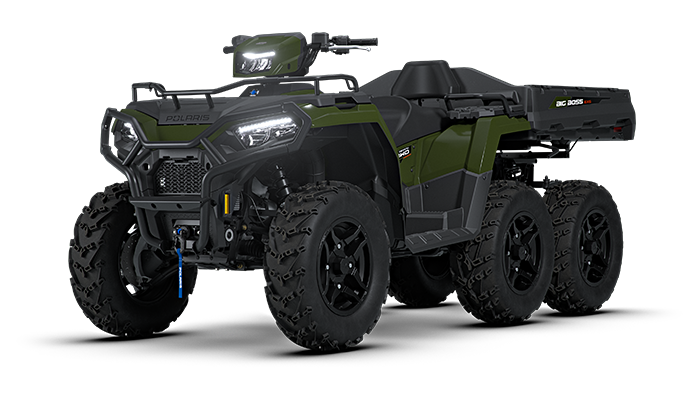
The 2027 Sportsman 6x6 600 starts at $14,999, only $1,000 less than the Touring XP 1000 Trail. Its 44-hp single, 1,194-lb dry weight, 119-inch length, 86.5-inch wheelbase, and six driven wheels define a very different machine.
The 6x6 brings an 800-lb dumping box, 1,115-lb payload, two-inch receiver, second seat, winch, and Ride Control functions. It can carry a passenger and genuinely bulky material on the same trip. The Touring XP 1000 Trail is 265 lb lighter, 34.7 inches shorter, 1.4 inches narrower, and twice as powerful.
The choice is purpose, not prestige. The 6x6 is the work transporter for cargo and soft-ground traction. The Touring XP 1000 Trail is the recreational two-up ATV for tighter paths, quicker response, easier trailering, and far less chassis to turn around.
Transport, maintenance, and ownership
Trailer planning should use the 974-lb curb figure as a starting point, then add accessories, mud, gear, and cargo. Two adults riding the ATV onto a trailer are not part of transport weight once they step off, but installed boxes, windshields, guards, and tools remain. Confirm trailer payload, axle and tire ratings, ramp capacity, tongue weight, and tow-vehicle limits with margin.
The 84.3-by-48.2-inch footprint fits many utility trailers more easily than a side-by-side. Measure the narrowest point between rails or at the gate, not only the deck. The mirrors and handguards also deserve clearance during loading.
Routine care includes engine oil, air filtration, cooling, CVT intake and belt inspection, driveline fluids, brakes, tires, steering, suspension, battery, and winch rope. Dust, mud, water, towing, and prolonged low-speed work can move service into a severe-duty pattern. The owner’s manual is the maintenance authority.
Before a two-up ride, verify payload, tire pressure, rack security, passenger handholds and foot positions, brake operation, and suspension condition. A heavy machine with a powerful engine rewards consistency more than last-minute corrections.
Who should buy the 2027 Touring XP 1000 Trail?
The strongest buyer regularly carries one passenger, rides narrow or technical trails, wants substantial climbing power, and would install a winch and protection on a lesser trim. It suits couples, hunting partners, landowners, and recreational riders who prefer ATV access and an open riding experience to a side-by-side cabin.
It is a weaker choice for riders who travel solo most of the time, buyers who want a dumping cargo body, or shoppers who expect a touchscreen at this price. The Touring 850 Premium saves $2,200. The Touring 600 saves $4,500 and carries more fuel. The standard-width one-seat XP 1000 Ultimate trades the passenger chassis for 90 hp and richer electronics at the same base MSRP.
There is also little reason for an owner of a comparable 2026 Touring XP 1000 Trail to trade solely for the model year. Polaris’s published core specification and MSRP carry over. Condition, warranty timing, actual dealer price, and color are more meaningful than the number on the title.
Verdict
The 2027 Polaris Sportsman Touring XP 1000 Trail is a convincing package because its upgrades support one clear job. An 88-hp twin carries two people with reserve. The long chassis gives the passenger a proper place to sit and brace. Arched A-arms, 27-inch tires, a winch, bumper, handguards, mirrors, EBS, ADC, and multi-select EPS prepare it for real trail use without an immediate accessory campaign.
Its compromises are equally clear. The 575-lb payload becomes tight with two adults and cargo. The 5.25-gallon tank is modest. The price reaches $16,699 with destination before dealer fees, while the display and connected-feature list remains basic. CFMOTO offers more equipment and towing for much less, and Polaris’s own Touring 850 covers the same dimensions and capacities for $2,200 less.
Buy the XP 1000 Trail for the combination the alternatives do not quite duplicate: a narrow, factory two-up Sportsman with strong power and the right recovery and protection equipment already fitted. Just buy it as an 88-hp touring ATV—not as a 90-hp Ultimate with an extra seat.