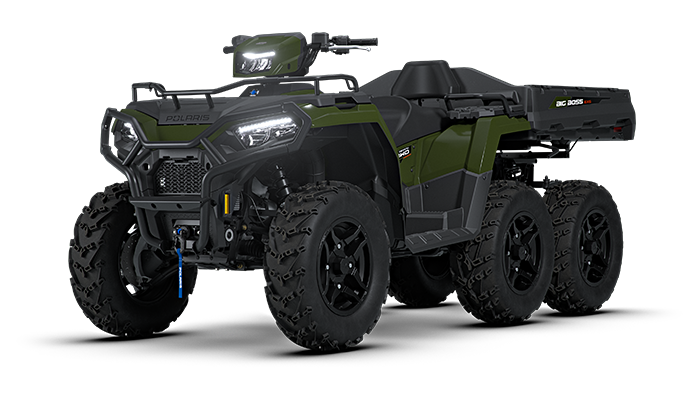
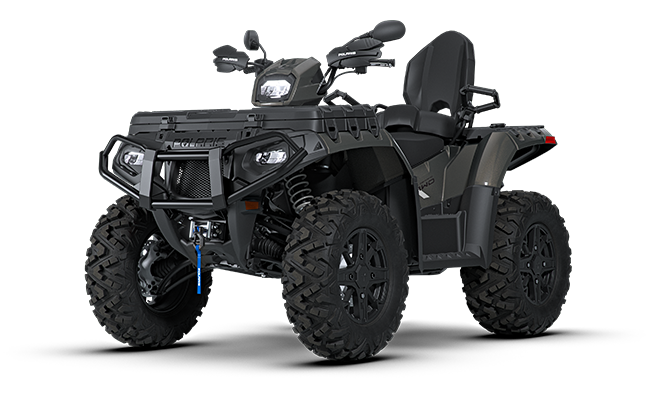
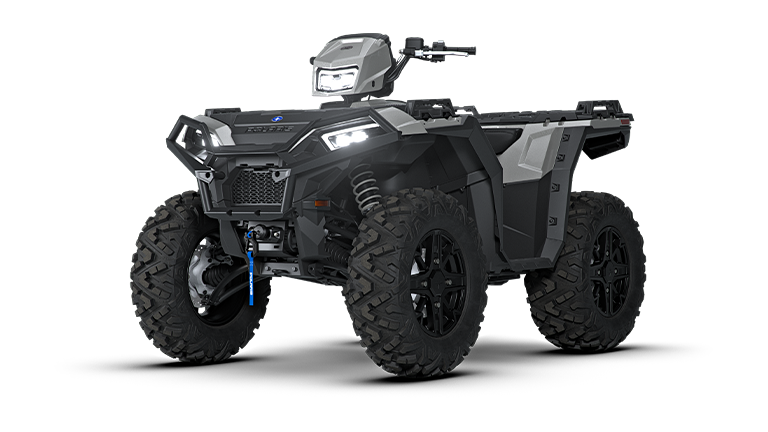
The 2027 Polaris Sportsman 6x6 600 is the rare ATV that can bring a passenger and a meaningful cargo load into the same narrow piece of country. It is 49.6 inches wide—close to a conventional trail ATV—but stretches 119 inches from bumper to box. Between those ends sit six driven wheels, a factory passenger saddle, an 800-lb dumping bed, a 3,500-lb winch, and a 1,500-lb tow rating.
That combination matters more than the new badge. The 6x6 600 is the former Sportsman 6x6 570, and Polaris says the 2027 machine is largely unchanged. Its liquid-cooled ProStar single still displaces 567cc and produces a published 44 hp. New graphics are the primary model-year update; “600” does not signal a larger engine or a fresh chassis.
At $14,999 plus a $700 destination charge, this is not a cheap way to buy 44 horsepower. It is a specialized way to buy access and carrying ability. The question is not whether it beats a normal ATV in a drag race. The question is whether six-wheel traction, a two-person layout, and a large box can replace a wider side-by-side on the buyer’s actual land.
What changed for 2027?
The short answer is the name and graphics. Polaris previously sold this platform as the Sportsman 6x6 570. For 2027, it joins the rest of the renamed 600 family. The manufacturer states there is no significant change in engine displacement, horsepower, or performance, and says accessories from the 6x6 570 remain compatible.
That makes leftover inventory worth a careful look. A well-priced late 6x6 570 may deliver essentially the same working hardware as the new 6x6 600. Compare the exact model year, warranty start, installed accessories, dealer support, and out-the-door price rather than assuming the higher number buys a stronger engine.
For a first-time buyer, the lack of a mechanical redesign is not a flaw. This is a mature, distinctive platform whose appeal comes from its layout. For an existing 6x6 570 owner, however, the 2027 badge alone offers little reason to trade.
Price and exact configuration
ATVPedia’s entry covers the Sage Green 2027 Sportsman 6x6 600 shown on Polaris’s U.S. site. MSRP is $14,999. Add the published $700 destination charge and the manufacturer subtotal becomes $15,699 before dealer setup, tax, title, registration, accessories, financing, or regional charges.
There is no ladder of trims to decode. The listed machine arrives with multi-select electronic power steering, Engine Braking System, Active Descent Control, a 3,500-lb synthetic-rope winch with Auto Stop, front trail bumper, front rack extender, front and rear A-arm guards, metal bed rails, 14-inch aluminum wheels, LED pod and low-beam headlights, and Ride Control.
That standard equipment helps explain the price, but it does not erase the comparison with utility UTVs. A base 2027 Polaris Ranger 600 starts $3,000 lower and has a protective ROPS structure, side-by-side seating, and a 500-lb dump box. The 6x6 earns its premium through a much narrower footprint, all-six-wheel traction, and an 800-lb box—not through cabin comfort.
The liquid-cooled four-stroke is a single-cylinder ProStar engine with dual overhead cams and electronic fuel injection. It drives an automatic Polaris PVT with park, reverse, neutral, low, and high ranges. Published output is 44 hp.
Forty-four horsepower is enough for deliberate trail travel and serious low-speed work, but the number needs context. Polaris lists an estimated dry weight of 1,194 lb and a curb weight of 1,248 lb. This is substantially heavier than a normal mid-size ATV, and its gearing and throttle response are expected to move mass rather than deliver sport-machine acceleration.
Low range is the important half of the transmission for loaded climbing, crawling, towing, or repeated slow work. Using high range for a job that belongs in low can create unnecessary heat in a belt-drive system. The owner’s manual should govern range choice, break-in, belt inspection, and severe-service maintenance.
The 6.75-gallon fuel tank gives the 6x6 more capacity than the 4.5-gallon base Sportsman 600. Real range changes with cargo, trailer load, grade, surface, temperature, tire pressure, and speed. A heavy six-wheel vehicle working in soft soil can consume fuel differently from an unloaded ATV cruising a firm road, so tank capacity is more useful than a single promised mileage figure.
Six-wheel drive: what it does and what it does not do
Polaris calls the system On-Demand AWD. When it detects rear-wheel slip, it can send power to all six wheels. That gives the machine four rear contact patches to push and two front tires to pull, which is particularly useful on loose climbs, wet tracks, snow, and soft ground.
It is not a dashboard full of locking-differential choices. The system decides when the front drive joins the rear wheels. Riders who want manual control over every axle should understand that distinction before buying. The benefit is simplicity: select AWD before the difficult section and concentrate on line, throttle, and momentum.
Six driven tires do not repeal physics. A 1,248-lb curb-weight ATV carrying people and cargo can still sink, high-center, slide sideways, or run out of grip. The extra rear axle spreads load and adds contact area, but tire choice, pressure, soil, rut depth, and the operator’s decisions remain decisive. A six-wheel machine that is driven farther into a bog can also be a more demanding recovery.
The factory 3,500-lb winch is therefore useful equipment rather than decoration. It uses synthetic rope and Auto Stop, but safe recovery still depends on the anchor, line angle, rigging, rope layers on the drum, and vehicle stability. Gloves, a tree saver, a rated shackle or soft shackle, a damper, and knowledge of winching technique belong with the machine.
Engine braking and downhill control
Engine Braking System and Active Descent Control are standard. EBS keeps the driveline engaged as the throttle closes so the engine can help slow the ATV. ADC is intended to add controlled braking through the drive system on descents.
These systems are especially relevant on a long, heavily loaded vehicle. They can reduce how much the rider must depend on the service brakes during a slow descent and help prevent the rear of the machine from trying to overtake the front. They do not select a safe gear, fix an overloaded box, or create traction on a slick side slope.
The braking hardware is listed as a single-lever four-wheel hydraulic-disc system with a hydraulic rear foot brake. The wording can look odd on a six-wheel ATV; it should not be rewritten as six-wheel disc braking without manufacturer confirmation. Load placement, tire grip, trailer behavior, and speed still determine stopping distance.
The 800-lb dump box is the main event
The rear Lock & Ride dumping box measures 38 by 39 by 8 inches and is rated for 800 lb. Metal rails, four D-rings, and tie-down points make the space more useful than an open rack for tools, fencing supplies, feed bags, firewood, game-recovery gear, or bagged material.
An 8-inch-deep box remains shallow. Loose material needs to stay below or be safely contained, and long items need secure attachment. The 800-lb rating is not an invitation to pile dense material until the sides disappear. Distribution matters: a compact load concentrated behind one corner does not treat the chassis like the same weight spread evenly across the floor.
The box dumps, but payload should be planned before loading. Polaris rates total payload at 1,115 lb and the front rack at 90 lb. If the rear box is carrying its full 800 lb, only 315 lb remains for the driver, passenger, accessories, front-rack cargo, and trailer tongue weight. Two average adults can consume that remainder by themselves.
That arithmetic is the most important number in this review. The machine can carry two people and cargo simultaneously, but it cannot carry two people plus the maximum box load plus the maximum front-rack load plus hitch weight. Component limits and total payload apply at the same time.
Five gallons of sealed front storage provide a useful place for straps, gloves, small tools, and items that should stay away from the load bed. Keeping frequently used equipment forward also avoids burying it beneath cargo.
Towing: capable, but still an ATV
Polaris rates the Sportsman 6x6 600 to tow 1,500 lb through a standard 2-inch receiver. The receiver size is convenient because it accepts common drawbar hardware, but the machine’s rating—not the hitch opening—sets the limit.
A trailer that rolls easily on a flat gravel lane may push hard on a wet downhill. Tongue weight also consumes the ATV’s 1,115-lb payload and adds load at the back of an already long chassis. Trailer balance, terrain, local rules, tire condition, braking distance, and the owner’s manual matter as much as whether the engine can start the load moving.
The combination of six-wheel traction and low range makes the 6x6 well suited to moving a utility trailer, small spreader, or property equipment at controlled speeds. It is not a road tow vehicle, and the published rating should not be treated as a target for every surface and slope.
Two real seats, plus the box
The 6x6 uses a stationary passenger saddle behind the driver. It is factory-rated for two people; it is not a one-seat ATV with an aftermarket cushion on the rack. That means the chassis, passenger foot positions, handholds, and load ratings were designed around two-up use.
Its packaging advantage over the 2027 Sportsman X2 600 is simple. The X2 converts the rear passenger area into a 400-lb dump box, so the buyer chooses between carrying the passenger and using the box in its cargo configuration. The 6x6 has a separate passenger position and an 800-lb box behind it. It can do both jobs on the same trip, within payload limits.
The passenger changes the machine’s center of gravity, steering, braking, and behavior on side slopes. Both occupants need appropriate protective equipment, and the passenger must keep hands and feet in the intended positions and move with the ATV. A driver who has only ridden alone should learn the changed response at low speed on easy ground first.
Dimensions, suspension, and trail access
Overall dimensions are 119 inches long, 49.6 inches wide, and 52.7 inches high. The wheelbase is 86.5 inches, ground clearance is 11.5 inches, and seat height is 36 inches. Those figures explain both the machine’s usefulness and its compromises.
At 49.6 inches, it can physically enter routes that stop many side-by-sides. That does not automatically make it legal on every 50-inch trail. Agencies can use their own measurement rules, weight limits, vehicle definitions, seasonal restrictions, and passenger policies. Check the current rules for the specific trail rather than rounding 49.6 down in the parking lot.
The 86.5-inch wheelbase improves the platform available for passenger and cargo load, but it also lengthens the turning arc and increases the distance between the front and rear contact patches. A crest or drainage hump that a short ATV clears can touch the middle of a longer chassis even when both machines list similar static ground clearance.
Front suspension uses sealed arched dual A-arms with 8.9 inches of travel. The rear uses sealed dual-A-arm independent suspension with 6.3 inches. The travel figures are modest compared with recreational sport ATVs, especially at the back, and they should be read as load-focused utility tuning. Smooth speed selection matters when the box is loaded; no suspension specification makes an 800-lb cargo load happy over repeated sharp bumps.
Independent movement helps the wheels follow uneven ground and keeps the ride more controlled than a simple solid arrangement. Sealed components can reduce routine contamination, but inspection for torn boots, looseness, impacts, and bearing play still belongs in ownership.
Twenty-six-inch CST tires are fitted to 14-inch aluminum wheels: 26x8-14 at the front and 26x10-14 at the rear. The factory sizing preserves the gearing, clearance, steering load, and suspension behavior used for the published ratings. Large aftermarket tires may add clearance, but they also change effective gearing, rotating mass, steering effort, belt load, and braking feel.
Steering, electronics, and daily usability
Multi-select electronic power steering lets the rider adjust steering assist. More help can reduce fatigue during slow work, repeated turns, or loaded maneuvering; less can preserve more feedback at trail speed. The 49.6-inch chassis remains easier to thread between trees than a 60- or 64-inch UTV, but six tires and an 86.5-inch wheelbase are still noticeable in tight turns.
Ride Control adds an easy-effort throttle, speed limiting, geofencing, PIN-activated security through P.A.S.S., and three drive modes. Speed control can be useful for spraying, towing, training, or repetitive work where a consistent pace matters. Geofencing and a PIN can support supervision and theft deterrence, but neither substitutes for training, direct oversight, a physical lock, or secure storage.
There is no standard touchscreen or connected navigation service. The machine uses an all-digital gauge with the expected speed, rpm, gear, fuel, temperature, odometer, hour, trip, and drive-status information. That keeps the cockpit workmanlike. Riders who need mapping can choose an accessory solution without paying for a display they may never use.
LED pod and low-beam headlights are standard. The front trail bumper, rack extender, and A-arm guards are practical factory additions for brush, trail debris, and work sites. They are protection, not armor: a guard can deflect ordinary contact but cannot make suspension components immune to stumps and rocks.
Sportsman 6x6 600 versus Sportsman X2 600
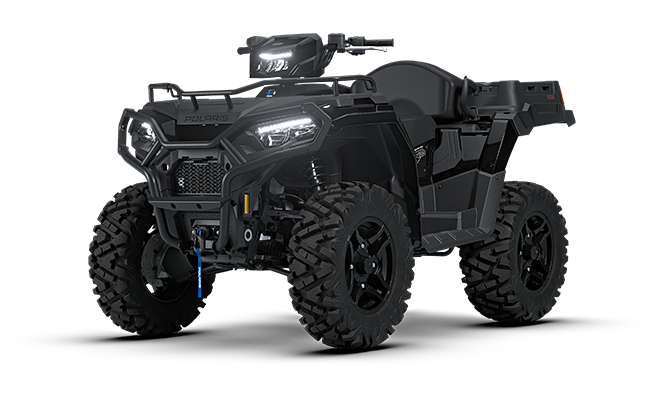
The X2 is the closest Polaris alternative. Both machines use the 567cc, 44-hp ProStar single, automatic PVT, 6.75-gallon tank, multi-select EPS, EBS, ADC, Ride Control, and a 3,500-lb winch. The X2 starts at $14,399—only $600 less than the 6x6.
The physical differences are much larger than the price gap. ATVPedia’s X2 record lists 928 lb dry, 92 inches of overall length, a 56-inch wheelbase, a 705-lb payload, 400-lb box, and 1,350-lb tow rating. The 6x6 weighs 1,194 lb dry, measures 119 inches long, has an 86.5-inch wheelbase, carries 1,115 lb of payload, holds 800 lb in its box, and tows 1,500 lb.
Choose the X2 if compactness, easier trail maneuvering, and the ability to alternate between passenger and cargo use are enough. Choose the 6x6 if a passenger and substantial cargo must travel together, soft-ground traction matters, or the larger box will be used regularly. Paying $600 for unused capacity makes little sense; paying $600 to solve a real simultaneous passenger-and-cargo problem makes the 6x6 persuasive.
Sportsman 6x6 600 versus Can-Am Outlander MAX 6x6
The 2027 Can-Am Outlander MAX 6x6 Backcountry 1000R is the high-output alternative. In ATVPedia’s current record it costs $21,099, makes 101 hp from a 999cc V-twin, carries 1,000 lb in its bed, tows up to 2,475 lb when properly braked, and provides selectable 4WD, 6WD, and locked 6WD modes.
The Can-Am adds 57 hp, 200 lb of bed capacity, 975 lb of tow rating, 1.5 inches of clearance, and more direct drivetrain choices. It also costs $6,100 more and weighs 255 lb more in the published dry figures. The Backcountry package is aimed at buyers who need maximum power, flotation, and work capacity and are willing to pay for them.
The Polaris is the calmer value. It is not as fast or as heavily rated, but 44 hp, an 800-lb box, and 1,500 lb of towing cover a broad range of land-management and hunting jobs. Its lower mass may also matter during transport and recovery. The right choice depends on the heaviest routine job, not the most impressive row in a specification table.
Sportsman 6x6 600 versus Ranger 600
The two-seat Ranger 600 is 56 inches wide, weighs 1,168 lb dry, carries 1,000 lb of total payload, has a 500-lb dump box, and tows 1,500 lb. It starts at $11,999 in base trim. It also gives occupants side-by-side seating, a steering wheel, a protective ROPS structure, and a larger 9.5-gallon tank.
The Sportsman is 6.4 inches narrower and has four driven rear tires rather than two. Its 800-lb box rating is 300 lb higher, and its standard equipment includes EPS and a winch that the base Ranger lacks. It can make sense on narrow woodland access, soft ground, or work routes built around ATV width.
The Ranger is easier to enter, carries its occupants in a more enclosed layout, and lets them sit beside each other. It is the more natural choice for property work that does not demand the 6x6’s narrowness or traction. Buyers should not assume an ATV is automatically lighter, cheaper, or easier to transport: the Sportsman is slightly heavier in these published dry figures and 27 inches longer overall than the Ranger’s 92-inch length.
Transport and ownership realities
Use the 1,194-lb dry figure only as a starting point for trailer calculations. The published curb weight is 1,248 lb, and installed accessories, fuel beyond the stated assumptions, mud, tools, straps, and spare gear add more. The trailer’s axle, tires, deck, ramp, tie-down points, and tow vehicle all need margin.
Length is the easy detail to miss. A 49.6-inch-wide machine sounds trailer friendly, but 119 inches requires nearly ten feet of clear deck before considering safe positioning and tie-down geometry. Measure the actual trailer, gate opening, ramp transition, and available tongue-weight range.
Six tires, additional suspension joints, two rear axle areas, a dump body, winch, CVT, and electronic systems create more inspection points than a basic one-seat ATV. Polaris promotes extended service intervals, but the owner’s manual and use conditions control the schedule. Dust, water, mud, towing, low-speed heavy loads, and long idle periods may qualify as severe service.
The factory warranty is listed as one year. The written warranty supplied with the purchased unit governs coverage. Dealer access is worth considering because a 6x6 is specialized enough that parts familiarity and service experience may vary between shops.
Who should buy the 2027 Sportsman 6x6 600?
The ideal owner has a route that is too narrow or soft for a conventional side-by-side and a job too large for ordinary ATV racks. Hunting properties, forestry work, fence maintenance, livestock chores, remote cabins, trail crews, and wet-ground access can all make the layout worthwhile. A buyer who regularly carries a second person and cargo has an especially clear reason to choose it over the X2.
It is a weak fit for riders who mainly want speed, sharp turning, or casual unloaded trail play. The long wheelbase, 1,194-lb dry weight, and 44-hp single tell the truth: this is a work platform. A conventional Sportsman is less expensive and more agile, while a side-by-side gives occupants a more protective, sociable seating arrangement.
Do not buy the 6x6 merely because it has the highest count of wheels in the showroom. Buy it because a mapped route, measured gate, recurring load, and real passenger requirement make those wheels useful.
Verdict
The 2027 Polaris Sportsman 6x6 600 is not a new 600cc breakthrough. It is the familiar Sportsman 6x6 570 under a new family name, still using a 567cc single and still rated at 44 hp. The change should be described honestly because the machine does not need badge inflation to make its case.
Its case is the packaging: a factory passenger seat, separate 800-lb dump box, 1,115-lb payload, 1,500-lb tow rating, on-demand drive to all six wheels, EBS, ADC, multi-select EPS, Ride Control, and a proper winch in a 49.6-inch-wide chassis. Few vehicles combine that much carrying ability with ATV-width access.
The tradeoffs are equally clear. It is long, heavy, modestly powered, and expensive beside a base mid-size UTV. Payload arithmetic limits how much of the passenger, box, rack, and hitch capacity can be used simultaneously. Tight turns, sharp crests, transport length, and recovery all require more thought than they do with a normal four-wheeler.
For a buyer who needs the narrowest useful bridge between an ATV and a utility side-by-side, the Sportsman 6x6 600 remains one of the most convincing tools available. For anyone who does not need the passenger and the box on the same trip, the shorter X2—or a cheaper conventional ATV—will be easier to justify.