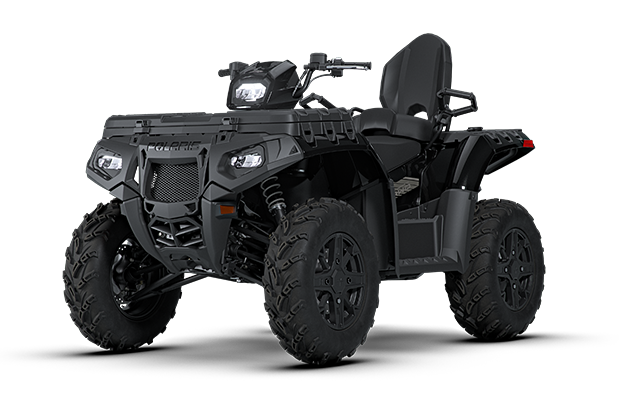
The 2027 Polaris Sportsman Touring 850 Premium sits in a useful gap between mid-size two-up ATVs and the more expensive 1,000-class machines. It brings a genuine two-person chassis, a 78-hp twin, 1,500 lb of towing, and a narrow 48.2-inch stance for $13,799 plus destination. For riders who want strong acceleration and passenger comfort without moving to a side-by-side, the formula is easy to understand.
The “Premium” badge needs a little more explanation. This ATV includes multi-select power steering, LED lighting, Engine Braking System, Active Descent Control, aluminum wheels, and painted bodywork. It does not include a winch, touchscreen, connected services, electronic Ride Control, speed limiting, or Polaris’s PIN-based P.A.S.S. security. Premium here describes its place in the Touring range, not an everything-included specification.
Polaris does not present the 2027 model as a redesign. Its 850cc engine, 78-hp rating, chassis dimensions, suspension travel, rack capacity, towing rating, and core equipment match the published 2026 machine. MSRP also remains $13,799. The published destination charge, however, rises from $595 for 2026 to $700 for 2027. That makes this a mature carryover choice rather than a reason for a recent owner to trade on model year alone.
Price and exact 2027 configuration
ATVPedia’s entry covers the Onyx Black Sportsman Touring 850 Premium shown on Polaris’s U.S. site. The $13,799 MSRP plus $700 destination produces a manufacturer subtotal of $14,499. Dealer setup, tax, title, registration, accessories, financing, and local charges are separate.
Standard equipment includes the passenger seat system, selectable On-Demand AWD and 2WD, EBS, ADC, multi-select electronic power steering, LED pod and bumper headlights, dual LED brake lights and taillights, 14-inch aluminum wheels, a 12-volt outlet, an all-digital gauge, and six gallons of combined sealed storage.
There is only one current trim and one displayed color, which makes online configuration unusually simple. The complexity moves to accessories. A buyer who wants a winch, bumpers, windshield, heated controls, cargo boxes, or navigation should compare installed prices rather than treating MSRP as the complete cost.
The one-year factory limited warranty is consistent with other current Sportsman models. The written warranty supplied with the purchased machine governs the actual coverage and start date.
850cc twin and 78 horsepower
The engine is a liquid-cooled ProStar four-stroke parallel-twin with single overhead cams and electronic fuel injection. Polaris pairs it with an automatic PVT using park, reverse, neutral, low, and high ranges. A 400 CCA battery supports starting and the standard electrical equipment.
Seventy-eight horsepower is the Touring 850’s central advantage. The 2027 Sportsman Touring 600 makes 44 hp, so the 850 adds 34 hp without adding size or dry weight. Polaris lists the 850 at 860 lb dry, 72 lb lighter than the Touring 600 in ATVPedia’s current records despite its larger twin-cylinder engine.
That power-to-weight difference should be felt most when accelerating, climbing, carrying two adults, or asking the ATV to regain speed after a slow corner. It also provides more reserve before the engine feels burdened by passenger and cargo weight. The 850 is still a utility-touring ATV, not a long-travel sport machine; engine output does not change its rack limits, payload rating, or passenger responsibilities.
Low range belongs to steep, slow, heavily loaded, or repeated pulling work. High range suits normal trail travel. A CVT is simple to operate, but range choice matters to belt temperature and control. The owner’s manual should decide the operating procedure rather than the assumption that 78 hp can compensate for using the wrong range.
The 5.25-gallon fuel tank is adequate but not class-leading. It holds 1.5 gallons less than the Touring 600’s 6.75-gallon tank and substantially less than some large touring rivals. Actual range depends on passenger load, speed, surface, elevation, temperature, and throttle use. The twin’s extra power is useful, but repeated use of it is not free at the fuel pump.
Factory two-up design, not an accessory seat
The Touring 850 is rated for two occupants. Its 57-inch wheelbase, bolstered passenger seat, ergonomic backrest, integrated hand grips, dedicated foot positions, and suspension are designed around carrying someone behind the driver. That distinguishes it from a one-person ATV fitted with a rack-mounted cushion.
The passenger position is raised, giving the second rider a view forward and placing their mass high on the chassis. With two aboard, steering response, braking distance, climbing behavior, and side-slope stability all change. A driver experienced only with solo riding should learn those differences on easy ground at low speed before taking a passenger into technical terrain.
Both riders need appropriate protective equipment. The passenger must be able to keep hands on the grips, feet in the intended locations, and move with the ATV. The owner’s manual controls passenger fit, operating restrictions, tire pressures, and riding technique.
The rear seat occupies space that a one-up Sportsman uses for its rear cargo area. Polaris still provides a 240-lb rear rack, but this is a touring arrangement rather than a dumping body or open platform. Buyers who need to carry a passenger and bulky material on every trip should compare the Sportsman 6x6 600 or a utility side-by-side.
Suspension and ride-focused chassis
Straight dual A-arms provide nine inches of front travel. The independent rear suspension also uses straight dual A-arms and supplies 10.25 inches of travel. Ground clearance is 11.25 inches.
Those numbers support the Touring name. More rear than front travel helps the back of the machine manage passenger weight and repeated trail impacts. Independent rear suspension allows each tire to follow the surface more independently than a solid rear axle and avoids transferring every bump directly across the chassis.
Suspension travel is not the same as payload capacity. Spring and damper behavior changes as the ATV approaches its load limit, and an impact that feels ordinary when ridden solo can use travel quickly with two people and cargo aboard. Preload, if owner-adjustable under the manual’s procedure, tire pressure, load placement, and speed all influence the ride.
The Touring 850 uses 26x8-14 front and 26x10-14 rear CST tires on aluminum wheels. This is a moderate factory size that preserves steering effort, effective gearing, clearance, and driveline load. Larger aftermarket tires may add underbody clearance, but they also add rotating mass and change gearing, braking, belt load, and suspension response.
At 860 lb dry and 906 lb curb, this is still a substantial ATV. The suspension can smooth trail chatter, but no shock package can remove the momentum of a loaded 900-plus-pound machine. Line choice and speed remain the most important ride-quality settings.
Dimensions and 50-inch trail questions
The Touring 850 measures 84.3 inches long, 48.2 inches wide, and 48.8 inches high. Wheelbase is 57 inches and seat height is 35.75 inches. Compared with most side-by-sides, it is narrow and short; compared with a one-seat ATV, its extra wheelbase and passenger structure are obvious.
A 48.2-inch published width leaves theoretical room inside a 50-inch opening. That does not automatically make the machine legal on every “50-inch trail.” Land managers may define vehicle classes, maximum width, passenger use, weight, tire width, or measurement methods differently. Gates can also be narrower than the number on a map. Check current rules for the specific route.
The 57-inch wheelbase improves passenger room and straight-line stability but creates a wider turning arc than a short single-seat ATV. It also changes breakover geometry: a sharp crest that passes beneath a compact machine may contact the middle of a longer one even when published ground clearance looks similar.
The narrow body helps between trees and on old access tracks, but two-up width is only part of the packaging question. Handlebars, mirrors, cargo, and the passenger’s body need clearance too. An accessory that extends beyond the ATV’s listed width can become the first thing to meet a gatepost.
AWD, EBS, and Active Descent Control
One-touch On-Demand AWD lets the rider select two-wheel drive or an automatic all-wheel-drive mode. In AWD, the system detects rear slip and brings the front wheels into the job. It is designed to provide traction without requiring the rider to operate a manual front differential lock.
Two-wheel drive is appropriate on firm surfaces where front assistance is unnecessary. AWD should be selected before entering loose, wet, snowy, or steep ground rather than after momentum is gone. The system can distribute drive, but it cannot create tire grip where the surface offers none.
Engine Braking System keeps driveline deceleration available when the throttle closes. Active Descent Control works with the driveline and braking behavior to help manage downhill speed. Both are particularly useful on a two-up ATV because passenger and cargo weight add momentum and can make abrupt brake inputs more unsettling.
Neither feature replaces the service brakes, low range, safe loading, or a deliberate line. Descending a wet hill with 575 lb of payload is a different task from rolling down the same grade alone. Tires, surface, trailer behavior, and weight distribution still set the limit.
Polaris lists a single-lever three-wheel hydraulic-disc braking system plus a hydraulic rear foot brake. That wording can surprise shoppers expecting four hydraulic discs. It should be evaluated as the manufacturer’s stated arrangement rather than rewritten into a more familiar specification.
Rack capacity, storage, and payload math
The steel-reinforced racks carry 120 lb at the front and 240 lb at the rear, for 360 lb combined. Six movable Lock & Ride tie-down points help adapt the racks to different loads. The vehicle also provides four gallons of dry storage at the front and two gallons at the rear.
Six gallons of sealed space is useful for straps, gloves, a compact tool kit, first-aid supplies, and items that should stay out of dust or rain. It is not a substitute for a large cargo box. Soft bags or accessory boxes may be needed for bulky trail gear, and their mass counts toward rack and vehicle limits.
Total payload is 575 lb. Payload includes driver, passenger, cargo, installed accessories, and trailer tongue weight. If the racks are loaded to their combined 360-lb maximum, only 215 lb remains for both occupants and everything else. In practice, two adults will usually prevent simultaneous use of maximum rack capacity.
The reverse arithmetic is more useful. Subtract the actual weight of both riders, protective gear, permanent accessories, and hitch load from 575 lb. What remains is the realistic cargo allowance, subject to the separate 120- and 240-lb rack limits. The published numbers overlap; they are not separate allowances that can all be added together.
Load position matters even below the rating. A dense object high on the rear rack changes steering and side-slope behavior more than the same weight carried low and centered. Secure every load against fore-aft and side-to-side movement, and do not let cargo interfere with the passenger, lighting, exhaust, steering, or brakes.
Towing capacity and receiver size
Polaris rates the Touring 850 to tow 1,500 lb through a standard 1.25-inch receiver. That is a strong ATV rating and suits utility trailers, small implements, and property work at controlled speeds.
The receiver opening does not determine what is safe to pull. The ATV’s rating, approved hitch hardware, tongue weight, trailer balance, terrain, braking, tire condition, and local rules all matter. Tongue weight also consumes the 575-lb payload, which can become restrictive with two riders aboard.
A maximum trailer on level, firm ground is not the same job as that trailer on wet grass, a cross-slope, or a long descent. The 78-hp engine may make a load easy to start, but starting it is only one part of towing. Directional control and stopping distance deserve more attention than acceleration.
The Touring 600 is rated to tow 1,350 lb, so the 850 adds only 150 lb despite its 34-hp advantage. That difference is a good reminder that tow ratings depend on chassis, hitch, cooling, braking, and stability rather than engine output alone.
What “Premium” includes—and what it leaves out
The standard multi-select EPS is one of the most useful premium features. Adjustable assistance can reduce effort during slow, loaded maneuvering while preserving more steering feedback at trail speed. Power steering reduces fatigue; it does not add front-tire grip or make a top-heavy load stable.
LED pod and bumper headlights improve illumination, and the pod light turns with the handlebars. Dual LED brake lights and taillights help the rear of the machine remain visible. A 12-volt outlet supports common accessories, and the digital gauge reports speed, rpm, gear, fuel, AWD status, voltage, coolant temperature, hours, odometer, trip information, and time.
There is no factory winch. That omission stands out because the $11,499 Touring 600 Premium includes a 3,500-lb synthetic-rope winch. The Touring 850’s front structure is accessory-ready, but adding the comparable part and installation widens its real transaction price.
There is also no touchscreen, connected-vehicle service, Ride Control, speed limiting, or P.A.S.S. security. Accessory display options are available, but buyers should not infer them from the Premium name. The standard electronics focus on steering, lighting, driveline control, and basic instrumentation.
Touring 850 Premium versus Touring 600 Premium
The Touring 600 is the most important in-house comparison. It costs $11,499, which is $2,300 less than the 850. Both are factory two-person Sportsman ATVs with On-Demand AWD, EBS, ADC, multi-select EPS, LED lighting, automatic PVTs, aluminum wheels, and a one-year limited warranty.
The 850’s argument is performance. Its 78-hp twin produces 34 hp more, it is 72 lb lighter in the published dry figures, and it tows 1,500 rather than 1,350 lb. The 850 also carries 360 lb across its racks versus 270 lb on the 600.
The 600 counters with more practical standard equipment. It includes a 3,500-lb winch, 11 gallons of combined storage, and a 6.75-gallon fuel tank. Its 567cc single will not match the 850’s acceleration, particularly with two people, but it may be the more complete trail-and-work purchase once a winch and storage are priced into the larger machine.
Choose the 600 if value, range, storage, and recovery equipment matter more than outright power. Choose the 850 if strong two-up performance and a lighter chassis justify the premium.
Touring 850 Premium versus CFMOTO CForce 1000 Touring
The 2026 CFMOTO CForce 1000 Touring costs $10,499 in ATVPedia’s current record. It makes 84 hp from a 963cc V-twin, tows 1,800 lb, has a 3,500-lb winch, adjustable piggyback shocks, ride modes, adjustable EPS, downhill assist, and a seven-inch TFT display.
On equipment and price, the CFMOTO applies uncomfortable pressure. It costs $3,300 less, makes six more horsepower, and includes several features missing from the Polaris. Its 50-inch width is 1.8 inches greater, its 975-lb dry weight is 115 lb heavier, and its 58-inch wheelbase is one inch longer.
The Polaris response is a narrower, lighter package with straightforward controls and the specific value of the local dealer and parts network available to the buyer. Those local factors should be checked, not assumed. Warranty terms, service access, delivered price, accessory availability, resale expectations, and the quality of the actual dealership can matter more over several years than a showroom feature count.
Touring 850 Premium versus Sportsman 6x6 600
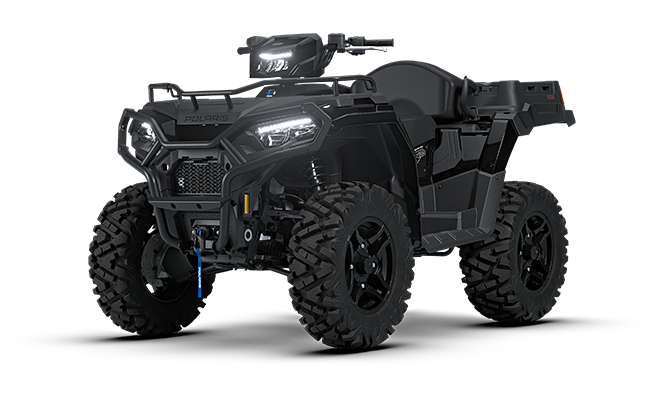
The Sportsman 6x6 600 costs $14,999, only $1,200 more than the Touring 850. It makes 44 hp rather than 78, weighs 1,194 lb dry, stretches 119 inches long, and uses an 86.5-inch wheelbase. It is a work transporter, not simply another touring trim.
The 6x6 provides on-demand drive to all six wheels, an 800-lb dumping box, 1,115 lb of payload, a 3,500-lb winch, a two-inch receiver, and a separate stationary passenger seat. It can carry a passenger and use its box on the same trip, subject to payload.
The Touring 850 is 334 lb lighter, 34.7 inches shorter, 1.4 inches narrower, and much more powerful. It should be the better fit for recreational two-up trails, quicker response, easier transport, and tight turning. The 6x6 makes sense when cargo, soft-ground traction, and simultaneous passenger-and-box use define the job.
Transport, maintenance, and ownership
The 860-lb dry weight is only the beginning of a trailer calculation. Polaris lists 906 lb curb. Add accessories, fuel beyond the published assumption, mud, tools, riding gear, and cargo before comparing the total with trailer payload and tow-vehicle limits.
At 84.3 by 48.2 inches, the ATV fits many utility trailers more easily than a side-by-side. Measure the narrowest point at the gate or rails, not just the deck. Ramp capacity, breakover at the ramp hinge, tire placement, tongue weight, axle rating, trailer tires, and tie-down geometry all need margin.
Routine ownership includes engine oil, filtration, cooling, CVT intake and belt inspection, driveline fluids, brakes, tires, suspension, battery, and steering. Dust, water, mud, towing, repeated low-speed load, and long idle time can move a machine into severe-service maintenance. The owner’s manual is the schedule, even when marketing language emphasizes long intervals.
Two-up use adds a simple pre-ride question: does the remaining payload cover the passenger and everything being carried? Tire pressure, rack security, passenger grips, foot positions, brakes, and suspension condition deserve inspection before every loaded ride.
Who should buy the 2027 Touring 850 Premium?
The strongest buyer regularly carries a passenger, wants substantially more performance than a mid-size single provides, and still needs access to ATV-width trails. It suits couples, hunting partners, landowners, and recreational riders who prefer a straddle-seat machine to a side-by-side and who value EBS, ADC, EPS, and a long-travel rear suspension.
It is a weaker choice for solo riders, buyers who need a dump box, or anyone expecting a premium trim to include a winch and modern display. A one-seat Sportsman 850 is cheaper and more compact. The Touring 600 is better equipped for recovery and sealed storage. A 6x6 or UTV handles serious cargo more naturally.
The model also makes little sense as a model-year upgrade for an owner of a comparable 2026 machine. Polaris’s published core specifications and MSRP carry over. The meaningful purchase comparison is condition and delivered price, not the calendar number on the title.
Verdict
The 2027 Polaris Sportsman Touring 850 Premium is a focused two-up ATV with an excellent core specification: 78 hp, a true passenger chassis, 48.2-inch width, 10.25 inches of rear travel, On-Demand AWD, EBS, ADC, multi-select EPS, 360 lb of rack capacity, and 1,500 lb of towing.
Its strengths are power, manageable dimensions, and passenger-ready trail hardware. Its weaknesses are a modest 575-lb payload, a 5.25-gallon tank, and a Premium equipment list that omits a winch, touchscreen, connected services, and Polaris’s newer work-control electronics.
At $13,799 plus $700 destination, it is not the value leader. The Touring 600 costs less and includes more utility equipment, while the CForce 1000 Touring offers more power and features for less money. The Polaris earns consideration by being lighter and narrower than the CFMOTO and far more agile than a six-wheel cargo machine.
Buy it when the job is carrying two people quickly and comfortably along narrow trails—not hauling the largest load or collecting the longest feature list. Judged on that specific role, the Touring 850 Premium remains a strong and unusually tidy package.