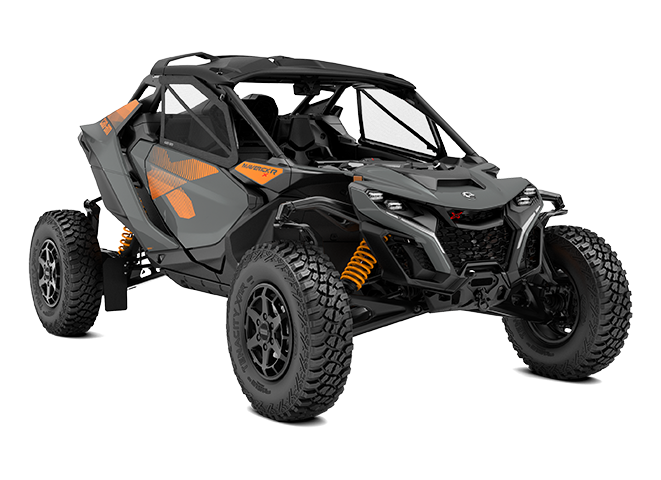
The 2027 Can-Am Maverick R X is the least expensive route into Can-Am’s 240 hp, dual-clutch flagship, but “entry” needs some perspective. At $39,699 before transportation, preparation, taxes and accessories, this is a 78-inch-wide, 2,372 lb two-seat sport UTV with a turbocharged triple, a seven-speed DCT, launch control, Smart-Lok front-drive control and 25 inches of travel at both ends.
That makes the R X a far more deliberate buy than a normal recreational side-by-side. It is too wide for most restricted trail systems, too powerful for a casual first UTV and expensive enough that a realistic budget must include a suitable trailer, safety gear, insurance and recovery equipment. But it is also the honest way into the Maverick R platform: it retains the engine, transmission, chassis, 32-inch tires, roof, doors, camera and screen that define the vehicle, without asking the buyer to pay for the X rs’s more elaborate suspension or the rock-specific X rc package.
For desert, dune and open-terrain riders who want a DCT instead of a belt CVT, that is a compelling specification. For everyone else, its width and purchase price should end the conversation before the horsepower number starts it.
What is new for 2027
Can-Am’s 2027 Maverick R range continues with the same core proposition: 240 hp from the 999cc Rotax 999T turbo triple, a seven-speed dual-clutch transmission with an extra-low range, and a 77-inch-class high-travel chassis. The R X starts at $39,699, $200 above the $39,499 starting price Can-Am listed for the 2026 model family. The manufacturer’s 2027 materials do not describe a ground-up R X redesign, so shoppers should compare actual equipment and dealer pricing against remaining 2026 inventory rather than assume the year alone changes the mechanical package.
The trim structure matters more than the calendar. The R X uses FOX 2.5 PODIUM piggyback shocks with QS3 compression adjustment, 16-inch flow-formed wheels and a rear camera. The $44,199 R X rs moves to FOX 3.0 PODIUM RC2 hardware, beadlock wheels and front-and-rear cameras; Smart-Shox is available on selected packages. The $48,199 X rc is the rock-focused model, with 35-inch tires, rock mode and audio equipment. Those are different uses, not a simple ladder where every buyer should want the highest sticker price.
Engine and DCT: why the Maverick R feels different on paper
At the center of the R X is Can-Am’s liquid-cooled, EFI-fed 999cc Rotax 999T turbo triple. It is rated at 240 hp and uses an integrated intercooler, high-performance air filter and launch control. That output puts the Maverick R firmly in the top tier of production sport UTVs. It deserves the kind of measured throttle discipline, helmet use, harness use and progressive learning that are easy to ignore when a machine is marketed with a launch-control feature.
The transmission is the more unusual part of the package. Instead of a continuously variable belt transmission, the R X uses a seven-speed Rotax dual-clutch transmission with high and extra-low ranges. A DCT can change gears without the elastic feel of a CVT and, in the right terrain, lets the driver select a ratio more directly. Can-Am says shifts occur in 0.2 seconds without interrupting torque at the wheels. The practical benefit is not merely a headline number: a positive gear choice can be useful when the surface, grade or approach speed needs more consistency than a variable belt drive normally provides.
There is no reason to pretend a DCT makes the Maverick R maintenance-free or simple. It is sophisticated hardware in a high-output off-road vehicle. Prospective owners should ask the dealer about scheduled service, fluid requirements and diagnostic coverage, then plan for the cost and time of looking after it. The enthusiast appeal is real, but so is the difference between owning a 240 hp DCT machine and a simpler CVT trail UTV.
Smart-Lok, size and suspension: built for open ground
The R X has a lockable Smart-Lok front differential with four listed drive configurations: 2WD, 4WD with the front differential locked, 4WD Trail Activ and 4WD Trail. These give the driver a useful range from rear-drive playfulness to more deliberate front-end traction. The setting should be chosen before the obstacle and matched to the ground; locking every available function is not a substitute for line choice, tire pressure or restraint.
Its 78.1-inch width, 142-inch length and 110-inch wheelbase make the intended landscape clear. This is a wide-open desert and dune machine, not a forest trail side-by-side. It will not fit 50-, 60- or 64-inch routes, and even on unrestricted land it needs a thoughtful plan for gates, loading ramps, garage space and tight turns. The 17-inch ground clearance and 32-inch tires help it move through rough terrain, but the vehicle’s size and mass remain with the driver on every off-camber corner.
Suspension travel is 25 inches front and rear. Up front, forged-aluminum heavy-duty tall-knuckle double A-arms work with a sway bar and FOX 2.5 PODIUM QS3 piggyback shocks. The rear uses four-link trailing arms, forged-aluminum heavy-duty tall knuckles and FOX 2.5 QS3 piggyback shocks with bottom-out control. QS3 adjustment gives the owner a usable way to tailor compression damping for terrain and load, but it is not an electronic semi-active system. The R X rs and selected Smart-Shox-equipped packages are the relevant alternatives for riders who specifically want more advanced or more adjustable suspension hardware.
The 32-inch ITP XNR Tenacity tires on 16-inch flow-formed aluminum wheels are appropriate for the R X’s intended U.S. use. They provide more ground clearance and obstacle ability than a conventional 29- or 30-inch sport tire, but replacements will cost more and the large footprint is another reason the vehicle is not a fit for every trail network. Bring a real puncture and recovery plan; 240 hp does not help with a damaged tire far from the trailer.
Standard equipment: enough to ride, not every premium option
Can-Am did not strip the R X just because it is the lowest-priced Maverick R. It comes with a full hard roof, premium half doors, window nets, a full plastic skid plate, rock guard, front and rear anchors, premium LED headlights and the Can-Am LED signature. It also gets a 4-point harness with shoulder pads, a 4.5-inch display with keypad, a 10.25-inch touchscreen, rear camera, telescopic steering wheel with infotainment controls and a 1,700-watt magneto.
That is important because the cost of retrofitting core items on a sport UTV mounts quickly. A roof, doors, camera and display are more useful as integrated equipment than a pile of accessories added after the sale. The 200 lb rear rack rating and 2.1 gallons of total storage offer enough space for the basics, but this is not a cargo vehicle. Pack tools and recovery gear carefully and keep mass low and secure.
There are also limits worth being clear about. The R X’s bumper is winch-ready, but a 4,500 lb winch is not installed. Smart-Shox is not standard. It does not have the R X rs’s 3.0-inch RC2 shocks or beadlock wheels, and it should not be presented as though it does. Those omissions are exactly why the R X can hold the line under $40,000. A buyer who will add a winch, beadlocks and electronic suspension immediately should price an upper trim against that plan before deciding the base R X is the economical choice.
2027 Can-Am Maverick R X specifications
| Specification |
Maverick R X |
| Engine |
999cc liquid-cooled turbocharged Rotax 999T triple with integrated intercooler |
| Output |
240 hp |
| Fuel system |
Intelligent Throttle Control with EFI |
| Launch control |
Standard |
| Transmission |
Seven-speed Rotax DCT with high and extra-low ranges |
| Drive system |
Smart-Lok front differential; 2WD / locked 4WD / 4WD Trail Activ / 4WD Trail |
| Power steering |
High-torque Gen 2 Tri-Mode DPS |
| Front suspension |
Forged-aluminum tall-knuckle double A-arm with sway bar; 25 in travel |
| Rear suspension |
Four-link trailing arm with forged-aluminum tall knuckle; 25 in travel |
| Shocks |
FOX 2.5 PODIUM piggyback QS3; rear bottom-out control |
| Tires |
ITP XNR Tenacity, 32 x 10-16 front and rear (North America) |
| Wheels |
16-inch flow-formed aluminum |
| Brakes |
265 mm front discs with triple-piston calipers; 255 mm rear discs with twin-piston calipers |
| Length x width x height |
142 x 78.1 x 71.5 in |
| Wheelbase |
110 in |
| Ground clearance |
17 in |
| Estimated dry weight |
2,372 lb |
| Fuel capacity |
13.2 gal |
| Rear rack capacity |
200 lb |
| Storage capacity |
2.1 gal total |
| Seats |
2 with 4-point harnesses |
| Winch |
4,500 lb winch-ready bumper; winch not installed |
| Base MSRP |
$39,699; transportation and preparation extra |
Maverick R X versus the right alternatives
The 2025 Can-Am Maverick R is the obvious comparison for a buyer considering discounted prior inventory. The existing ATVPedia model lists the same 240 hp engine, seven-speed DCT and 77-inch width, while the 2027 R X adds a precisely documented equipment package and starts $5,300 lower in the site’s data. A real dealer comparison still matters because installed accessories, warranty coverage and actual out-the-door pricing can overwhelm a model-year sticker. Compare the two Maverick Rs.
The 2027 Polaris RZR Pro R Boost Ultimate is the direct horsepower alternative. Polaris lists 275 hp, active DYNAMIX suspension, a 74-inch width and a $49,999 MSRP. The Maverick R X is less powerful and lacks active damping, but its DCT, extra-low range and $10,300 lower entry price make it a distinct choice rather than a lesser copy. Compare the Maverick R X and Pro R Boost.
The 2025 Polaris RZR Pro R is another useful reality check. Its naturally aspirated 2.0-liter four-cylinder is listed at 225 hp and the vehicle is narrower at 74 inches, with a much lower price in the current data. The Can-Am offers a more powerful turbo triple and DCT; the Polaris may be the better value for a rider who wants big-travel capability without committing to the R’s price, width and transmission complexity. See the Pro R and Maverick R X comparison.
Within Can-Am, the 2025 Maverick X3 X rs Turbo RR remains relevant for riders attracted to the brand but not ready to pay for the R. It is a CVT machine and uses older-generation architecture, but it costs less in the site’s current data and its 200 hp output is still substantial. Choose the R X for its DCT, extra-low range and newer heavy-duty platform; choose an X3 only when the price difference leaves room for the riding budget that follows the purchase. Compare the Maverick R X and X3 X rs.
Price and buying advice
The $39,699 MSRP is only the beginning. Ask for a written out-the-door figure that separates transportation, preparation, registration, financing and optional equipment. Factor in a trailer that can carry a 142-inch-long, 2,372 lb machine, secure tie-downs, a spare-tire strategy, a fire extinguisher, communications and a recovery setup. The R X has no installed winch, which is an especially important item to price honestly for remote riding.
Buy the Maverick R X if you ride open terrain often enough to use its width, travel, DCT and 240 hp. It makes sense for a driver who prefers manually choosing gears and will value the base R’s integrated roof, doors, camera and Smart-Lok system. Move to the X rs only when its suspension, beadlocks and camera upgrades are actual needs; move to the X rc only when rock terrain and its 35-inch tire/rock-mode focus are part of the plan.
Skip the R X if access is limited to tight trail systems, if most riding is slow exploration with passengers or if a 240 hp vehicle would live permanently in its least aggressive mode. A narrower sport UTV, a trail machine or a more modest recreation model will be easier to transport, easier to insure and more enjoyable in the places where most owners really ride.
Verdict
The 2027 Can-Am Maverick R X earns its position as the sensible Maverick R. It preserves the pieces that make the platform unusual—the 240 hp turbo triple, seven-speed DCT, extra-low range, Smart-Lok and 25-inch chassis—while including a roof, doors, display and camera that buyers would otherwise add later.
It is not inexpensive and it is not remotely a universal trail UTV. But for a two-seat desert or dune rider who wants a DCT sport machine with enough standard equipment to start riding immediately, the R X is the version of the Maverick R that makes the most financial sense. Browse more Can-Am UTVs, explore the 2027 model-year hub, see sport UTVs, or add the R X to the comparison tool.