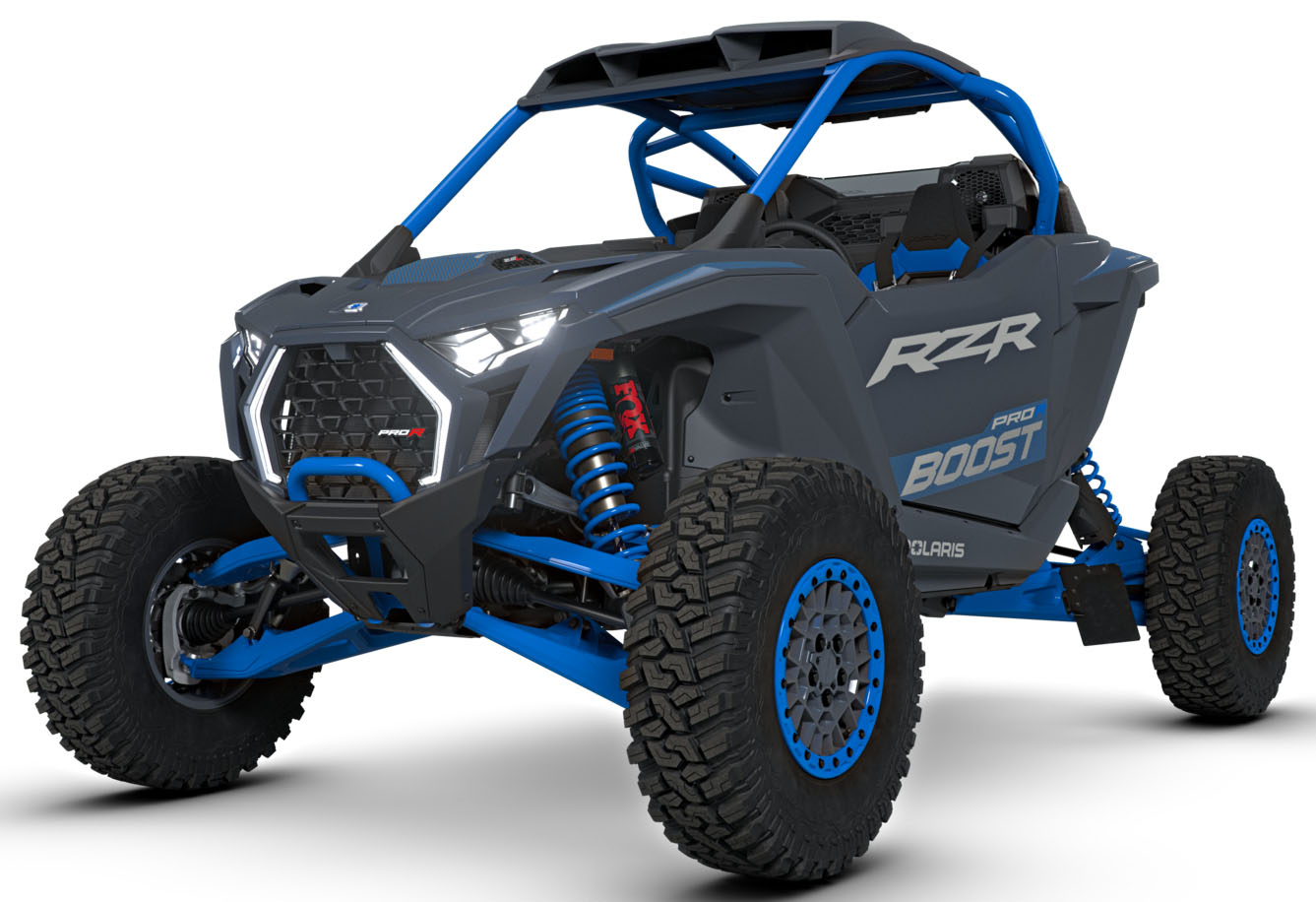
The 2027 Polaris RZR Pro R Boost Ultimate is not a routine horsepower bump. Polaris has built a 275 hp turbocharged flagship around the fact that extreme power exposes every weak link: belt heat, cooling capacity, front-drive durability, cab temperature and suspension control. The result is a $49,999, 74-inch-wide sport UTV whose new engine is only part of the story.
It also needs to be judged with some discipline. Polaris says deliveries start in November 2026, so this is a launch review based on manufacturer specifications rather than a long-term test. It is likely to be ferocious in dunes and open desert. It is also 2,531 lb dry, two-seat only, has no tow rating and costs at least $51,994 before tax or setup once its $1,995 destination charge is included. That is a very specific kind of recreation purchase.
What’s new for 2027
Everything important. The Pro R Boost is a new RZR, powered by a 1,997cc ProStar Fury 2.0 turbocharged inline-four rated at 275 hp. Polaris pairs it with a larger, higher-airflow clutch system, an updated transmission, a stronger front drive and reinforced half shafts. Those changes matter because a power claim means little if a machine loses belt life or consistency after a few hard miles.
Cooling is the other major rethink. A high-temperature radiator sits behind the cab for engine cooling, while a low-temperature radiator at the front looks after the turbo and transmission. A roof scoop feeds the rear radiator. Polaris also says the separation helps keep engine heat out of the footwells. That is a practical improvement for desert riders, not a styling exercise.
The Ultimate receives FOX 3.0 Live Valve X2 internal-bypass shocks controlled by DYNAMIX DV. Its 2027 calibration adds G-out protection and rear-bump control. The pricier Ultra version adds DYNAMIX DVS active sway-bar links; this review and ATVPedia listing cover the two-seat Ultimate, the $49,999 entry point to the Boost range.
Engine and driveline: the number is 275, but the hardware is the headline
The Boost’s 275 hp rating is 50 hp above the 2025 RZR Pro R in ATVPedia’s data and 35 hp above the 2025 Can-Am Maverick R. It also comes from a 2.0-liter four rather than a smaller turbo triple. In open country, that output should translate to much stronger acceleration and a greater ability to hold pace on long sand climbs, especially because Polaris says the turbo sustains peak power as high as 10,000 feet.
But the useful question is whether the new driveline can deliver it repeatedly. This is still an automatic PVT, not the seven-speed DCT used by Can-Am. Polaris addresses the expected concern with a high-capacity clutch, extra airflow and cooling fins, a transmission cooler and revised CVT calibration. Those are credible responses on paper; real belt temperatures and durability will need independent testing after the first customer machines accumulate hours.
The driver can choose true 2WD, 4WD or 4WD Lock. That last setting, plus the strengthened front drive and half shafts, should be valuable in deep sand, loose hill climbs and low-speed technical work. It does not make the Boost a beginner’s machine. With 275 hp available at the pedal, throttle judgment and good terrain reading are fundamental safety equipment.
Chassis, suspension and size: designed for speed, excluded from tight trails
At 74 inches wide and 136.5 inches long, the Pro R Boost belongs in the wide-open class. Its 104.5-inch wheelbase is 8.5 inches longer than the 2025 Pro R recorded in our database, while ground clearance remains 16 inches. The footprint and the suspension numbers tell the story: 22.25 inches of front wheel travel, 24.5 inches at the rear and 32-inch, 8-ply Pro Armor Trekker tires on beadlock wheels.
The Ultimate’s DYNAMIX DV system actively controls compression and rebound at each shock, with Comfort, Rock, Track and Baja suspension modes. That is a serious package, but it is not a magic switch. A 2,531 lb UTV carries a lot of energy through a g-out or a bad landing. The DYNAMIX tuning should expand the safety margin and make pace easier to manage; it cannot repeal the physics of a 275 hp, 74-inch sport machine.
The penalty is access. Many public trail systems have 50-, 60- or 64-inch restrictions. A Boost owner needs to verify local rules before ordering, then plan for a trailer, storage space and loading setup that suit a vehicle this large. Buy it for dunes, desert, wide open roads and private terrain—not because the spec sheet is exciting.
Cab, cooling and day-long usability
The bigger 14.7-gallon fuel tank is 3.2 gallons larger than the 2025 Pro R figure in the database, which is welcome when the engine has this much appetite. Polaris places the fuel pump for easier service access and gives the Ultimate a 150 lb cargo box. Neither makes this a utility side-by-side, but both reduce the number of compromises on a full desert day.
For the driver and passenger, the meaningful additions are the rear radiator, fresh-air intakes and 360-degree cab vents. The Ultimate also includes heated and ventilated seats, a color-matched aluminum roof with air scoop, half doors and high-assist EPS. There is no factory heat or air conditioning, so this is still an exposed sport cockpit; the goal is less radiated heat and better airflow, not a climate-controlled cabin.
Technology is lavish: a 10.4-inch RIDE COMMAND touchscreen with mapping, Group Ride, configurable gauges and rear camera support, plus a Rockford Fosgate Stage 4 system with a 10-inch subwoofer. Apple CarPlay is promised in a future software update, which means shoppers should not treat it as a delivered feature on day one.
2027 Polaris RZR Pro R Boost Ultimate specifications
| Specification |
Two-seat Ultimate |
| Engine |
1,997cc ProStar Fury 2.0, DOHC turbocharged inline-four |
| Output |
275 hp |
| Fuel system |
Electronic fuel injection |
| Transmission |
Automatic PVT; P/R/N/L/H |
| Drive system |
Race Performance true 2WD / 4WD / 4WD Lock |
| Cooling |
Rear-mounted liquid radiator; dual-radiator architecture |
| Front suspension |
Boxed dual A-arms; 22.25 in wheel travel |
| Rear suspension |
Boxed trailing arm with toe link; 24.5 in wheel travel |
| Shocks |
FOX 3.0 Live Valve X2 internal bypass with DYNAMIX DV |
| Tires |
32 x 10-15 Pro Armor Trekker, 8-ply |
| Wheels |
15-inch five-lug cast aluminum beadlocks |
| Brakes |
Four-wheel hydraulic discs |
| Length x width x height |
136.5 x 74 x 76.4 in |
| Wheelbase |
104.5 in |
| Ground clearance |
16 in |
| Estimated dry weight |
2,531 lb |
| Fuel capacity |
14.7 gal |
| Payload |
740 lb |
| Cargo box capacity |
150 lb |
| Towing |
Not rated |
| Seats |
2 |
| Base MSRP |
$49,999 plus $1,995 destination |
RZR Pro R Boost versus the obvious alternatives
The natural in-house comparison is the 2025 RZR Pro R. The older naturally aspirated four makes 225 hp and lists for $35,999 in ATVPedia’s data. The Boost asks $14,000 more before destination, but brings 50 more hp, turbo altitude compensation, a longer wheelbase, larger tank, new cooling architecture and a much more extensive standard equipment list. Compare the Pro R Boost and Pro R.
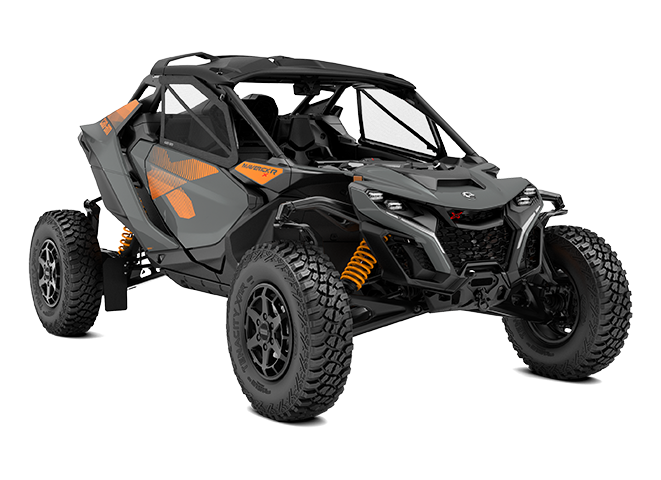
The Can-Am Maverick R is the sharper external rival. It makes 240 hp, uses a seven-speed DCT rather than a CVT and lists for $44,999. The Polaris has 35 more hp, is three inches narrower and costs $5,000 more. The Can-Am’s fixed-ratio transmission is the reason to test it; the Polaris’s extra output, active suspension and integrated cooling package are the reason to look hard at the Boost. See the head-to-head comparison.
For buyers who want a wide, boosted RZR without spending flagship money, the 2025 RZR Turbo R remains relevant in the database at $30,999 and 181 hp. It gives up 94 hp, the four-cylinder engine, 32-inch tires and the new cabin/cooling package, but saves $19,000 at MSRP. Compare the two wide-body RZRs.
Price, trim choice and ownership reality
The $49,999 Ultimate is not the all-in number. Add Polaris’s $1,995 destination charge and it starts at $51,994 before dealer setup, tax, registration, a trailer or safety gear. The Ultra trim is for shoppers who specifically want the active sway-bar links, carbon-fiber trim, MPI GT steering wheel and its exclusive tires and finish. It will not make a narrow trail wider or make a huge monthly payment smaller.
At this level, dealer quality and support matter. Ask about delivery timing, service capacity for the 2.0L turbo platform, warranty details, parts lead times and the cost of routine belt and tire replacement. A pre-delivery inspection and a dealer who understands high-performance RZRs are worth more than a few decorative accessories thrown into a deal.
Who should buy it
The RZR Pro R Boost Ultimate makes sense for experienced drivers who routinely ride dunes, desert or other unrestricted high-speed terrain and want the most powerful production RZR available. It is compelling when 275 hp, active suspension, better heat management and the longer-range fuel tank will genuinely be used.
Skip it if your local riding is width-limited, your priorities include utility work, or the $19,000 gap to a Turbo R would fund more riding, training and a good trailer. Buyers who prefer a geared drivetrain should test the Maverick R before committing. And because this model is new, cautious shoppers can reasonably wait for independent heat, belt-life and reliability testing.
Verdict
The 2027 Polaris RZR Pro R Boost Ultimate is a serious new benchmark on paper because Polaris has upgraded the systems around the engine rather than chasing a peak number alone. Its two-radiator layout, larger tank, strengthened driveline and DYNAMIX suspension are the right places to invest when output jumps to 275 hp.
The qualification is just as serious: it is expensive, wide, heavy and not yet independently proven. For an experienced desert rider with the terrain and budget, it looks like the RZR to beat. For almost everyone else, a less extreme RZR or Maverick will be easier to access, own and enjoy. Browse more Polaris UTVs, view the 2027 model-year hub, explore sport UTVs, or add this RZR to the comparison tool.