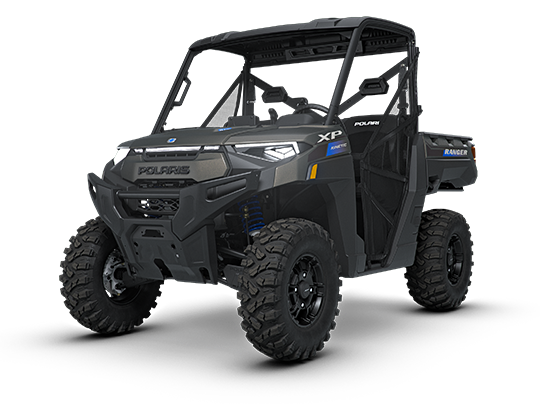
The 2027 Polaris Ranger XP Kinetic makes the strongest case for an electric UTV when it is treated as a work vehicle, not an environmental statement. Its useful numbers are 110 hp, 140 lb-ft of torque, a 1,250-lb cargo box, and a 2,500-lb tow rating. It seats three across, runs on 29-inch eight-ply tires, and gives the driver 14 inches of ground clearance. Nothing about that list asks an owner to accept reduced utility in exchange for a battery.
The compromise appears elsewhere. The only 2027 configuration currently listed by Polaris is the loaded Ultimate, priced at $37,499 plus a $1,195 destination charge. Its 29.8 kWh battery carries an estimated range of up to 80 miles, which can be plenty for a farm, estate, jobsite, hunting property, or a day built around a known loop. It is less reassuring when the route is remote, the weather is cold, a trailer stays attached, or there is no outlet where the machine sleeps.
That makes the buying question unusually clear. The Ranger XP Kinetic is not merely a Ranger without a fuel tank. It is a premium, quiet tool whose value depends on a repeatable duty cycle and convenient charging. Buyers who can describe where it will work, how far it normally travels, and where it will plug in are in a much better position than buyers attracted mainly by the horsepower figure.
What the 2027 Ranger XP Kinetic Ultimate includes
Polaris has simplified the U.S. range to one highly equipped three-seat trim. The 2027 Ranger XP Kinetic Ultimate starts at $37,499, with Heavy Metal and Polaris Pursuit Camo shown as the current color choices. Destination adds $1,195 before tax, registration, dealer setup, or accessories.
The standard equipment explains part of that price. A seven-inch RIDE COMMAND display supplies GPS navigation, trail mapping, Group Ride functions, and vehicle information. The package also includes a rear camera, JBL Trail Pro 2000 audio, and RIDE COMMAND+ connected services. LED headlights and a charge-indicating center accent light are standard. So are a roof, cab nets, a full-body skid plate, and a large front bumper with integrated winch and plow mounting provisions.
The word provisions deserves attention. The specification sheet does not list a winch as standard equipment. Buyers who need one should include the hardware, wiring, labor, and any related mounting parts in the delivered-price comparison. The same rule applies to a windshield, rear panel, heater, doors, and other cab pieces. The Kinetic Ultimate is well equipped electronically, but it is not a factory-enclosed NorthStar.
The cabin uses an adjustable contoured bench with room for three. Tilt steering, dual glove boxes, under-seat storage, cup holders, and USB charging make it a recognizable full-size Ranger workspace. The dimensions are also familiar: 120 inches long, 62.5 inches wide, 79.5 inches high, and 81 inches between the axles. In practical terms, the battery-electric model occupies the same sort of shed, trailer, and trail footprint as a Ranger XP 1000.
The interior permanent-magnet AC motor is rated at 110 hp and 140 lb-ft of peak torque. Those numbers matter, but the way the Kinetic delivers them matters more. An electric motor does not need to build revs through a conventional combustion cycle before producing useful torque. It can move a load from rest cleanly and answer the accelerator without the flare, belt engagement, and engine noise associated with a gasoline CVT utility machine.
That character should be particularly useful when backing a trailer, easing toward a hitch, crawling beside livestock, or starting on a grade with a loaded box. It does not eliminate the limits of traction. One hundred forty pound-feet cannot help if the tires are on ice, mud has filled the tread, or tongue weight has unbalanced the vehicle. The virtue is controllability: the powertrain can make small, immediate adjustments without asking the driver to hold a gasoline engine in a noisy part of its rev range.
Polaris provides Eco+, Standard, and Sport drive modes. Eco+ is the sensible choice when stretching a charge matters; Sport sharpens response when immediacy matters more. Standard is likely to be the everyday setting for most owners. The modes cannot create energy, so a driver who repeatedly asks for maximum acceleration will not see the same range as someone moving steadily around a property.
The transmission uses a Gates synchronous belt with high, low, neutral, and park ranges, plus electronic forward and reverse selection. This is not the consumable CVT drive belt used on a gasoline Ranger. Polaris specifically promotes the electric powertrain for having fewer scheduled service items: there are no engine-oil changes, spark plugs, fuel filters, or gasoline-engine clutch maintenance. Tires, brakes, suspension joints, cooling circuits, reduction-drive components, and chassis hardware still require inspection and service. “Low maintenance” does not mean “no maintenance.”
AWD, Turf Mode, and low-speed control
True On-Demand AWD sends drive to the front when rear-wheel slip calls for it. The selector also provides 2WD and VersaTrac Turf Mode. Turf Mode unlocks the rear differential so the inside tire can travel a shorter path in a turn, reducing scuffing on grass and improving maneuverability on firm ground. It is not intended to replace AWD in loose, steep, or slippery conditions.
This three-mode system suits the Kinetic’s likely working environments. Turf Mode is useful around lawns, paddocks, and landscaped property. Two-wheel drive is appropriate when traction is predictable. AWD is the answer when a muddy lane, snow, a climb, or a heavy pull requires all four tires. The drive selector does not absolve the operator from reading the terrain; engaging the appropriate mode before the machine is stuck remains the cheaper strategy.
The quiet powertrain changes how that work feels. Conversation at low speed should be easier, and the machine is less intrusive around horses, cattle, neighbors, or a hunting area. Tire noise, suspension movement, cargo rattle, wind, and the motor’s own sound do not disappear. “Quiet” is relative to an internal-combustion UTV, not literal silence. Pedestrians and animals may also receive less audible warning, putting more responsibility on the driver in shared spaces.
Battery, range, and what “up to 80 miles” means
The Ultimate’s lithium-ion battery has 29.8 kWh of nominal capacity. Polaris publishes an estimated range of up to 80 miles. That figure is useful for comparing configurations, but it is not a promise that every owner can leave at 100 percent, travel 40 miles into the backcountry, and return with a comfortable reserve.
Polaris explicitly says actual range varies with the external environment, weather, speed, cargo, acceleration, maintenance, and usage. Terrain belongs in the practical calculation too: soft soil, snow, repeated climbs, and low tire pressure all increase the energy required to cover a mile. Towing and a full box add work. Cold conditions can reduce available battery performance and increase cabin-accessory demand. A route with frequent descents may recover some energy, but regenerative braking should be treated as efficiency assistance rather than a substitute for charge planning.
An owner should build a range budget from the hardest normal day, not the easiest demonstration loop. Start by logging actual mileage or operating hours for the current work vehicle. Add the usual payload and trailer. Identify the point at which the vehicle cannot simply return to its charger. Then retain a reserve for detours, cold weather, battery aging, and unexpected work. If the routine day is 15 to 30 miles around a fixed property, an 80-mile estimate gives substantial room. If the normal ride is already near that estimate, the use case is asking for trouble.
Battery percentage is also more informative than a fuel gauge only after the operator learns the machine. Early in ownership, record starting charge, route, temperature, load, and ending charge. A few weeks of real data will reveal whether the Kinetic is comfortably oversized for the job or operating close to its limit.
Charging: the outlet matters as much as the vehicle
The Ultimate accepts both Level 1 and Level 2 charging. Level 1 uses a conventional 120-volt outlet and is the accessibility option: many barns, garages, shops, and equipment sheds already have one. Level 2 uses a suitable 240-volt supply and is the practical choice for faster, repeatable turnaround. Polaris lists a combined Level 1/Level 2 charging cord and says a zero-to-full charge can take as little as five hours as equipped.
“As little as” is important. Actual time depends on amperage, the electrical circuit, the charging equipment, temperature, and battery state of charge. A normal 120-volt receptacle cannot deliver energy at the same rate as a properly installed 240-volt circuit. Owners who expect to finish an evening shift and begin the next morning near full should have an electrician assess the parking location, panel capacity, cable route, receptacle, grounding, weather exposure, and local code before taking delivery.
The factory Ultimate uses a 6 kW onboard charger, and Polaris offers hardware to increase onboard capacity to 9 kW when paired with appropriate charging equipment. The vehicle only charges as quickly as the weakest part of the chain permits. Paying for a higher-capacity onboard charger achieves little if the building circuit or EV supply equipment cannot support it.
Charging where the vehicle already parks is the ideal pattern. That turns refueling into plugging in at the end of the day and can remove trips to a fuel station. Charging from a distant building, a long undersized extension cord, or a generator introduces inconvenience and potential safety problems. The Kinetic is strongest when the property and routine are ready for it.
Work capacity: box, payload, and towing
The cargo box is rated for 1,250 lb and uses gas assistance for dumping. Its published internal dimensions are 36.7 by 54.2 by 12.5 inches. Total payload is 1,500 lb, while the two-inch receiver carries a 2,500-lb tow rating.
Those numbers cannot all be stacked together without calculation. Payload includes the driver, passengers, cargo, accessories, and trailer tongue weight. Put three adults on the bench, mount a winch, add doors and a windshield, load tools under the seat, and part of the 1,500-lb allowance is already spoken for. A 1,250-lb box load leaves very little room for occupants or tongue weight. The owner’s manual and vehicle labels govern the actual load plan.
The tow rating also describes what the machine is allowed to pull, not what it can safely stop on every surface. A maximum trailer on wet grass or a steep descent can push a light off-road vehicle regardless of motor torque. Trailer brakes, load distribution, speed, grade, tire condition, and local rules remain relevant.
Where the Kinetic distinguishes itself is the combination of capacity and precise low-speed response. A 1,250-lb box is 250 lb stronger than the current base 2027 Polaris Ranger 1000, while both list 1,500 lb of payload and 2,500 lb of towing. Buyers hauling dense material will appreciate that extra box rating, provided they respect the overall payload ceiling.
Chassis, suspension, tires, and braking
The Kinetic weighs 1,982 lb dry. That is 495 lb heavier than ATVPedia’s 2027 Ranger 1000 base record, and the extra mass will be apparent when trailering, crossing soft ground, or recovering a stuck machine. It also sits low in the chassis, which can help the vehicle feel settled. Weight is neither automatically good nor bad; it changes how the machine loads its tires and how much momentum the brakes and suspension must manage.
Dual A-arm suspension supplies 10 inches of travel at both ends. Ground clearance is 14 inches. The 29x9-14 front and 29x11-14 rear Pro Armor X Terrain tires use eight-ply construction on 14-inch aluminum wheels. That is a credible work and trail package, with more clearance and tougher tires than the inexpensive end of the full-size UTV market.
The suspension is not a long-travel sport system. Ten inches is appropriate for ruts, fields, forest roads, jobsite debris, and ordinary trail obstacles when speeds match conditions. A 1,982-lb machine still asks a lot of its dampers and tires when driven quickly into repeated holes. The cargo rating should not be mistaken for permission to maintain unloaded speeds with the box full.
Four-wheel hydraulic disc brakes handle normal stopping, and regenerative braking can return some energy during deceleration. Regen response can vary with conditions and battery state, so the friction brakes remain essential. The park position is also operationally important: Polaris warns that the vehicle can roll whenever the selector is not in park.
Ranger XP Kinetic versus Ranger 1000
The 2027 Ranger 1000 is the clearest price reality check. Its base MSRP is $14,499, a full $23,000 below the Kinetic Ultimate before comparing destination or equipment. It makes 61 hp from a 999cc twin, weighs 1,487 lb dry, carries 1,000 lb in the box, and matches the Kinetic’s 1,500-lb payload and 2,500-lb tow ratings.
The comparison is not trim-for-trim. The base Ranger 1000 lacks the Kinetic Ultimate’s standard EPS, premium display, camera, audio, 29-inch tires, and connected features. Even after adding equipment, though, the gasoline model retains an enormous purchase-price advantage. Fuel and routine maintenance savings require many hours of work to close a five-figure gap, and electricity is not free.
The Kinetic responds with 49 more horsepower, far stronger immediate torque, a 250-lb advantage in box capacity, two inches more clearance, quiet operation, and no tailpipe exhaust. Its owner can begin each day with a full “tank” without transporting gasoline. The Ranger 1000 can refill in minutes almost anywhere and keep working far beyond an 80-mile estimated battery window. The right answer comes from the route and schedule, not from a universal verdict.
Ranger XP Kinetic versus other premium utility UTVs
The 2026 CFMOTO UForce U10 Pro starts at $17,499 in ATVPedia’s current record. It makes 88 hp, weighs 1,742 lb, carries 1,000 lb in its power-tilt bed, and matches the Kinetic’s 2,500-lb towing figure. It also includes a roof, 4,500-lb winch, eight-inch display, Apple CarPlay, and audio. The Kinetic costs $20,000 more, but offers electric quietness, 22 additional horsepower, 140 lb-ft of peak torque, and another 250 lb of box rating.
The 2025 Ranger XP 1000 NorthStar asks a different question. At $30,999 in the database, it pairs an 82 hp gasoline engine with a factory-enclosed cab, heat, and air conditioning. The Kinetic is $6,500 dearer before destination and remains an open-cab vehicle unless accessorized. For cold-weather plowing or all-season commercial use, a factory cab can be worth more than electric refinement. For indoor-adjacent work, livestock, hunting, or noise-sensitive property, the Kinetic’s powertrain may matter more.
The 2026 Can-Am Outlander Electric is not a direct rival—it is a one-rider ATV—but it shows how different electric formats serve different jobs. The Can-Am uses an 8.9 kWh battery and carries an estimated 50-mile range in our record. The Ranger’s 29.8 kWh battery, three-seat cab, dump box, and receiver make it a work-platform purchase rather than simply an electric way to ride.
Comfort, technology, and daily use
RIDE COMMAND is more than decoration when work spans a large property. Offline trail mapping can help establish routes, Group Ride supports coordinated recreation, and the rear camera improves visibility when backing toward a trailer or working around equipment. RIDE COMMAND+ adds remote vehicle-health, maintenance, and security information through the Polaris app, subject to service availability and subscription terms.
The JBL audio system is arguably less important in a quiet electric UTV because conversation and ambient sound are easier to hear, but it is part of the Ultimate package. More useful every day are the roof, USB port, storage, adjustable seating, and tilt wheel. The open sides and cab nets preserve easy entry but offer little weather protection. Owners should compare a complete cab build, not only a windshield price, if rain, snow, dust sealing, or winter heat matters.
Noise reduction makes short jobs less tiring and reduces the temptation to shut the machine down during every brief stop. Electric drive also avoids idling exhaust near barns, garages, or crews. It does not make enclosed operation automatically safe: battery charging and electrical equipment still require proper ventilation, clearances, and manufacturer instructions, and any accessory heater can introduce its own requirements.
Warranty and long-term ownership
Polaris advertises five-year battery coverage, described in its current footnote as the 12-month factory battery warranty plus an additional 48-month promotional warranty. Promotional terms can change and may carry conditions, so a buyer should obtain the written warranty applicable to the specific VIN and purchase date rather than relying on a headline.
The battery is the component most gasoline-UTV owners will be least familiar with. Ask the dealer how usable capacity, faults, charging history, and warranty eligibility are diagnosed. Confirm what the warranty considers normal degradation, whether coverage transfers to a second owner, and what transportation or labor costs are included. A sophisticated powertrain deserves equally clear after-sales support.
Routine service should be lighter than on a gasoline equivalent, but long-term economics remain site-specific. Electricity price, annual mileage, gasoline cost, dealer labor, financing, insurance, residual value, and accessory spending all belong in the calculation. A low-hour recreational owner is unlikely to recover the purchase premium through avoided oil changes. A commercial operator using the machine daily may care more about reduced downtime, predictable overnight charging, and worker comfort.
Who should buy the 2027 Ranger XP Kinetic?
The strongest buyer has a fixed home base, reliable electrical service, a normal day well inside the estimated range, and work that benefits from quiet, controllable torque. Farms, equestrian properties, campuses, resorts, parks, vineyards, large private estates, industrial sites, and hunting land can all fit that description. The Kinetic is also appealing when starting each morning charged is more convenient than storing and transporting gasoline.
It is a weak fit for riders who routinely cover unpredictable distances, camp far from electrical service, tow near maximum for hours, or need a quick refuel to start a second shift. It is also difficult to justify for buyers whose main priority is low purchase price. The Ranger 1000 and several well-equipped competitors perform the same basic cargo and towing jobs for dramatically less money.
The 2027 Ranger XP Kinetic is therefore neither a novelty nor an automatic upgrade. It is a very capable full-size utility UTV with a specific infrastructure requirement. When the work loop and charging plan fit, the combination of 110 hp, 140 lb-ft, a 1,250-lb box, quiet operation, and reduced routine powertrain service is genuinely persuasive. When they do not fit, no touchscreen or torque figure will compensate for waiting on a charge.
Verdict
Polaris has built the Ranger XP Kinetic around real Ranger duties. It tows 2,500 lb, carries 1,250 lb in the box, seats three, and delivers precise power without engine noise or exhaust. The Ultimate also avoids the stripped-base-model problem by including navigation, a rear camera, audio, connected services, a roof, tough tires, and useful protection.
Its limitations are equally real: $37,499 before destination, nearly a ton of dry weight, an open cab, no standard winch, and an 80-mile estimate that depends heavily on conditions. The five-hour charging claim assumes the right setup; a 120-volt outlet is convenient, not necessarily quick.
For an owner who can plug in where the vehicle parks and whose hardest day sits comfortably inside the range envelope, the Kinetic may be the most refined work Ranger available. For everyone else, a gasoline utility UTV remains the cheaper and more flexible tool. That is not a failure of the electric concept. It is the reason to match the machine to the job before signing the order.