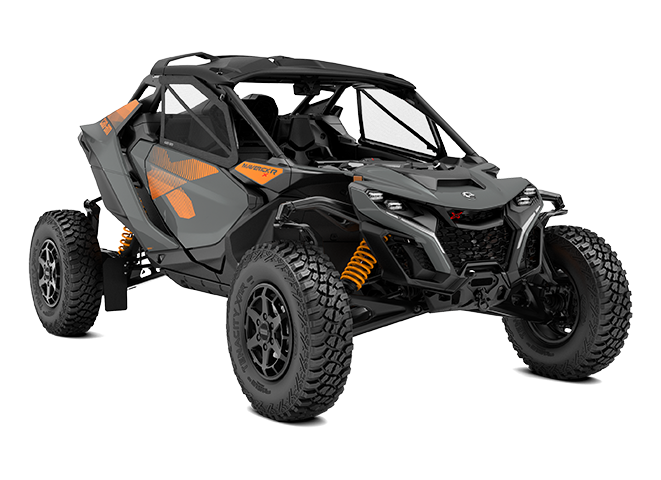
The 2025 Can-Am Maverick R is the brand’s statement piece: 240 turbocharged horsepower, a seven-speed dual-clutch transmission and 25 inches of suspension travel. It replaces the familiar CVT with fixed gears. It is also 77 inches wide and costs $44,999, so it only makes sense when the terrain, budget and driver can use what it offers. Our guide to reading ATV and UTV specs puts these extreme numbers in context.
The Maverick R uses a 999cc liquid-cooled Rotax inline-three with a turbocharger, producing about 240 hp. That is 40 hp more than the Maverick X3 X rs Turbo RR and 15 hp more than the Polaris RZR Pro R. The output exists for dunes, desert and fast open routes where sustained acceleration matters.
Power at this level demands respect. The Maverick weighs 2,050 lb, but 240 hp can overwhelm available traction and close distances quickly. It rewards drivers who understand how surface changes affect braking and grip.
Seven-speed DCT: the defining mechanical difference
Instead of an automatic CVT, Can-Am uses a seven-speed dual-clutch transmission. A DCT moves between fixed gears with automated clutches, so the engine and wheels remain connected through a geared driveline rather than a variable belt system. That gives the Maverick R a distinct mechanical character among high-output sport side-by-sides.
A seven-speed DCT is more complex than a simple CVT. Drivers need to decide whether they value the gear changes enough to pay the Maverick’s premium. For buyers avoiding CVT belts at extreme power, the transmission is a central reason to look here.
Chassis and suspension: 77 inches wide
The chassis is as specialized as the engine. It spans 77 inches, uses a 105-inch wheelbase and provides 15 inches of ground clearance. The dataset also lists 25 inches of travel. Those dimensions favor stability and suspension control across large bumps at speed.
Width is the unavoidable downside. The Maverick R is three inches wider than a Pro R and five inches wider than an X3 X rs. It cannot fit conventional 50-inch, 60-inch or 64-inch trail systems. Owners need open terrain, a wide trailer and enough storage space.
Pure sport purpose
The Maverick R seats two and has no tow rating. Its 12-gallon fuel tank supports recreation, but every major specification points toward speed. Buyers needing a cargo box, trailer capacity or extra seats should choose another platform.
That narrow mission is not a flaw for the right owner. It does make the Maverick R difficult to justify as an only side-by-side unless recreation is the only job.
Who it’s for
The Maverick R suits experienced dune and desert drivers who have open terrain, a substantial budget and a clear reason to want the DCT. It is for buyers who consider the transmission as important as the horsepower and want the current summit of Can-Am’s two-seat sport range.
It is wrong for narrow trails, utility work and casual family recreation. Its width can prevent access, while the price leaves room to buy a capable sport UTV plus other equipment. New drivers should build experience on something less extreme.
How it compares
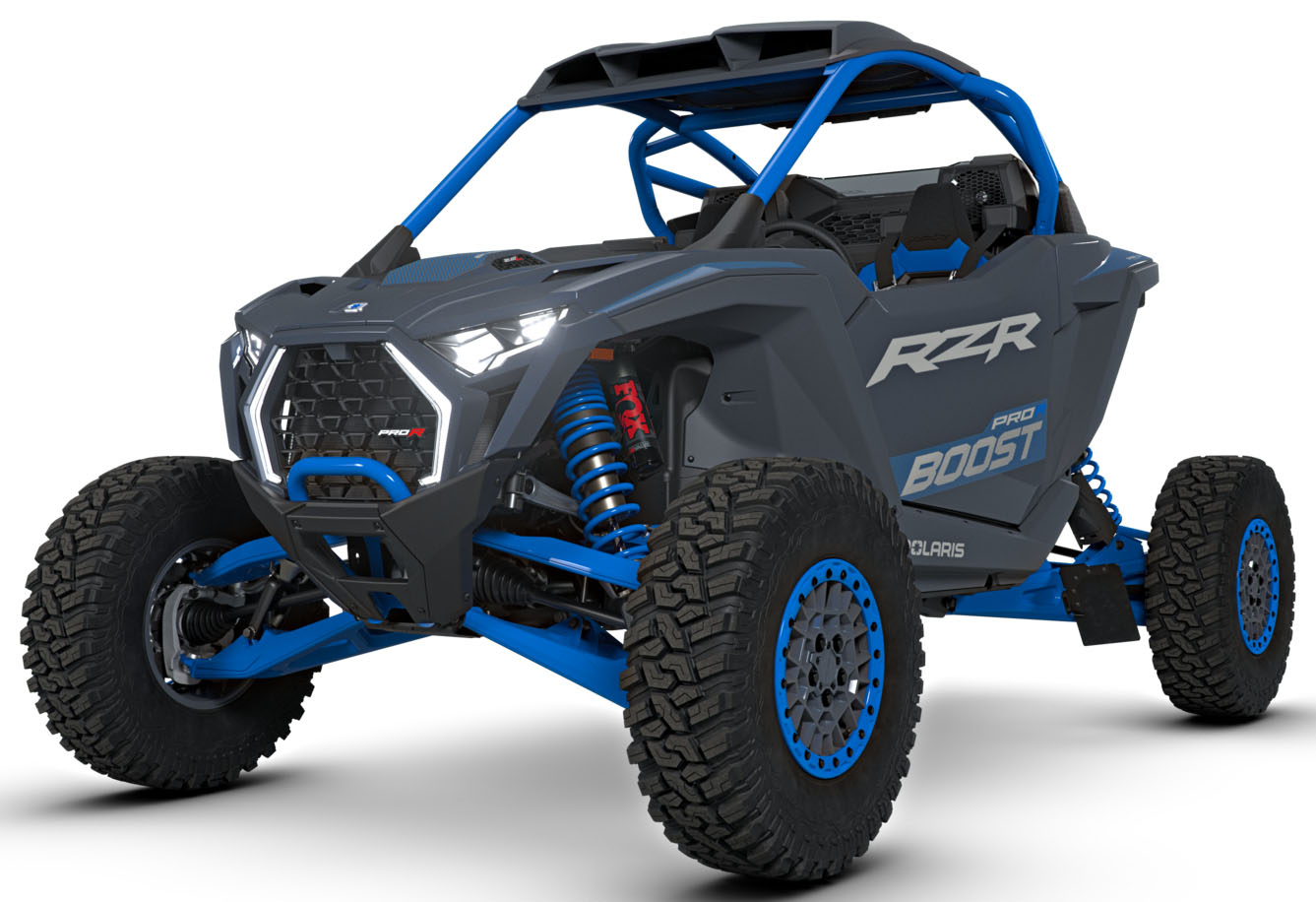
The Polaris RZR Pro R is the closest flagship rival. Its naturally aspirated 1,997cc four makes 225 hp and sends power through a CVT. At $35,999, it costs $9,000 less. The Polaris is three inches narrower and has one inch more clearance, while the Can-Am offers 15 more hp, the turbocharged character and the seven-speed DCT. Compare them directly.
The Maverick X3 X rs Turbo RR makes 200 hp and costs $32,499. It is 450 lb lighter, five inches narrower and uses a CVT, while matching the R’s 15 inches of clearance. The X3 gives up 40 hp and the geared transmission but saves $12,500. See the full comparison. The Polaris RZR Turbo R lowers the price to $30,999 with 181 hp and a 74-inch stance. It cannot match the Maverick’s output, but the $14,000 difference is difficult to ignore. Compare the two turbo machines.
Where it sits in the Can-Am lineup
The Maverick R sits above the X3 family. The Maverick X3 Turbo opens the turbo range at $22,899 with 120 hp. The X3 X rs Turbo RR brings 200 hp for $32,499, and the four-seat X3 MAX X rs Turbo RR costs $34,999. The Maverick R adds 240 hp and its DCT at $44,999. It is the flagship for buyers who want the highest output and newest driveline concept, not the value choice.
Price and value
At $44,999, the Maverick R is the most expensive model in ATVPedia’s 2025 Can-Am entries. The premium over an X3 X rs Turbo RR buys 40 hp, a seven-speed DCT, more suspension travel and the R platform. Whether that is good value depends on using those differences rather than simply wanting the largest number.
The RZR Pro R makes the decision harder by offering 225 hp for $9,000 less. The Maverick’s case rests on its geared transmission, turbo power and Can-Am chassis. Buyers who do not specifically want that combination can save a significant amount without leaving the flagship sport category.
Pros and cons
The good: 240 hp from a turbocharged Rotax triple, a distinctive seven-speed DCT, 25 inches of suspension travel, 15 inches of ground clearance and a chassis designed around high-speed open terrain.
The catch: a $44,999 price, 77-inch width, 2,050 lb weight and extreme performance that demands experience. It seats two, tows nothing and offers little value when the terrain cannot use its speed or width.
The verdict
The 2025 Can-Am Maverick R is one of the most specialized machines in the database. Its 240 hp and seven-speed DCT give it a character no CVT rival copies directly, while the wide chassis and 25 inches of travel support its open-terrain mission.
That focus makes the buying decision unusually simple. Choose it if you have the terrain, experience and desire for the DCT. Choose an X3, RZR Pro R or Turbo R if price, width or outright necessity matters more. The Maverick R is not the sensible default. It is the flagship for a driver who knows exactly why the alternatives are not enough.
Want to compare it with another sport UTV? Add it to the comparison tool, or browse the full database by power, width and price.