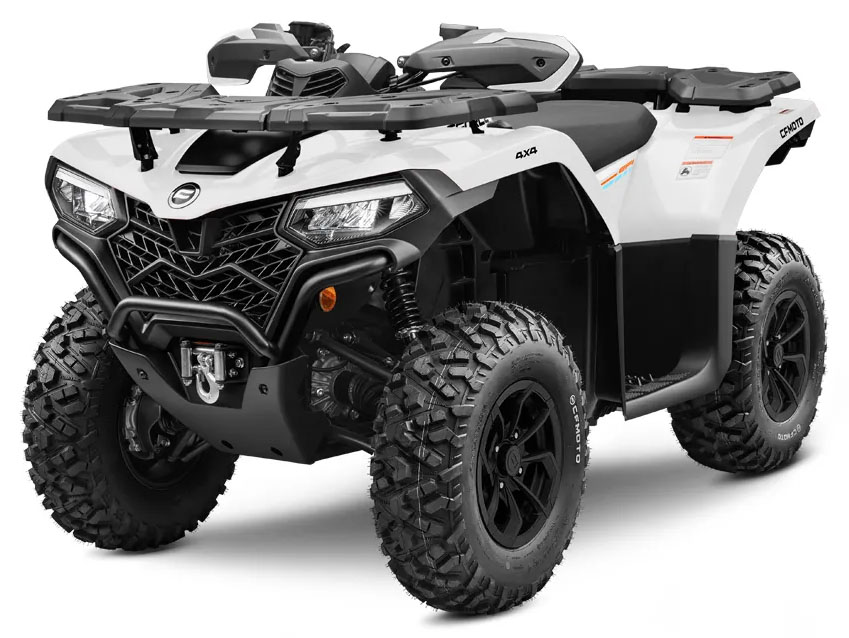
The 2026 CFMOTO CForce 500 is the rare middle child that makes a persuasive case for itself. It costs $6,499, produces 34 hp and measures only 44 inches wide, yet its standard-equipment list includes electronic power steering, selectable 4WD with a locking front differential, aluminum wheels, LED lighting and a 2,500 lb winch.
That combination matters more than the 500 badge. Plenty of mid-size utility ATVs can carry tools, pull a small trailer and explore easy trails. The CForce 500’s pitch is that the equipment most owners would add—or pay for through a higher trim—is already installed. It is compact without being stripped down.
There are limits. The single-cylinder engine is built for useful low- and mid-range response, not big-bore acceleration. A 4.5-gallon fuel tank is modest, the shocks offer only spring-preload adjustment, and CFMOTO’s 713 lb figure is dry weight rather than a ready-to-ride number. This is a practical ATV with a strong price-to-hardware ratio, not a premium machine hiding behind a low price.
A compact chassis with adult utility ratings
The CForce 500 is 80 inches long, 44 inches wide and 45 inches high. Its 50-inch wheelbase keeps the footprint short enough for wooded trails, compact storage and common utility trailers. The 10.3 inches of ground clearance is competitive for the class without depending on unusually tall tires.
Width is the standout dimension. At 44 inches, the CFMOTO is 3.8 inches narrower than the 2026 Suzuki KingQuad 500AXi and four inches narrower than the announced 2027 Polaris Sportsman 500. The 2026 Kawasaki Brute Force 450 is slightly narrower at 43.3 inches. Those differences are small on paper but noticeable when threading between trees, working around gates or sharing space on a trailer.
A narrow ATV also deserves measured handling on side slopes. Track width is only one part of stability, but reducing lateral distance between the tires does not create the planted feel of a wider chassis. Cargo placed high on a rack and an operator moving abruptly can make that more obvious. The right approach is smooth steering, sensible speed and thoughtful load placement—not treating a narrow footprint as free maneuverability.
CFMOTO lists a 713 lb dry weight. That does not include every operating fluid or accessory load, so it is not directly comparable with the curb weights Kawasaki and Suzuki publish. It does tell us that this is no featherweight. Owners should confirm ramp, trailer and rack ratings using the ATV’s actual ready-to-ride weight, not just the brochure number.
The 500cc single prioritizes usable response
The liquid-cooled 500cc engine is a fuel-injected, four-stroke single with a single overhead cam and four valves. CFMOTO rates it at 34 hp at 6,800 rpm and 29 lb-ft at 6,000 rpm. Bosch electronic fuel injection handles fueling.
Those figures put the CForce in the heart of the mid-size utility class. It has enough output for property chores, trail riding, hunting access and moderate towing, while remaining a meaningful step below the 44 hp CForce 600. Riders moving down from a high-output twin will notice the difference on long climbs and when accelerating with a trailer. Riders moving up from an older 300 or 400 should find the 500 much less strained.
The engine’s character is more relevant than peak horsepower. A utility ATV spends a great deal of time below maximum rpm: easing up to a trailer, crawling through a washout, crossing uneven ground or moving cargo without shifting it on the racks. The 29 lb-ft torque rating suggests useful middle-range pull, and the CVT keeps the engine in the part of its range that suits the load.
There are no selectable throttle maps. That keeps the controls simple, but it also means the operator’s thumb supplies the finesse that a dedicated work mode can provide on larger CFMOTO models. Buyers should use a test ride to check low-speed throttle pickup and CVT engagement rather than judging the powertrain by the horsepower figure alone.
CVTech CVT, low range and a real front lock
The CVTech automatic transmission provides park, reverse, neutral, high and low. Shaft drive carries power to the axles, and the drive selector offers 2WD, 4WD and locked 4WD.
That three-stage system is preferable to an ATV that offers only two-wheel and automatic four-wheel drive when the owner needs deliberate control. Two-wheel drive is appropriate for firm ground. Four-wheel drive adds traction without fully tying the front wheels together. The lock is reserved for the obstacle where both front tires must pull at the same rate.
The front differential should be unlocked after the difficult section. Locked 4WD increases steering effort and makes the machine less willing to turn, especially on a high-grip surface. Standard electronic power steering reduces the effort, but it does not erase the mechanical effect.
Low range is just as important as the lock. Slow towing, plowing, deep mud and steep climbs can create excess belt heat if the ATV is forced to creep in high. Selecting low before the load arrives improves mechanical advantage and reduces unnecessary belt slip. A CVT removes manual shifting; it does not remove the need to choose the correct range.
Engine braking is standard and helps manage speed downhill. It should be treated as one part of the control system, not a substitute for the four-wheel hydraulic disc brakes. Trailer mass, a loose surface and a steep grade can still push the ATV beyond the traction available at its tires.
Power steering earns its place here
Electronic power steering is not just a comfort item on a utility ATV. It reduces kickback when a front tire catches a root, lightens steering when locked 4WD is engaged and makes repeated low-speed corrections less tiring. That is useful when plowing, backing a trailer or navigating a technical trail at walking pace.
Its inclusion is one of the CForce 500’s biggest price advantages. The base 2026 Suzuki KingQuad 500AXi and base 2026 Kawasaki Brute Force 450 4x4 use conventional steering; both manufacturers charge more for EPS-equipped versions. CFMOTO makes it standard at $6,499.
EPS cannot fix poor front-end setup. Tire pressure, damaged alignment, inappropriate wheel offset and excessive front-rack load still affect steering. Owners fitting heavier tires or wheels should expect more rotating mass and kickback even with assistance.
Independent suspension and sensible 25-inch tires
Independent double A-arms are used at both ends. CFMOTO publishes 7.5 inches of front travel and 8.9 inches at the rear. The oil-damped shocks allow spring-preload adjustment.
The travel numbers are useful for a value-class utility ATV. Rear travel is notably generous, while the front figure is close to the 7.6 inches published for the Brute Force 450. This is still not a sport chassis. Repeated square-edge impacts and fast whooped-out trails will expose the limits of simple shocks before the brochure travel runs out.
Preload lets the owner restore ride height when cargo or an implement changes static sag. It does not increase suspension travel or add compression damping. Record the factory position, make equal changes from side to side and test on familiar ground. Cranking preload to the maximum is not a substitute for reducing an overloaded rack.
The tires measure 25 x 8-12 at the front and 25 x 10-12 at the rear, mounted on 12-inch cast aluminum wheels. This is a sensible stock package. It contributes to the 10.3-inch clearance without adding the gearing, steering and clutching compromises that can arrive with oversized tires.
Owners tempted by taller mud tires should account for more than clearance. Added rotating weight slows acceleration and braking, higher gearing makes low-speed belt work harder, and aggressive tread increases steering load. Wheel offset can widen the ATV and increase leverage on bearings. The factory setup is part of the chassis balance.
Work ratings are credible for the class
CFMOTO rates the CForce 500 to tow 1,350 lb through its two-inch receiver. The front steel rack carries 75 lb and the rear rack 132 lb. Composite covers create broad cargo surfaces, while the steel structure beneath provides useful tie-down points.
The towing number matches the announced Polaris Sportsman 500, exceeds the Brute Force 450 by 300 lb and edges the KingQuad 500AXi by 28 lb. Those differences do not mean every 1,350 lb trailer belongs behind the CFMOTO on every surface. Grade, speed, tongue weight, cooling, braking traction and the total load on the ATV determine whether a job is reasonable.
The rear rack’s 132 lb rating is practical for feed, tools, camping equipment or a compact cargo box. Heavy items should be kept low and secured against movement. Loading both racks to their limits while adding a trailer tongue load can alter steering, suspension travel and braking more than any single rating suggests.
The 2,500 lb winch uses steel cable. It is valuable standard equipment for snow work, moving obstacles and self-recovery, but it requires correct technique. Inspect the cable for kinks and broken strands, use rated recovery points and keep people clear of the line. A snatch block changes line direction and mechanical advantage, but it also changes the loads carried by anchors and rigging.
Standard equipment is the real value argument
Beyond EPS and the winch, the CForce 500 includes RideVision LED headlights and taillights with backup lights, a front bumper, cast aluminum wheels, a 3.5-inch LCD display, a 12-volt outlet and USB charging. An aluminum bash plate and HDPE skid plates protect the underside.
That is a complete base package. A phone or navigation unit can be powered, early or late chores get LED lighting, and the recovery hardware is already integrated. Buyers should still inspect the installation: confirm the winch controls are comfortable with gloves, check access to service points and look at how much of the underside is covered rather than assuming every skid system protects every vulnerable component.
Hand guards are not standard on this model in CFMOTO’s 2026 U.S. equipment table. They are listed as an accessory for the CForce 500. That is a small detail, but it illustrates why an exact trim sheet matters when showroom machines may already carry dealer-installed parts.
Color choices are Pearl White, Magma Red and TrueTimber Kanati camouflage. The review vehicle pictured here is Pearl White. Color can affect price or availability, so it belongs in the same out-the-door quote as freight and preparation rather than being assumed to be a no-cost swap.
2026 CFMOTO CForce 500 specifications
| Specification |
CForce 500 |
| Engine |
500cc liquid-cooled SOHC four-valve single-cylinder |
| Output |
34 hp at 6,800 rpm; 29 lb-ft at 6,000 rpm |
| Fuel system |
Bosch electronic fuel injection |
| Transmission |
CVTech automatic CVT; P/R/N/H/L |
| Drive system |
2WD / 4WD / locked 4WD; shaft drive |
| Steering |
Electronic power steering |
| Front suspension |
Independent double A-arms; 7.5 in travel |
| Rear suspension |
Independent double A-arms; 8.9 in travel |
| Shocks |
Oil-damped; spring-preload adjustable |
| Brakes |
Four-wheel hydraulic discs; parking brake |
| Tires |
25 x 8-12 front; 25 x 10-12 rear |
| Wheels |
12-inch cast aluminum |
| Length x width x height |
80 x 44 x 45 in |
| Wheelbase |
50 in |
| Ground clearance |
10.3 in |
| Dry weight |
713 lb |
| Fuel capacity |
4.5 gal |
| Seat height |
20 in |
| Rack capacity |
75 lb front; 132 lb rear |
| Towing capacity |
1,350 lb |
| Winch |
2,500 lb with steel cable |
| Display |
3.5-inch LCD |
| Base MSRP |
$6,499 |
CForce 500 versus CForce 400
CFMOTO’s 2026 U.S. table makes the family relationship unusually clear. The CForce 400 is rated at 30 hp and 22 lb-ft, while the 500 produces 34 hp and 29 lb-ft. Both are 44 inches wide with a 50-inch wheelbase and use 25-inch tires, but the 500 gains half an inch of clearance.
The more important changes are equipment. The 500 includes EPS, cast aluminum wheels and a 2,500 lb winch. Those items are absent from the standard 400 specification. Oddly, the brochure lists the 500 at 713 lb dry and the 400 at 730 lb dry, so the more powerful, better-equipped model is 17 lb lighter on CFMOTO’s published figures.
The 400’s $4,999 base price leaves a $1,500 gap. It is the rational choice for easy property work and buyers who do not need power steering or a winch. The 500 is the better factory package when those items were already on the shopping list. Adding them later narrows the cash difference and still does not reproduce the 500’s extra output or aluminum wheels.
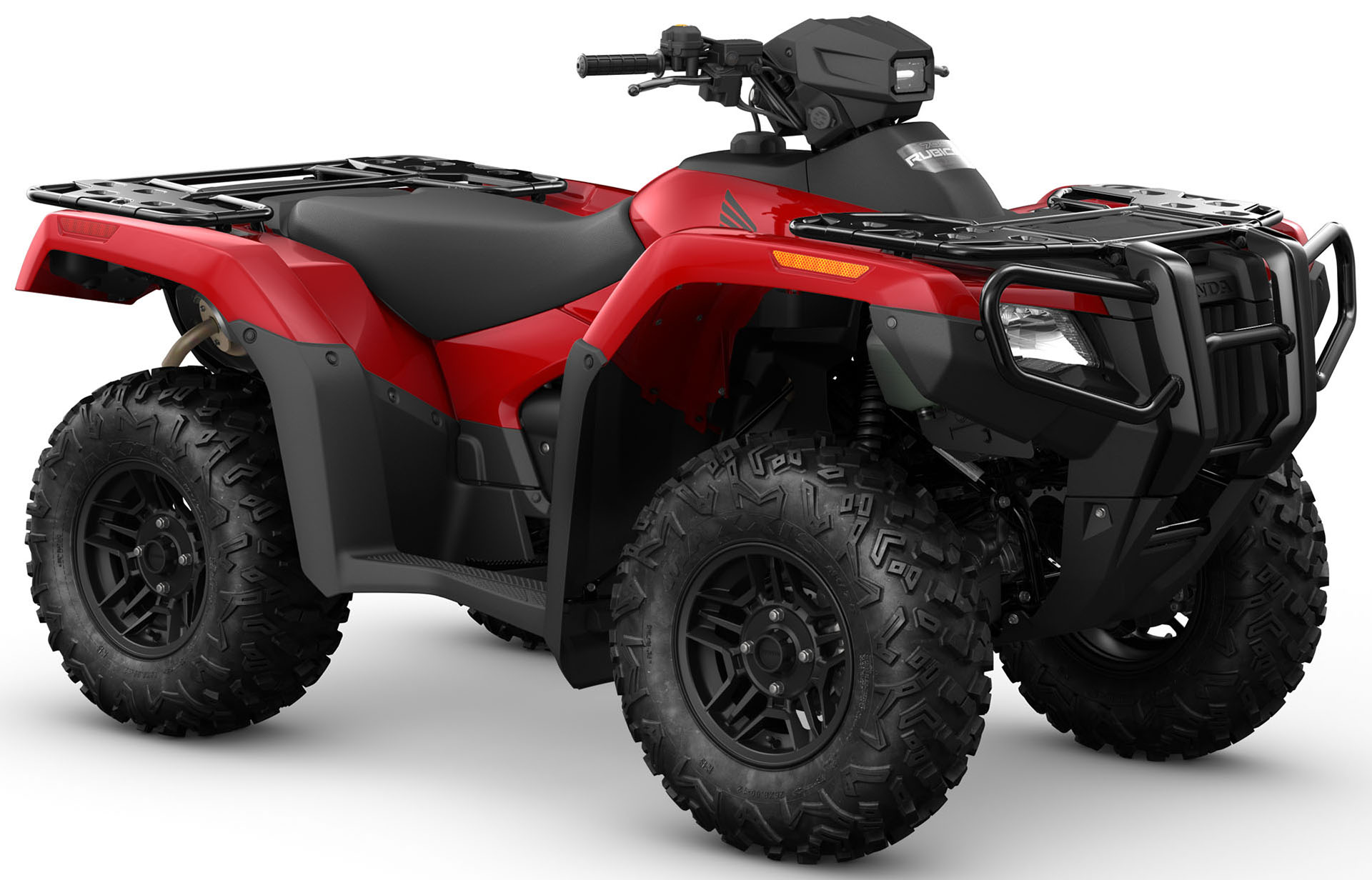
CForce 500 versus Kawasaki Brute Force 450 4x4
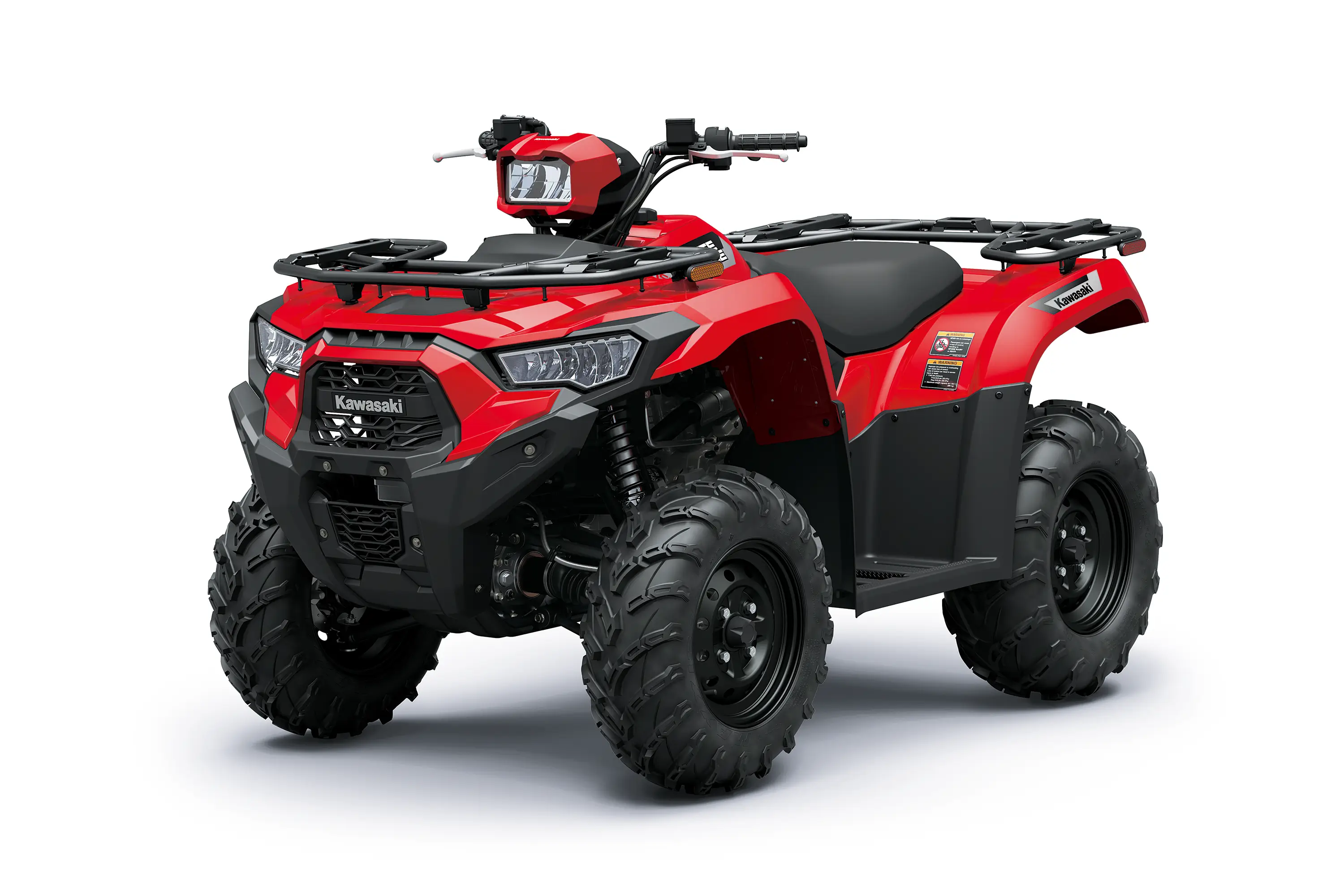
The 2026 Kawasaki Brute Force 450 4x4 starts at $6,899. Kawasaki publishes 32 hp, 24.6 lb-ft, a 43.3-inch width, 9.3 inches of clearance, 1,050 lb towing and 225 lb of combined rack capacity.
The CForce costs $400 less on base MSRP, claims two more horsepower and 4.4 lb-ft more torque, provides one inch more clearance and tows 300 lb more. It also includes EPS, aluminum wheels and a winch, while the base Kawasaki has conventional steering and no factory winch in its published base specification.
The Kawasaki is 0.7 inch narrower, and both manufacturers publish a 12-month limited warranty for these models. Its 688 lb figure is curb weight, so it should not be read as a direct 25 lb advantage over CFMOTO’s 713 lb dry figure. The decision is mainly between Kawasaki’s dealer-network and brand appeal and CFMOTO’s richer equipment package. Compare the CForce 500 and Brute Force 450.
CForce 500 versus Suzuki KingQuad 500AXi
The 2026 Suzuki KingQuad 500AXi is a closer displacement match. Suzuki uses a 493cc single, lists a 1,322 lb tow rating, measures 47.8 inches wide and starts at $8,379 before its separately published destination charge. Suzuki does not publish a current horsepower rating; ATVPedia’s 34 hp data field is an estimate, not a factory claim.
The CForce is $1,880 less by base MSRP and includes EPS and a winch. The base KingQuad has neither. The Suzuki counters with a 24-month limited warranty, a long-established platform and a torque-sensing limited-slip front differential alongside its selectable lock.
Again, the weight labels differ: Suzuki’s 695 lb is curb weight and CFMOTO’s 713 lb is dry. Treating the Suzuki as 18 lb lighter would be false precision. Buyers should compare dealer competence, final delivered price and the steering feel of the exact trims. On equipment per dollar, the CForce wins decisively; on proven-platform confidence, the Suzuki has the stronger traditional argument. Compare the CForce 500 and KingQuad 500AXi.
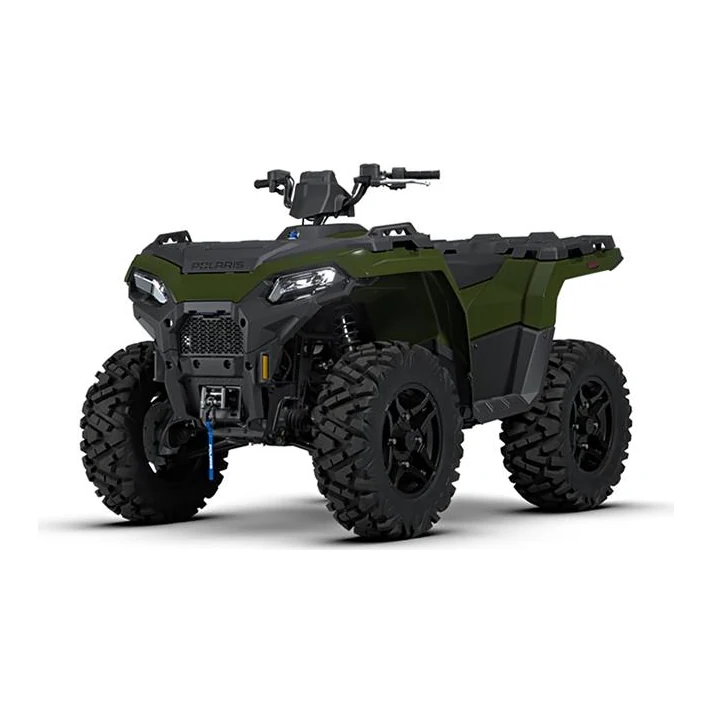
CForce 500 versus Polaris Sportsman 500
The announced 2027 Polaris Sportsman 500 starts at $6,999 and is rated at 33 hp. It matches the CFMOTO’s 1,350 lb towing and 4.5-gallon fuel capacity, includes a 2,500 lb winch and adds 270 lb of combined rack capacity plus five gallons of sealed front storage.
The Polaris is four inches wider, has 1.2 inches more clearance and wears 26-inch tires. Its 773 lb dry weight is 60 lb above the CFMOTO figure. Polaris describes the new front drive as auto-locking AWD; CFMOTO gives the rider explicit 2WD, 4WD and locked-4WD selections.
The CForce saves $500, is narrower and makes one more claimed horsepower. The Sportsman offers more rack capacity, storage, clearance and a larger tire package. Availability also matters: Polaris says dealer shipments begin in September 2026, while the CForce is a 2026 model already represented in CFMOTO’s dealer network. Compare the CForce 500 and Sportsman 500.
CForce 500 versus CForce 600 Touring
The 2026 CForce 600 Touring is not simply the next engine size. It is a dedicated two-up ATV with a passenger seat, backrest, grab handles and floorboards. Its 58.5-inch wheelbase is 8.5 inches longer, its 46.5-inch body is 2.5 inches wider and its 863 lb dry weight is 150 lb higher.
The $8,799 Touring adds 10 hp, 8 lb-ft, 26-inch tires, 0.3 inch of clearance, 150 lb of towing capacity and a 3,500 lb synthetic-rope winch. Curiously, the lighter CForce 500 has more suspension travel: 7.5/8.9 inches versus the Touring’s 6.3/8.3 inches.
The choice follows the seat count. A solo owner gains little by carrying the Touring’s length and weight on every ride. A regular passenger deserves the longer approved chassis rather than an accessory pad on the 500. Compare the CForce 500 and CForce 600 Touring.
Who should buy the CForce 500?
The best match is a solo rider who wants a compact utility ATV for mixed work and trail use, values a real front differential lock and intends to use both EPS and a winch. It is especially convincing when a narrow body and a complete base specification matter more than brand prestige or maximum resale confidence.
It is less suitable for routine two-person riding; this is a single-seat ATV. It is also not the obvious choice for sustained high-speed terrain, repeated maximum-load towing or remote trips where a larger fuel tank and more engine reserve are priorities. The CForce 600 and larger touring models exist for those jobs.
Before buying, obtain a written out-the-door quote and ask the service department about the initial service, CVT inspection, belt availability and normal parts lead times. Sit on the ATV in riding boots, operate the drive selector with gloves and inspect winch access. Dealer quality can turn an attractive specification sheet into a good ownership experience—or undo the price advantage.
Verdict
The 2026 CFMOTO CForce 500 is compelling because its strengths are useful every day. A 44-inch width helps in tight spaces. Thirty-four horsepower is appropriate for ordinary utility work. EPS, low range, locked 4WD and a winch solve real problems rather than decorating a brochure.
Its compromises are equally plain: modest fuel capacity, basic shocks, a steel winch cable and a dry-weight figure that cannot be compared directly with every rival. Buyers who prioritize a familiar dealer network or Suzuki’s longer standard warranty have credible alternatives.
At $6,499, however, those rivals struggle to match the complete package. The CForce 500 is not the class’s most powerful or most sophisticated ATV. It may be the easiest one to buy without immediately writing an accessory list. Browse more CFMoto models, explore utility ATVs, visit the 2026 model-year hub, or build another matchup in the comparison tool.