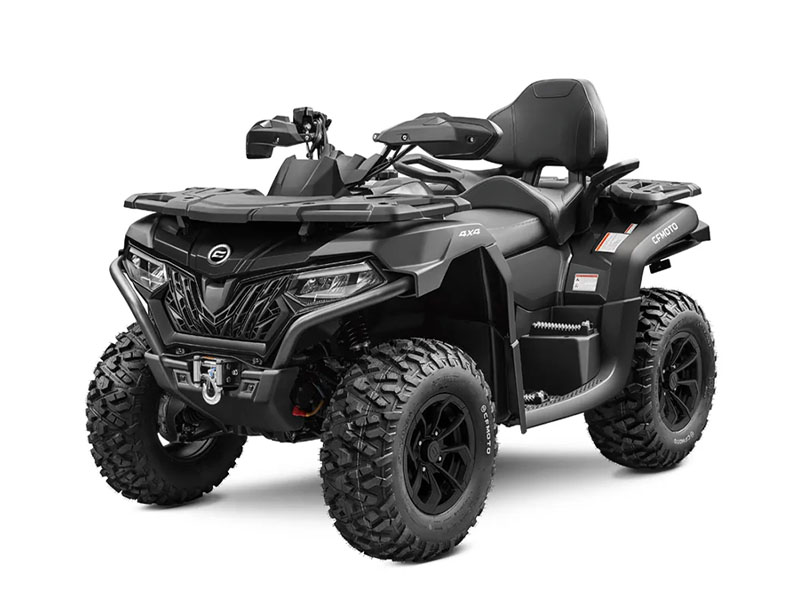
The 2026 CFMOTO CForce 600 Touring lands in a useful middle ground. It is a genuine two-person ATV rather than a single-seat machine wearing an accessory backrest, but it does not carry the width, weight, price or appetite of a big-bore twin. Its 580cc single makes 44 hp, the chassis measures 46.5 inches wide, and the $8,799 base price includes power steering, aluminum wheels and a 3,500 lb winch.
That combination makes more sense than a horsepower contest would suggest. A touring ATV spends much of its life at modest speed with another person aboard. Predictable throttle response, room for two sets of boots, useful low range and a chassis that stays composed under load matter more than a dramatic top-end number.
There is a tradeoff. At 863 lb dry, the Touring is 110 lb heavier than the standard 2026 CForce 600. It also stretches eight inches farther between the axles. The extra structure and passenger equipment improve accommodation, but they make the ATV less nimble than the solo version. This is a machine to buy because the second seat will be used, not because a backrest looks reassuring in a showroom.
A real two-up chassis, not an improvised seat
The most important CForce 600 Touring specification is its 58.5-inch wheelbase. The standard 2026 CForce 600 measures 50.5 inches between the axles. CFMOTO uses those additional eight inches to create a separate passenger position with a sculpted seat, fixed backrest, grab handles and floorboards.
That space changes how two adults fit. The operator is less likely to be pushed toward the handlebars, and the passenger has defined places for hands and feet. A longer wheelbase can also settle the fore-and-aft motion of the chassis over rolling ground. When the rear suspension compresses under a second person, the occupants are not perched on the same short platform.
The other side of the equation appears in tight woods. The Touring is 88 inches long, compared with 80 inches for the standard model, and its brochure turning radius is 12.1 feet. It needs more room to pivot around trees, and the long center section is easier to touch on a sharp breakover. The 10.6 inches of ground clearance does not increase just because the wheelbase does.
Width stays at 46.5 inches. That is a practical figure for narrow trails and trailer loading, although owners should verify the rules for the actual route and measure the finished ATV if access depends on a hard limit. Different tires, pressures and wheel offsets can alter real-world width.
The passenger equipment deserves an in-person fit check. Backrest height, knee angle, foot placement and reach to the grab handles vary from one body to another. Bring the person who will actually ride in back, have both people sit on the ATV in normal gear, and make sure neither rider has to borrow the other’s space.
The 580cc single is about control, not theater
The engine is a 580cc liquid-cooled, fuel-injected single with a single overhead cam and four valves. CFMOTO claims 44 hp at 6,500 rpm and 37 lb-ft at 6,000 rpm. Those numbers are shared with the standard CForce 600.
Forty-four horsepower is enough to move an 863 lb ATV with two adults, but the Touring will not have the effortless reserve of the 70 hp CForce 800 Touring or the 84 hp CForce 1000 Touring. That difference becomes most obvious on sustained climbs, at elevation, or when the hitch and racks are occupied. A rider moving up from a smaller utility single should find the 600 substantial; someone accustomed to a liter-class twin will notice the calmer pace.
That is not automatically a weakness. A moderate single is easier to meter when crossing rocks, backing a trailer or carrying a passenger who does not want every thumb movement amplified. It can also be cheaper to buy and simpler in concept than a larger twin. The right question is not whether 44 hp sounds impressive. It is whether the engine has enough reserve for the owner’s normal load and terrain.
Bosch electronic fuel injection and ride-by-wire throttle are standard. The two response settings are WORK and NORMAL. WORK should soften the initial relationship between thumb travel and throttle opening, which is useful for low-speed chores and rough technical sections. NORMAL is the everyday map.
Neither mode creates or removes horsepower. The published maximum remains 44 hp. The maps change how readily the engine delivers it. That distinction matters because selectable modes are sometimes treated as separate performance levels when they are really control tools.
Fuel capacity is 4.75 gallons. That is modest for a touring machine and considerably smaller than the 6.75-gallon tank listed for the 2027 Polaris Sportsman Touring 600 or the 6.9-gallon tank on CFMOTO’s 1000 Touring. Range will depend on terrain, speed, temperature, tire pressure and load. Owners planning long remote loops should establish consumption from their own riding rather than treating tank size as a range guarantee.
CVTech transmission and selectable four-wheel drive
The automatic CVTech CVT provides park, reverse, neutral, high and low. The driveline offers 2WD, 4WD and locked 4WD. That is the correct set of choices for an ATV expected to work during the week and carry two people on the weekend.
Two-wheel drive is suitable for firm, easy ground and generally keeps steering lighter. Four-wheel drive is the normal step when the surface becomes loose or slippery. Locking the front differential is the final tool for the obstacle that needs both front tires pulling together. The lock should be released when it is no longer useful because it increases steering effort and changes how readily the ATV turns.
Low range is equally important. Towing, plowing, deep mud and slow steep climbs build belt heat when attempted in high range at very low speed. Selecting low before the load arrives lets the transmission multiply torque without asking the belt to slip unnecessarily. A CVT is easy to operate, but it still rewards mechanical sympathy.
Electronic power steering is standard. On a two-up ATV, EPS earns its keep when the front differential is locked, the tires are loaded against a rut or the operator is correcting the line at walking pace. CFMOTO describes the system as speed-sensitive, so assistance is intended to be stronger at low speed while retaining more feel as speed rises.
Engine braking is included. It can help hold speed on a descent, but the rider still needs the correct range and deliberate brake inputs. A passenger raises the center of mass and adds momentum. A trailer can continue pushing after the ATV’s own tires have reached the edge of their grip. Electronic and mechanical aids do not change those fundamentals.
Suspension is useful, but the numbers need context
Independent double A-arms are used at both ends. The front wheels have 6.3 inches of travel and the rear has 8.3 inches. Spring-preload-adjustable, oil-damped shocks are fitted front and rear.
Those figures are ordinary rather than extravagant. The larger CForce Touring models provide nine inches at both ends, and the 1000 adds compression- and rebound-adjustable piggyback shocks. The 600’s simpler suspension is consistent with its price and intended pace.
Preload adjustment still matters. Adding a passenger and cargo can consume rear ride height before the trail begins. Increasing spring preload helps restore the intended stance, steering geometry and usable bump travel. It does not make the spring stiffer, add suspension travel or create more damping. It simply changes the spring’s installed tension and the point at which the machine sits in its travel.
Owners should record the factory setting, make equal changes on paired shocks and test on familiar ground. A setting chosen for two-up riding may feel unnecessarily firm when the ATV is used solo. Conversely, a soft solo setup can ride too low when a passenger and rear-rack load are added.
The staggered travel numbers also deserve attention. With only 6.3 inches at the front, repeated sharp impacts will reach the limits sooner than a modern long-travel sport machine. The answer is not to assume the backrest makes the passenger immune. It is to reduce pace, pick cleaner lines and leave enough suspension in reserve for the hit that was not visible.
Tires, brakes and trail dimensions
The Touring uses 26 x 9-12 front and 26 x 11-12 rear tires on 12-inch cast aluminum wheels. This is a sensible utility size: large enough to contribute to 10.6 inches of clearance without creating the gearing and steering penalties of an oversized aftermarket package.
Hydraulic disc brakes operate at all four wheels, and a parking brake is listed. Brake feel matters on a loaded ATV. The system may stop an empty showroom demonstrator easily while behaving differently with fuel, two adults, cargo and trailer tongue weight aboard. A careful test should include low-speed modulation and controlled downhill behavior, not just a single hard stop on pavement.
The 46.5-inch width is one of the CForce’s practical advantages against physically larger touring ATVs. It is 1.5 inches narrower than the Sportsman Touring 600 and 3.5 inches narrower than the CForce 1000 Touring. The narrow stance helps between trees and on transport, but it also calls for respect on side slopes. Smooth steering and conservative line choice matter more as passenger weight moves higher and farther rearward.
Owners considering replacement wheels should guard that advantage. Extra offset can increase overall width and bearing leverage. Taller tires reduce effective gearing, add rotating mass and can change clearance at full steering lock. The stock package is part of the chassis balance, not merely a set of temporary tires waiting to be discarded.
Work equipment comes standard
CFMOTO rates the front rack for 75 lb and the rear for 100 lb. Both are steel structures with composite covers, giving cargo a broad surface and providing practical tie-down locations. The ratings are lower than the 99/198 lb figures on the 800 and 1000 Touring models, so buyers who routinely carry heavy rack loads should compare more than engine size.
The two-inch receiver accompanies a 1,500 lb towing rating. That capacity is useful for a midsize ATV, but it is not a universal operating allowance. Trailer weight, tongue load, gradient, surface, speed, cooling and the total weight carried by the ATV all matter. The owner’s manual, hitch labeling and local rules control the actual job.
A 3,500 lb winch with synthetic rope is standard. That saves the cost and installation work of an immediate accessory purchase. The rating does not make recovery casual: anchors, shackles and recovery points must be appropriately rated, people should stand clear of the line, and the operator needs to understand how redirects change loads.
Hand guards, a front bumper and full fender protection are also included. RideVision LED headlights and taillights are paired with backup lights. The LCD instrument panel adds a Bluetooth call indicator, while a 12-volt outlet and USB port can power a phone or navigation device. These are not luxury features, but together they make the base vehicle feel complete.
The display should not be confused with the seven-inch TFT and RideSync package on the CForce 1000 Touring. The 600’s LCD is more basic. Buyers who want integrated mapping or a richer interface should compare the actual dashboards rather than assuming every Bluetooth reference means the same thing.
2026 CFMOTO CForce 600 Touring specifications
| Specification |
CForce 600 Touring |
| Engine |
580cc liquid-cooled SOHC four-valve single-cylinder |
| Output |
44 hp at 6,500 rpm; 37 lb-ft at 6,000 rpm |
| Fuel system |
Bosch electronic fuel injection |
| Throttle modes |
WORK and NORMAL |
| Transmission |
CVTech automatic CVT; P/R/N/H/L |
| Drive system |
2WD / 4WD / locked 4WD |
| Steering |
Electronic power steering |
| Front suspension |
Independent double A-arms; 6.3 in travel |
| Rear suspension |
Independent double A-arms; 8.3 in travel |
| Shocks |
Oil-damped; spring-preload adjustable |
| Brakes |
Four-wheel hydraulic discs; parking brake |
| Tires |
26 x 9-12 front; 26 x 11-12 rear |
| Wheels |
12-inch cast aluminum |
| Length x width x height |
88 x 46.5 x 55 in |
| Wheelbase |
58.5 in |
| Ground clearance |
10.6 in |
| Dry weight |
863 lb |
| Fuel capacity |
4.75 gal |
| Seat height |
21 in |
| Seating |
Two-up seat with backrest, grab handles and floorboards |
| Rack capacity |
75 lb front; 100 lb rear |
| Towing capacity |
1,500 lb |
| Winch |
3,500 lb with synthetic rope |
| Display |
LCD with Bluetooth call indicator |
| Base MSRP |
$8,799 |
CForce 600 Touring versus the standard CForce 600
The standard 2026 CForce 600 and Touring share almost every performance number in CFMOTO’s table. Both use the 44 hp, 37 lb-ft single, CVTech CVT, selectable 4WD, 46.5-inch width, 10.6-inch clearance, 26-inch tires, 6.3/8.3 inches of travel and a 1,500 lb tow rating.
The difference is packaging. The solo model is 80 inches long with a 50.5-inch wheelbase and a 753 lb dry weight. The Touring measures 88 inches, stretches to 58.5 inches between the axles and weighs 863 lb. It adds the passenger seat and supporting hardware without pretending that two people fit on the shorter chassis for free.
Buy the standard 600 when nearly every ride is solo and maneuverability matters. Buy the Touring when a passenger is routine. The longer model costs the rider some agility, but the second occupant gets proper space and support. An occasional accessory pad cannot reproduce the chassis geometry or approved two-person configuration.
CForce 600 Touring versus Polaris Sportsman Touring 600
The 2027 Polaris Sportsman Touring 600 is the direct nameplate rival. ATVPedia’s verified Premium-trim record lists the same 44 hp, along with a 932 lb dry weight, 48-inch width, 56-inch wheelbase, 11.5 inches of clearance, 6.75 gallons of fuel, 1,350 lb towing and an $11,499 base MSRP.
The CFMOTO is $2,700 less on those recorded base prices, 69 lb lighter and 1.5 inches narrower. It also carries a 150 lb higher tow rating. The Polaris counters with 0.9 inch more clearance, a fuel tank two gallons larger, more combined storage and a removable passenger seat that makes solo conversion easy.
The chassis proportions are different. CFMOTO uses a wheelbase 2.5 inches longer even though the machine is narrower. The Polaris is the better fit for a buyer who values range, storage, clearance and its tool-free seat system. The CForce makes a powerful value case when purchase price, narrow-trail access and standard equipment lead the decision. Compare the CForce 600 Touring and Sportsman Touring 600.
CForce 600 Touring versus Can-Am Outlander MAX 700
The 2025 Can-Am Outlander MAX 700 is another purpose-built two-up ATV. ATVPedia records a 650cc Rotax single with 50 hp, 775 lb dry weight, 46-inch width, 57-inch wheelbase, 11 inches of clearance, 5.4 gallons of fuel, 1,650 lb towing and a $10,299 MSRP.
The Can-Am is 88 lb lighter, half an inch narrower and six horsepower stronger. It also offers 150 lb more towing and a slightly larger tank. The CFMOTO costs $1,500 less in the recorded data and includes a 3,500 lb winch at its base price.
That makes the comparison unusually clear. The Outlander offers a lighter, slightly more capable numerical package before accessories. The CForce asks substantially less money and arrives with useful recovery hardware. Dealer quality, local parts supply, passenger fit and the final out-the-door quote can reasonably outweigh a small specification advantage. Compare the CForce 600 Touring and Outlander MAX 700.
CForce 600 Touring versus CForce 1000 Touring
The 2026 CForce 1000 Touring costs $10,499, or $1,700 more. That step buys an 84 hp V-twin, 1,800 lb towing, 12 inches of clearance, 27-inch tires, larger racks, a 6.9-gallon tank, nine inches of travel at both ends and fully adjustable piggyback shocks.
It also brings 112 lb more dry weight and a 50-inch width. The 1000 is the better tool for frequent towing, high-elevation riding, heavy two-up loads or owners who will genuinely tune the suspension. The 600 is easier to justify when trails are tight, speeds are moderate and the engine’s main job is moving people rather than demonstrating excess reserve.
Price alone should not decide this one. The $1,700 difference is small relative to the hardware gained, but the larger machine continues to cost more in fuel, tires and possibly insurance. More power also asks more restraint on a tall, passenger-carrying vehicle. Compare the CForce 600 Touring and CForce 1000 Touring.
Who should buy the CForce 600 Touring?
The strongest buyer is someone who regularly carries one passenger, rides trails narrow enough to value a 46.5-inch stance and wants a complete ATV without immediately adding a winch or power steering. Hunters, landowners and campers who split time between chores and moderate trail travel fit the brief.
It is less convincing for aggressive solo riding. The standard 600 saves 110 lb and eight inches of wheelbase. A rider who rarely uses the rear seat would carry that penalty on every turn and obstacle. It is also not the ideal answer for repeated heavy towing or fast two-up riding, where the 800 and 1000 Touring offer more engine and chassis reserve.
Before buying, ask for the complete delivered price and inspect the service department, not only the sales floor. Check belt-service requirements, initial service timing, common parts availability and how warranty work is scheduled. Sit on the machine with the regular passenger, test the handholds with gloves and confirm that both riders can mount without stepping on vulnerable bodywork.
The first setup discussion should include rear preload, tire pressures and cargo placement. A touring ATV is a variable-load machine. It cannot feel correct for a solo rider, two adults and a loaded trailer with no adjustment or change in technique.
Verdict
The 2026 CFMOTO CForce 600 Touring succeeds by being specific. It is not the cheapest solo utility ATV and not the fastest two-up model. It is a narrow, properly stretched passenger ATV with enough engine for ordinary trail and work use, plus a useful collection of standard equipment at $8,799.
Its weak points are visible in the same table as its strengths: 863 lb is substantial for 44 hp, front travel is only 6.3 inches, rack capacity is modest and the 4.75-gallon tank limits the touring story. Buyers expecting liter-class acceleration or long-range autonomy will be happier farther up the market.
For two people who ride at a sensible pace, however, the value is difficult to dismiss. Power steering, 4WD lock, low range, LED lighting, aluminum wheels and a synthetic-rope winch are already present. More importantly, the passenger sits on a chassis designed for the job. Browse other CFMoto models, explore utility ATVs, see the 2026 model-year hub, or build another matchup in the comparison tool.