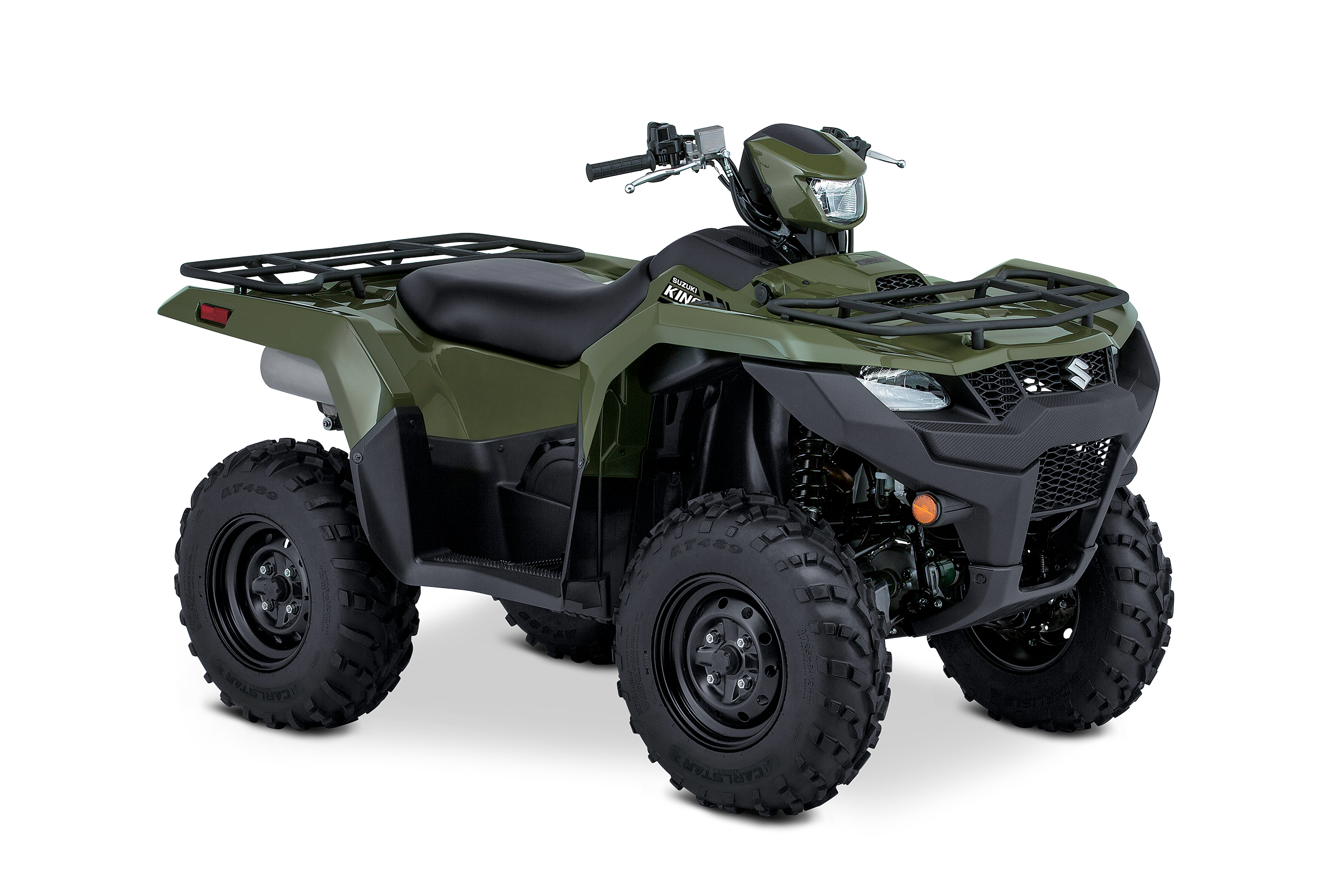
The 2026 Suzuki KingQuad 500AXi is a serious step up from a basic 400-class utility ATV without moving into the price and size of a 700-class machine. It starts at $8,379 plus a $600 destination charge, uses a liquid-cooled 493cc fuel-injected single, and includes the hardware that matters in wet, uneven terrain: push-button 2WD/4WD/differential-lock 4WD, independent rear suspension, 25-inch tires, and a 1,322-lb factory towing rating.
This review covers the base 500AXi, not the $10,029 Power Steering trim. The base model has the same engine, traction system, suspension layout, towing rating, and core chassis, but it does not have EPS. That creates a clear buying decision: choose the base machine for value if conventional steering suits the terrain and workload, or spend the difference when long, slow, technical riding makes reduced steering effort worth it.
Price and purpose: the middleweight work ATV
Adding Suzuki’s $600 destination charge places the starting figure at $8,979 before tax, registration, dealer charges, accessories, and any freight surcharge confirmed by the dealer. It is more money than the KingQuad 400ASi, but it buys liquid cooling, a larger engine, independent rear suspension, a front differential lock, and a published 1,322-lb towing rating. Those are functional upgrades, not a graphics package.
At 47.8 inches wide, the 500AXi is still manageable for general property use and wooded routes, but it is broader than the 400ASi and no substitute for a truly narrow-access ATV. Measure gates, bridges, trailer rails, and storage before deciding that it will fit. Its 84.6-inch length and 50.6-inch wheelbase also make it a more substantial machine than the 400, which helps ride stability but is worth considering for transport.
493cc liquid-cooled single: enough engine without a factory power claim
Suzuki’s 493cc, liquid-cooled, four-valve OHC single uses electronic fuel injection, a 9.9:1 compression ratio, and a wet-sump lubrication system. It is built around a broad usable powerband and steady throttle response, not a peak-output marketing contest. Suzuki does not publish a current horsepower number, so this review does not present one as a factory fact.
The Quadmatic automatic V-belt CVT has high and low ranges plus reverse, with a centrifugal clutch and shaft final drive. Engine braking helps reduce freewheeling on descents, which is more useful in real working terrain than a claimed top speed. The handlebar override button can temporarily bypass the normal reverse limiter when extracting the ATV from mud or loose soil; it is a recovery aid, not a reason to reverse quickly.
Traction system and independent suspension
Push-button controls let the rider choose 2WD, 4WD, or locked-differential 4WD. The compact torque-sensing limited-slip front differential helps find traction while retaining lighter steering in standard 4WD. When the route becomes genuinely difficult, the lock is there. Use it deliberately on slow, loose, or uneven ground, then return to the least aggressive mode that completes the job.
The fully independent suspension is a meaningful difference from a 400ASi. Suzuki lists 6.7 inches of front travel and 7.7 inches at the rear, with gas-charged shocks and five-way spring preload adjustment at all four corners. Along with the 25-inch tires and 10.2 inches of clearance, it should be more composed over ruts and uneven loads than a swingarm-rear ATV. It still is not a long-travel recreational quad, so pace and tire pressures should match the load and surface.
Work hardware with a real tow rating
Suzuki publishes a 1,322-lb towing capacity and provides a receiver-type hitch mount. The accessory ball mount, hitch pin, and R-clip are not included, so factor them in rather than treating the brochure number as a complete setup. Winch-ready mounts and wiring are standard, as are front and rear steel-tube racks, skid plates, a sealed 12V outlet, and both fender- and handlebar-mounted lighting.
The tow rating is valuable because it removes a major guesswork problem. It still does not override basic trailer safety: tongue weight, slope, brake condition, cargo placement, and stopping distance decide whether a job is sensible. It means the 500AXi is a credible light-trailer ATV, not that every 1,322-lb load should be pulled in every condition.
Comfort and ownership
The base 500AXi does not have EPS. On hard-packed surfaces that may be a sensible saving; in slow turns, ruts, or a long workday, steering load is real. The power-steering version costs considerably more, so the right answer depends on how often that fatigue will matter. There is no universal correct trim here.
Suzuki’s two-year limited warranty is a worthwhile advantage at this price point. The seating, footboards, steel racks, straightforward LCD instruments, and service-access panels are all oriented toward long-term utility rather than a flashy first impression.
2026 Suzuki KingQuad 500AXi specifications
| Specification |
2026 KingQuad 500AXi |
| Engine |
493cc liquid-cooled OHC four-valve single; electronic fuel injection |
| Factory-rated output |
Suzuki does not publish a current horsepower figure |
| Transmission |
Quadmatic automatic V-belt CVT; high/low range and reverse |
| Drive system |
2WD / 4WD / locked 4WD; torque-sensing limited-slip front differential; shaft drive |
| Curb weight |
695 lb |
| Overall width / length / height |
47.8 / 84.6 / 50.6 in |
| Wheelbase / ground clearance |
50.6 / 10.2 in |
| Fuel capacity |
4.6 gal |
| Towing |
1,322 lb |
| Tires |
25 x 8-12 front; 25 x 10-12 rear |
| Suspension travel |
6.7 in front / 7.7 in rear |
| Warranty |
24-month limited warranty |
| Base MSRP / destination |
$8,379 / $600 |
How it compares
The 2026 Suzuki KingQuad 400ASi costs less and is 2.7 inches narrower, but it uses an air/oil-cooled 376cc engine, a swingarm rear suspension, and a limited-slip rather than lockable front differential. The 500AXi costs more because it is the more complete work and rough-trail machine. Compare them →
The 2026 Kawasaki Brute Force 450 4x4 is narrower and less expensive, with a 443cc liquid-cooled single and a 1,050-lb tow rating. The Suzuki brings more displacement, independent rear suspension, a true front differential lock, five-way preload adjustment, and a higher 1,322-lb rating. Compare them →
The 2027 Polaris Sportsman 600 is another middleweight utility option with a factory-published 44-hp 567cc engine, 1,350-lb towing rating, and a standard 2,500-lb winch. The Suzuki is slightly narrower and provides a selectable front lock; the Polaris is more fully equipped for work from the showroom. Compare them →
The 2027 Yamaha Grizzly EPS adds standard EPS, 26-inch tires, and more suspension travel, but costs more and Yamaha does not publish a current tow rating. The Suzuki gives the buyer a defined 1,322-lb tow figure and differential-lock 4WD for less money; the Yamaha favors steering comfort and its premium trail chassis. Compare them →
Verdict
The 2026 Suzuki KingQuad 500AXi is a strong middleweight utility ATV for buyers who need real 4WD hardware, independent rear suspension, a liquid-cooled engine, and a published tow rating without stepping up to a large-displacement model. The combination of 2WD/4WD/locked 4WD, 25-inch tires, adjustable independent suspension, and 1,322-lb towing makes the price increase over a 400-class machine easy to understand.
The base trim’s lack of EPS is the essential compromise. If most riding is slow, rough, or loaded, price the EPS version before deciding. If the use case is ordinary property work, trail access, and light towing where value matters, the base 500AXi is a properly equipped, straightforward choice rather than a stripped-down one.