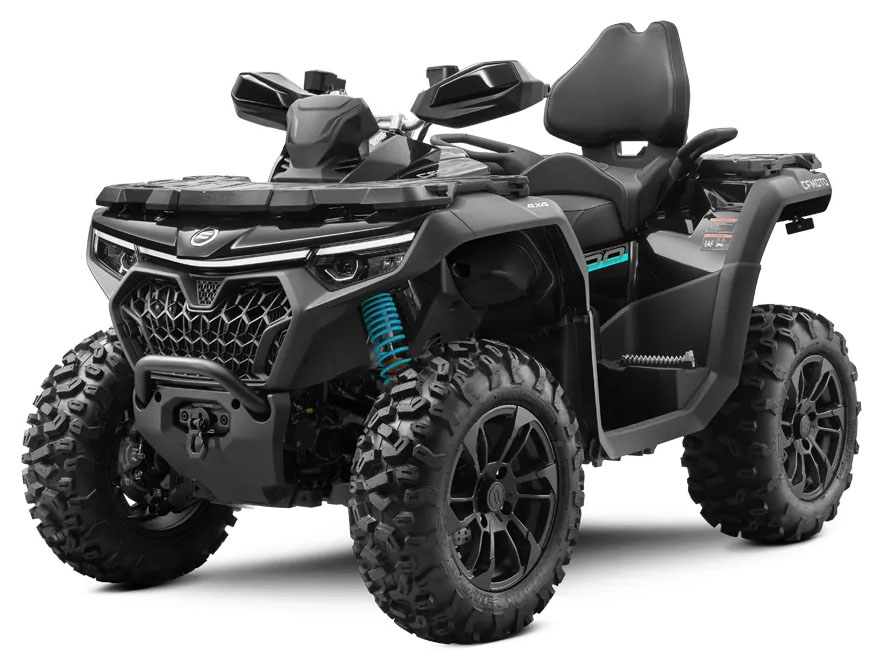
The 2026 CFMOTO CForce 1000 Touring is a large two-up ATV that does not make its passenger an afterthought. The second seat, raised backrest and handholds are built into a 58-inch-wheelbase chassis, while an 84 hp V-twin, fully adjustable piggyback shocks and 1,800 lb tow rating give the machine enough substance to work when the ride is not purely recreational.
Its $10,499 base price is the other half of the pitch. That figure includes adjustable electronic power steering, a 3,500 lb synthetic-rope winch, 7-inch TFT display, 14-inch aluminum wheels and a passenger package. Comparable equipment can move a rival well beyond its advertised starting price.
The CForce is not a small quad with an extra pad attached to the rear rack. It is 92 inches long, 50 inches wide and 975 lb dry. Add fuel, two adults, luggage and trailer tongue weight, and the real working mass becomes substantial. Buyers should approach it as a powerful two-person vehicle that happens to be straddled, not as a light single-rider ATV.
The touring label has a real mechanical meaning
Touring can be empty marketing when a manufacturer adds a backrest and calls the job finished. CFMOTO gives the 1000 Touring a 58-inch wheelbase and a proper second seating position. The passenger sits behind the operator with a raised backrest and dedicated handholds rather than borrowing space intended for cargo.
That chassis length helps two people fit without forcing the operator onto the fuel tank. It can also calm the vehicle’s pitch over rolling terrain. The cost appears in tight turns and breakover clearance: a longer machine needs more room between trees and is more likely to touch its center section when crossing a sharp crest.
The brochure lists a 22-inch seat height, 92-inch overall length, 50-inch width and 57.7-inch height. The 50-inch figure is important for trail access, but it should be checked against local rules and the actual finished vehicle. Tire pressure, replacement tires and wheel offset can all change measured width.
At 975 lb dry, this is one of the heavier ATVs in the class. The weight contributes to a planted feel and reflects the V-twin, long chassis, winch, racks and passenger equipment. It also makes a rollover harder to recover from and increases the consequences of entering a descent too quickly. Power steering cannot change physics.
The 963cc V-twin brings useful reserve
The engine is a liquid-cooled 963cc four-stroke V-twin with a single overhead cam and eight valves. CFMOTO rates it at 84 hp at 7,500 rpm and 62 lb-ft at 5,500 rpm. Bosch electronic fuel injection supplies the mixture.
Those numbers give the 1000 Touring real reserve for two adults, elevation and loaded racks. The point is not to use 84 hp at every opening. It is to avoid making the engine work at its limit whenever the trail points uphill or the hitch is occupied.
Ride-by-wire throttle offers WORK, NORMAL and SPORT modes. WORK should make initial response easier to meter around a trailer, livestock gate or technical obstacle. NORMAL is the everyday setting. SPORT sharpens the relationship between thumb movement and throttle opening when the route opens up.
The modes do not change the engine’s maximum published output. They change how it is delivered. On a heavy two-up ATV, a calm response map can improve traction and passenger comfort more than an aggressive initial hit. Smooth control is not the opposite of performance; on rough ground it is often what lets the available torque reach the surface.
An owner should also be realistic about heat and fuel use. A 963cc V-twin working slowly with limited airflow can produce more cabin-area heat than a smaller single. The 6.9-gallon tank gives useful range, but consumption will vary sharply with speed, load, terrain and throttle mode. Plan from observed fuel use rather than a best-case estimate.
OmniDrive CVT and selectable traction
The CForce uses CFMOTO’s OmniDrive automatic CVT with park, reverse, neutral, high and low ranges. The drive system provides 2WD, 4WD and locked 4WD. That gives the rider a logical progression instead of forcing maximum driveline engagement on every unpaved surface.
Two-wheel drive reduces steering effort and driveline bind on easy ground. Four-wheel drive is the normal step for mud, snow and loose climbs. The front lock is for the obstacle that needs equal front-wheel pull, then should be released when it is no longer helpful.
Low range deserves the same discipline. Slow travel with high load - towing, deep mud, steep technical climbs or recovery work - is precisely where lower gearing protects the belt from unnecessary heat. High range may move the ATV at low speed, but that does not make it the kinder mechanical choice.
Adjustable electronic power steering is standard. Assistance matters on a 975 lb ATV with 27-inch tires, particularly when 4WD is engaged or the front differential is locked. Buyers should still look for predictable feedback. A system that feels light in a showroom should not become vague when a front tire strikes a root.
Downhill assist control is part of the large-displacement CForce package. It is useful support, especially with a passenger, but it does not replace correct range selection, controlled speed and balanced braking. A loaded trailer can continue pushing after the ATV has reached the limit of its own grip.
Fully adjustable shocks separate it from the 800
Independent high-clearance A-arms control the front wheels. The rear uses independent trailing arms. Wheel travel is nine inches at both ends, and high-pressure gas shocks use piggyback reservoirs with preload, compression and rebound adjustment.
The adjustment range is one of the 1000 Touring’s strongest technical features. Preload establishes ride height for the load. Compression damping controls how readily the suspension moves into its stroke. Rebound controls how quickly it returns. These are related settings, not three unrelated knobs to turn at random.
A solo rider, a two-person touring load and a trailer tongue all ask the rear suspension to support different weight. The correct baseline is therefore more important on this machine than on a fixed-load single-seat ATV. Record the factory positions before making changes, alter one variable at a time and test on a familiar section of trail.
Nine inches of travel is not a sport-quad number, but it is adequate when the suspension is properly set and the pace matches the mass. The 12-inch ground-clearance figure helps over ruts and debris. Neither figure turns a 58-inch-wheelbase, 975 lb machine into something that should be launched over blind crests.
The 2026 CForce 800 Touring uses the same nine-inch travel figures but spring-preload-adjustable oil-damped shocks in CFMOTO’s table. That is the clearest hardware reason to choose the 1000 beyond engine output. The larger model gives an owner more control over how the chassis manages passenger weight and repeated impacts.
Tires, brakes and steering geometry
The 1000 Touring rolls on 27 x 9-14 front and 27 x 11-14 rear tires fitted to 14-inch cast aluminum wheels. The larger tire package contributes to the 12-inch clearance and gives the V-twin useful traction without entering oversized aftermarket territory.
Hydraulic disc brakes operate at both ends, and a parking brake is listed. The braking system must manage far more than the 975 lb brochure number once the vehicle carries fuel, two people, gear and possibly a trailer. A buyer should evaluate lever feel and low-speed modulation, not just whether the brakes can make an unloaded demonstration stop.
The 50-inch width keeps the ATV relevant on many regulated routes. It also means the machine remains relatively narrow for its height and mass. Smooth steering, conservative side-hill lines and correct body position matter. A backrest can make a passenger feel secure, but it cannot compensate for a poor line across an off-camber slope.
Aftermarket tires deserve restraint. Extra diameter can reduce effective gearing, add steering load, alter braking and stress axles. Wider tires or offset wheels may also push the ATV beyond a width restriction. The stock 27-inch combination is part of the vehicle’s tested balance, not an arbitrary placeholder.
The stepped two-up seat gives the passenger a better view and separates the two occupants more clearly than a flat saddle. The raised backrest and handholds provide support during acceleration and rough sections. Both riders should sit on the vehicle before purchase, because leg angle, reach and foot placement cannot be judged from a specification table.
The operator faces a seven-inch color TFT display. Bluetooth phone functions and CFMOTO RideSync compatibility move the dash beyond a basic speedometer. This is useful on a touring machine, provided the interface remains legible in sunlight and can be operated without taking attention away from the trail.
Hand guards, LED lighting, a 12-volt outlet and USB power are standard. These are modest details individually, but they reduce the number of immediate accessory purchases. Device power matters on long days when a phone is carrying maps, and hand protection earns its place in brush or cold weather.
Comfort still depends heavily on suspension setup and riding style. The rear passenger sits farther from the vehicle’s pitch center and will feel some impacts more strongly than the operator. The rider should treat the passenger as part of the control loop: communicate before steep obstacles, leave more braking distance and avoid abrupt throttle changes that would be trivial when riding alone.
Racks, winch and towing capacity
CFMOTO rates the front rack for 99 lb and the rear rack for 198 lb. The steel racks have composite covers, giving the machine usable flat surfaces without exposing every item directly to the rack structure. Load needs to be secured and distributed; a high rear load changes steering and slope behavior even when it stays below the printed number.
The factory winch is rated for 3,500 lb and uses synthetic rope. Its presence is a genuine value item, but the number on the motor does not guarantee a safe recovery. Use rated recovery points, keep people away from the line and understand how a snatch block changes both pulling force and anchor load.
The two-inch receiver accompanies a 1,800 lb published towing rating. That is a strong figure for a two-up ATV, but it is not permission to place 1,800 lb behind the machine in every condition. Trailer brakes, tongue weight, gradient, surface grip, cooling and total vehicle loading all matter. The owner’s manual is the controlling source for limits and operating procedure.
The 1,800 lb tow rating is shared with the CForce 800 Touring and 1000 Overland in the 2026 U.S. table. The 1000 engine therefore buys power reserve rather than a higher approved trailer number. Buyers who tow frequently may value that reserve; buyers who never tow should not count the rating as money saved.
2026 CFMOTO CForce 1000 Touring specifications
| Specification |
CForce 1000 Touring |
| Engine |
963cc liquid-cooled SOHC 8-valve V-twin |
| Output |
84 hp at 7,500 rpm; 62 lb-ft at 5,500 rpm |
| Fuel system |
Bosch electronic fuel injection |
| Throttle modes |
WORK, NORMAL and SPORT |
| Transmission |
OmniDrive CVT; P/R/N/H/L |
| Drive system |
2WD / 4WD / locked 4WD |
| Steering |
Adjustable electronic power steering |
| Front suspension |
Independent high-clearance A-arms; 9 in travel |
| Rear suspension |
Independent trailing arms; 9 in travel |
| Shocks |
Piggyback high-pressure gas; preload, compression and rebound adjustable |
| Brakes |
Front and rear hydraulic discs; parking brake |
| Tires |
27 x 9-14 front; 27 x 11-14 rear |
| Wheels |
14-inch cast aluminum |
| Length x width x height |
92 x 50 x 57.7 in |
| Wheelbase |
58 in |
| Ground clearance |
12 in |
| Dry weight |
975 lb |
| Fuel capacity |
6.9 gal |
| Seating |
Two-up seat with passenger backrest and handholds |
| Rack capacity |
99 lb front; 198 lb rear |
| Towing capacity |
1,800 lb |
| Winch |
3,500 lb with synthetic rope |
| Display |
7-inch TFT; Bluetooth and RideSync compatible |
| Base MSRP |
$10,499 |
CForce 1000 Touring versus CForce 800 Touring
The 2026 CForce 800 Touring is the most important comparison because the two machines share their basic mission. CFMOTO’s current table gives both a 58-inch wheelbase, nine inches of suspension travel, a 6.9-gallon tank and a 1,800 lb tow rating.
The 1000 produces 84 hp and 62 lb-ft, versus 70 hp and 51 lb-ft for the 800. It uses 27-inch rather than 26-inch tires, raises clearance from 11.4 to 12 inches and replaces the 800’s preload-adjustable oil shocks with fully adjustable piggyback units. Dry weight rises only 15 lb in the official table, from 960 to 975 lb.
At recorded base prices, the 1000 costs $1,000 more. That is a modest premium for the output, tires and suspension hardware. The 800 remains rational when the rider values a calmer engine and will not tune the shocks. The 1000 is the stronger value when two-up climbing, towing reserve or suspension adjustment will actually be used. Compare both CForce Touring models.
CForce 1000 Touring versus Polaris Sportsman Touring 600
The 2027 Polaris Sportsman Touring 600 takes a different approach. ATVPedia’s verified Premium-trim data lists a 567cc single with 44 hp, 932 lb dry weight, 48-inch width, 56-inch wheelbase, 1,350 lb towing and an $11,499 MSRP.
The CFMOTO costs $1,000 less on the recorded base prices while offering 40 more horsepower, 450 lb more towing capacity, a larger fuel tank and more sophisticated shocks. The Polaris is 43 lb lighter, two inches narrower and two inches shorter between the axles. It also offers a tool-free removable passenger seat and Polaris’s established accessory ecosystem.
This comparison is less about badge prestige than scale. The Sportsman is the more compact touring ATV. The CForce is the higher-output, higher-capacity choice for riders who accept extra mass. Compare the CForce 1000 Touring and Sportsman Touring 600.
CForce 1000 Touring versus Can-Am Outlander MAX 700
The 2025 Can-Am Outlander MAX 700 is another dedicated two-up alternative. ATVPedia currently records 50 hp, 775 lb, a 46-inch width, 57-inch wheelbase, 1,650 lb towing and a $10,299 MSRP.
The Can-Am is dramatically lighter and four inches narrower. Those qualities matter in soft terrain, tight woods and transport. The CFMOTO costs only $200 more in the recorded data, yet adds 34 hp, 150 lb of tow rating, a larger tank, factory winch and adjustable piggyback suspension.
The specification advantage does not erase ownership considerations. Dealer quality, parts availability, cockpit fit and control feel should carry real weight. The CForce offers far more hardware per dollar; the Outlander offers a smaller, lighter package from a long-established two-up platform. Compare the CForce 1000 Touring and Outlander MAX 700.
Who should buy it?
Buy the CForce 1000 Touring when two-person trail riding is normal rather than occasional, and when power reserve, towing and suspension tuning justify a large ATV. It suits riders who carry a passenger into hilly country, owners who tow within the manufacturer’s limits and buyers who would otherwise add a winch, upgraded shocks and a modern display separately.
Choose something smaller if most rides are solo and technical. A lighter single-seat ATV is easier to place between obstacles, less intimidating on side slopes and simpler to recover when stuck. Choose a utility UTV if cargo volume, weather protection or frequent heavy towing matters more than narrow ATV access.
Before paying a deposit, bring the regular passenger. Check both seating positions, confirm that the rear handholds can be reached with gloves and verify that neither rider’s boots interfere with the other. Ask the dealer to explain suspension setup, drive modes, initial service requirements and how common wear parts are stocked locally.
Verdict
The 2026 CFMOTO CForce 1000 Touring is compelling because the touring hardware is not superficial. The passenger gets a dedicated position on a long chassis, the suspension can be adjusted for load, and the drivetrain has enough reserve to make the 1,800 lb tow rating believable within the conditions set by the manual.
Its strongest argument may be the $10,499 MSRP. An 84 hp V-twin, adjustable EPS, fully adjustable piggyback shocks, 3,500 lb winch, 7-inch TFT and two-up package are all present before accessories. The price does not make its weight or size disappear, but it does make the equipment list difficult to ignore.
For riders who genuinely need two seats and will use the engine, towing or shock adjustment, the CForce 1000 Touring is the sharp end of CFMOTO’s value proposition. Browse more CFMoto models, explore utility ATVs, visit the 2026 model-year hub, or create another matchup in the comparison tool.