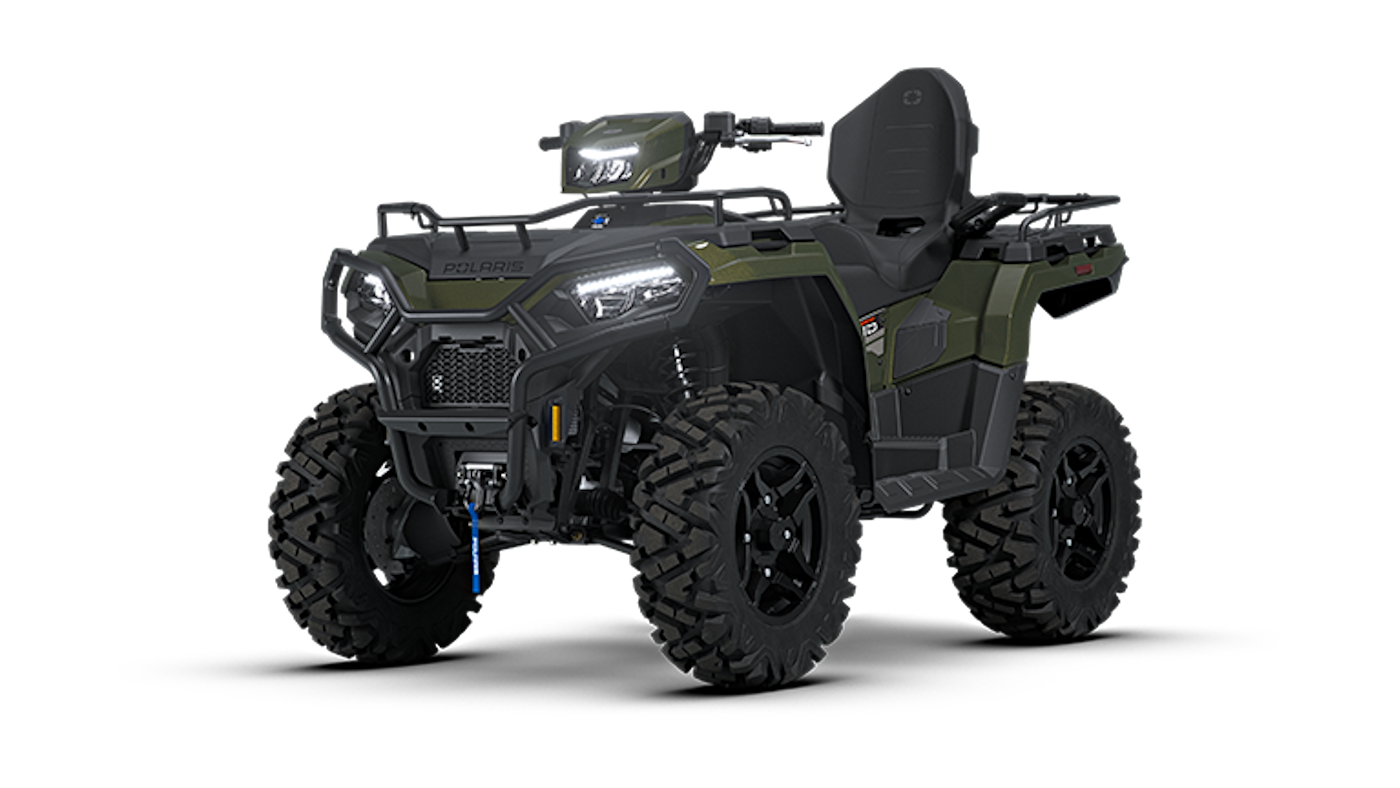
The 2027 Polaris Sportsman Touring 600 is the model to buy when “two seats” needs to mean more than a cushion strapped to the rear rack. Its passenger position is part of the ATV: a raised, removable seat with proper hand grips and a bolstered backrest, mounted on a 56-inch-wheelbase chassis that Polaris rates for two people. That distinction is the whole reason this machine exists.
The new 600 badge needs an explanation, however. This is the former Sportsman Touring 570 under a clearer name. Polaris says the switch does not bring a meaningful change in displacement, output or performance. The engine is still a 567cc liquid-cooled single producing 44 hp. For 2027, new graphics are the noteworthy update to the Premium and Ultimate trims.
At $11,499 before destination and dealer charges, the Touring 600 Premium is $3,500 more than the one-seat Sportsman 600. That is a substantial jump for the same advertised horsepower. The price makes more sense once the rest of the Premium package is counted: multi-select power steering, Engine Braking System, Active Descent Control, a 3,500 lb winch, 26-inch tires on aluminum wheels, LED lighting, rack extenders and underbody protection are all standard. It is not merely the base ATV with a second chair.
The name changed; the mission did not
Polaris’s 570-to-600 rename could easily cause a shopper to expect a larger engine. There is not one. The Touring 600 keeps 567cc of displacement and 44 hp, just as the outgoing Touring 570 did. Parts and accessories carry over, too. Anyone comparing a discounted prior-year Touring 570 should therefore look at exact trim equipment, warranty start date and out-the-door price instead of assuming the 2027 badge brings extra speed.
What remains is a useful middleweight touring ATV. It is less intimidating than a 70- or 90-hp two-up machine, yet it has enough output for normal trail riding, property work and moderate towing. The engine’s job is tractable response rather than drama. With a passenger aboard, that is often the better calibration: a smooth pull from low speed matters more than a headline acceleration number.
The automatic PVT has park, reverse, neutral, low and high ranges. Low is the sensible choice for slow towing, steep climbs and technical ground; high suits easier trail and road-speed work where legal. One-touch on-demand AWD lets the rider choose 2WD until front-wheel assistance is needed. It is a familiar Polaris system, simple to understand and well matched to an ATV that may move between chores and recreation during the same day.
A real passenger setup changes the ride
The Touring 600’s defining hardware sits behind the rider. The passenger gets a contoured backrest, handholds and a separate raised seat rather than occupying cargo space on an ATV designed for one person. The longer platform also gives both occupants dedicated foot room. Those pieces do not make rough terrain disappear, but they let the passenger brace properly and keep their weight in a predictable location.
That matters dynamically. A second adult changes steering effort, braking distances and the way an ATV pitches over bumps. A purpose-built two-up wheelbase is much easier to manage than placing the same person high and far rearward on a short solo chassis. The Touring’s 56-inch wheelbase is 5.5 inches longer than the single-seat Sportsman 600’s, while overall length grows from 83 to 91 inches.
The passenger seat comes off without tools. Remove it and the ATV becomes more useful for a solo workday, but it does not become as short or light as the regular Sportsman. The Touring 600 Premium weighs 932 lb dry—229 lb more than the base one-seat Sportsman 600 in Polaris’s published figures. Its turning behavior and trailer requirements remain those of the longer machine.
The sensible way to test one is with the person who will actually ride pillion. Check how easily they can climb on, whether their knees clear the rider, whether the backrest lands comfortably and whether both people can reach their supports without strain. Brochure photography cannot answer those questions.
Chassis, suspension and trail manners
At 48 inches wide, the Sportsman Touring 600 retains one of the practical virtues of a conventional ATV. It is narrow enough for many 50-inch trail systems, although owners should always check local rules and account for tire choice. The extra length is more noticeable in tight switchbacks and when loading a short trailer than the width is between trees.
Front suspension uses sealed MacPherson struts with 8.2 inches of travel. The rear has sealed dual A-arms, independent suspension and 9.5 inches of travel. Ground clearance is 11.5 inches. Those are useful numbers for roots, ruts and uneven access roads, without suggesting this is a high-speed sport chassis. The 26-inch Duro tires and 14-inch aluminum wheels are also a sensible middle ground between trail clearance and manageable steering weight.
Multi-select EPS is standard on the Premium. That feature earns its keep at walking speed, with the front rack loaded or when a passenger shifts more weight onto the rear half of the chassis. Riders can choose the assistance level to suit the terrain rather than accepting one fixed steering feel.
Engine Braking System and Active Descent Control are equally important. EBS helps hold the ATV back when the throttle closes, while ADC is intended to help control all four wheels on descents. Neither system eliminates the need for correct braking technique, low range and conservative speed. They do, however, make the Premium much better specified for hilly two-up riding than the base single-seat Sportsman 600, which does not include those systems.
The brakes themselves use a single hand lever operating a three-wheel hydraulic disc system, with a separate hydraulic rear foot brake. That layout will feel familiar to experienced Polaris owners. With 986 lb of curb weight before riders or cargo, leaving extra stopping space is not optional.
Work equipment is unusually complete
Touring does not mean the Sportsman has stopped being a utility ATV. The front rack carries 90 lb and the rear carries 180 lb, for 270 lb combined. Both get extenders on the Premium. A standard 1.25-inch receiver supports a 1,350 lb tow rating, and the factory 3,500 lb winch is useful for recovery, snow-plow work or pulling a stubborn load into place.
There is 11 gallons of sealed storage: five gallons at the front and six at the rear. That is a meaningful improvement over carrying every small item in a rack box. Recovery straps, gloves, a tire kit and rain gear can stay protected without consuming the rated rack area. When the passenger seat is installed, though, plan cargo placement carefully so nothing interferes with the passenger’s legs, grips or exit route.
Payload is rated at 485 lb. That figure includes the riders, cargo and accessories added to the vehicle. Two adults can use most of it before a tool box, cooler or hitch load enters the calculation. The 1,350 lb tow rating is not permission to ignore payload, terrain or tongue weight; a steep, loose trail can become the limiting factor well before a flat-ground marketing number.
Protection equipment includes front and rear A-arm guards plus a front trail bumper. The Premium is also pre-wired for hand and thumb warmers, has a 12-volt outlet and provides a trickle-charge port in the instrument pod. These are modest details, but they are the sort owners appreciate after the first cold week of use.
2027 Polaris Sportsman Touring 600 Premium specifications
| Specification |
Sportsman Touring 600 Premium |
| Engine |
567cc liquid-cooled ProStar DOHC single-cylinder four-stroke |
| Output |
44 hp |
| Fuel system |
Electronic fuel injection |
| Transmission |
Automatic PVT; park, reverse, neutral, low and high |
| Drive system |
One-touch on-demand AWD / 2WD |
| Descent systems |
Engine Braking System and Active Descent Control |
| Power steering |
Multi-select EPS |
| Front suspension |
Sealed MacPherson strut; 8.2 in travel |
| Rear suspension |
Sealed dual A-arm IRS; 9.5 in travel |
| Tires |
26 x 8-14 front; 26 x 10-14 rear Duro |
| Wheels |
14-inch aluminum |
| Length x width x height |
91 x 48 x 59 in |
| Wheelbase |
56 in |
| Seat height |
35.75 in |
| Ground clearance |
11.5 in |
| Dry / curb weight |
932 / 986 lb |
| Fuel capacity |
6.75 gal |
| Person capacity |
2 |
| Payload capacity |
485 lb |
| Towing capacity |
1,350 lb |
| Rack capacity |
90 lb front / 180 lb rear |
| Sealed storage |
5 gal front / 6 gal rear |
| Winch |
Factory 3,500 lb unit with steel cable |
| Base MSRP |
$11,499 plus destination and setup |
Touring 600 versus the one-seat Sportsman 600
The regular 2027 Sportsman 600 costs $7,999 and uses the same 567cc displacement and 44 hp rating. It is 5.5 inches shorter in wheelbase, 8 inches shorter overall and 229 lb lighter on listed dry weight. For a solo rider threading tight woods or loading a compact pickup bed, those are advantages—not deficiencies.
The Touring Premium answers with legal two-person capacity, a larger 6.75-gallon tank, multi-select EPS, EBS, ADC, aluminum wheels, a winch, more storage and more protection. If a passenger will ride regularly, buy the Touring. If nearly every mile is solo, the shorter ATV is the cleaner tool and leaves $3,500 for gear. Compare both Sportsman 600 versions side by side.
Touring 600 versus Outlander MAX 700
The Can-Am Outlander MAX 700 is the closest conceptual rival in ATVPedia’s current data. Its 650cc Rotax single is rated at 50 hp, six more than the Polaris, and its listed $10,299 MSRP undercuts the Touring 600 Premium by $1,200. The Can-Am is also narrower at 46 inches and much lighter in our listed specification.
The Polaris counters with a more complete Premium equipment story: a standard 3,500 lb winch, multi-select EPS, EBS/ADC, rack extenders and 11 gallons of sealed storage. The Can-Am carries the higher 1,650 lb tow rating versus 1,350 lb. Choose on the exact trim and dealer quote rather than engine size alone, because included equipment can reverse the apparent value. See the full Touring 600 and Outlander MAX comparison.
Touring 600 versus CForce 800 Touring
The 2026 CFMoto CForce 800 Touring takes the value-and-output route. ATVPedia lists its 799cc V-twin at 70 hp and $9,499—26 more horsepower and $2,000 less MSRP than this Polaris. Its 1,500 lb tow rating also splits the difference between the Sportsman and Outlander.
The trade is size and mass. The CFMoto is 48.8 inches wide, 58 inches between the axles and 970 lb in the listed weight field. A buyer who must stay within a 50-inch trail limit should verify the rule and the ATV’s as-delivered width before choosing it. The Polaris is down on power but is a known 48 inches wide and offers a very complete trail-and-work package in Premium form. Compare the two touring ATVs directly.
Premium or Ultimate?
The Premium is the rational Touring 600. It already has the passenger hardware, selectable steering assist, descent-control systems, winch, protection and LED lighting that materially change how the ATV works. Spending another $3,000 on the $14,499 Ultimate buys upgrades including the seven-inch RIDE COMMAND display, arched front suspension and higher-output lighting.
Those additions can be worthwhile for a rider who navigates unfamiliar trail networks or rides frequently after dark. They do not add horsepower, passenger capacity or towing capacity. For most owners, the Premium puts the money into the functional equipment first and is the better starting point.
Who should buy it
Buy the Sportsman Touring 600 Premium if two-up trail miles are a regular part of the plan, but a physically larger high-output ATV is unnecessary. It suits couples, landowners and hunting partners who want factory passenger accommodation and enough work hardware to avoid an immediate accessory bill. Its 48-inch width also deserves attention from riders whose local trail system has a width restriction.
Skip it if the passenger seat will be used twice a year. The single-seat Sportsman 600 is lighter, shorter and $3,500 cheaper. Riders who prioritize acceleration should also look seriously at the CForce 800 Touring, while buyers focused on towing capacity should examine the Outlander MAX 700.
Verdict
The 2027 Polaris Sportsman Touring 600 Premium is not exciting because of its renamed engine; there is no new 600cc performance story here. It is compelling because Polaris has assembled the right two-up hardware around the familiar 44 hp single. The passenger gets a genuine place to sit and brace, while the rider gets EPS, controlled descents, useful storage, a winch and a chassis that remains 48 inches wide.
Its weak point is price. At $11,499, it gives away horsepower and sticker-price ground to some direct rivals. But comparing only those two columns misses why the Premium works: the factory equipment list is unusually complete, and the dedicated touring layout solves a problem a solo ATV cannot safely solve. Browse more Polaris models, explore two-seat ATVs, visit the 2027 model-year hub, or build your own matchup in the comparison tool.