The Polaris Ranger 500 is the least expensive way to park a real Ranger in your shed. At $9,999 it is the entry point to the best-selling name in side-by-sides, with a 499cc single, a three-across bench and a 1,500 lb tow rating. It is not trying to be fast or fancy. It is trying to be the affordable workhorse that handles the light jobs without asking much of your wallet. The question is whether the entry Ranger gives you enough, or whether a little more money buys a lot more machine. Here is what it does well, where it holds back, and who should buy it. (New to spec sheets? Our guide on how to read ATV & UTV specs covers the numbers that matter.)
The Ranger 500 runs a 499cc single making about 28 horsepower through an automatic PVT transmission and switchable 2WD/4WD. That is a modest number, and it feels modest. This is a machine tuned for torque at low speed rather than pace, so it will pull a light trailer, creep along a fence line and haul a load across a property without complaint. Ask it to move fast or climb a steep grade under a heavy load and you will find its ceiling quickly. Owners generally report a top speed in the mid-40s mph. For feeding animals, running tools to a job site and getting around acreage, the little single is enough. For fast trail miles or heavy hauling, it is not, and that is by design.
Work and everyday use
What makes the 500 punch above its price is the layout. It seats three across a full-width bench, which is rare at this money, since most rivals in the sub-$10,000 bracket seat only two. It tows 1,500 pounds, more than a Honda Pioneer 500 or a Kawasaki Mule SX manages, and it carries roughly 1,000 pounds in a cargo box that works with Polaris’s Lock & Ride accessory system, the deepest catalog in powersports. A 2-inch receiver hitch comes standard. At 58.5 inches wide it slips down tight trails and drops into a full-size truck bed, and its light 1,210 lb weight makes it easy to trailer and easy on the ground. This is a genuine small workhorse, not a toy.
Where it holds back
The engine is the obvious limit. At 28 hp the 500 is the mildest machine in a class where a CFMoto UForce 600 makes 40 and even the step-up Ranger SP 570 makes 44. There is no electronic power steering at this trim, so you feel the wheel at crawl speed and on side-hills, and the 10 inches of ground clearance is fine for chores but shallow for rough country. The other catch is internal. The SP 570 sits just $1,300 up the ladder with far more power and On-Demand AWD, which makes the 500 a harder sell to anyone who can stretch. You are buying the lowest price, and you can feel where Polaris made room for it.
Who it’s for
The Ranger 500 is the right pick if your priority is a dependable, name-brand side-by-side at the lowest price of entry, for light chores, hunting access and getting around a property with a passenger or two. For that buyer it delivers the Ranger bench, the tow rating and the dealer and accessory network that budget rivals cannot match, and it does it for five figures that start with a nine.
It is the wrong pick if you do heavy work, ride fast or want any real comfort features. Power, EPS and clearance all point you up the range, and if you regularly carry a full crew you want a bigger machine. Buyers who value creature comforts over the badge should cross-shop hard, because the value brands hand you more equipment for the money.
How it compares
At $9,999 the Ranger 500 sits in a scrappy entry-level field:
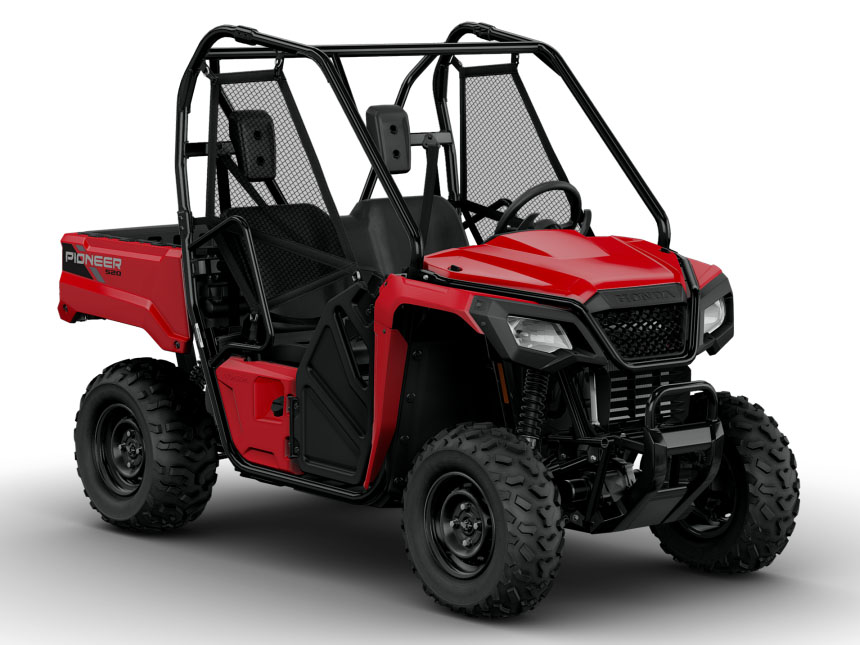
- Honda Pioneer 500, $10,199. Narrower at 50 inches and more trail-focused, with a slick five-speed automatic and Honda reliability, but it seats only two and tows 1,000 pounds. The Ranger answers with a third seat and half again the towing. Compare them →
- Hisun Sector 550, $9,999. The same price with more power at 34 hp and a bit more clearance, a real value play. The trade is a thinner dealer network and a shorter resale track record than Polaris, which matters when it is time to service or sell. Compare them →
- Kawasaki Mule SX 4x4, $8,999. Cheaper, simpler and famously tough, but smaller in every dimension with a 22 hp air-cooled single and two seats. It is the pick if bombproof simplicity beats capability for you. Compare them →
One more worth a look: the CFMoto UForce 600 ($10,999) adds 40 hp and standard EPS for a thousand more, the same value-versus-support trade as the Hisun.
Where it sits in the Ranger lineup
The 500 is the floor of a deep Ranger ladder. One rung up, the Ranger SP 570 ($11,299) adds real power and On-Demand AWD for not much more, and it is the upgrade most cross-shoppers should at least drive. Above that, the full-size Ranger 1000 ($14,299) steps up to a 999cc twin, 2,500 lb towing and a larger cab for serious work. If you are still choosing between a quad and a side-by-side in the first place, our ATV versus UTV breakdown lays out the trade. Compare the 500 and the SP 570 →
Pros and cons
The good: the lowest price of entry into a Ranger, a three-across bench that rivals at this money rarely offer, a strong 1,500 lb tow rating, a roughly 1,000 lb box on the deep Lock & Ride system, a light and narrow body that trails and truck-beds easily, and Polaris dealer and resale support behind it.
The catch: the smallest engine in the class at 28 hp, no power steering, modest ground clearance, and a step-up SP 570 that tempts you with a lot more machine for a little more money.
The verdict
The 2026 Polaris Ranger 500 does one thing clearly: it gets you into a genuine Ranger, with the bench seat and the tow rating and the dealer network, for the least money Polaris asks. If your jobs are light and your budget is firm, that is a real value. Just go in knowing the engine is small, the features are few, and the SP 570 one rung up is the machine you will keep glancing at. Match the 500 to light-duty work and a tight budget and it earns its keep. Ask more of it and the rest of the range is right there waiting.
Want to see it head to head with something specific? Drop it into the side-by-side comparison tool, or browse the full database to filter by price, power and tow rating.