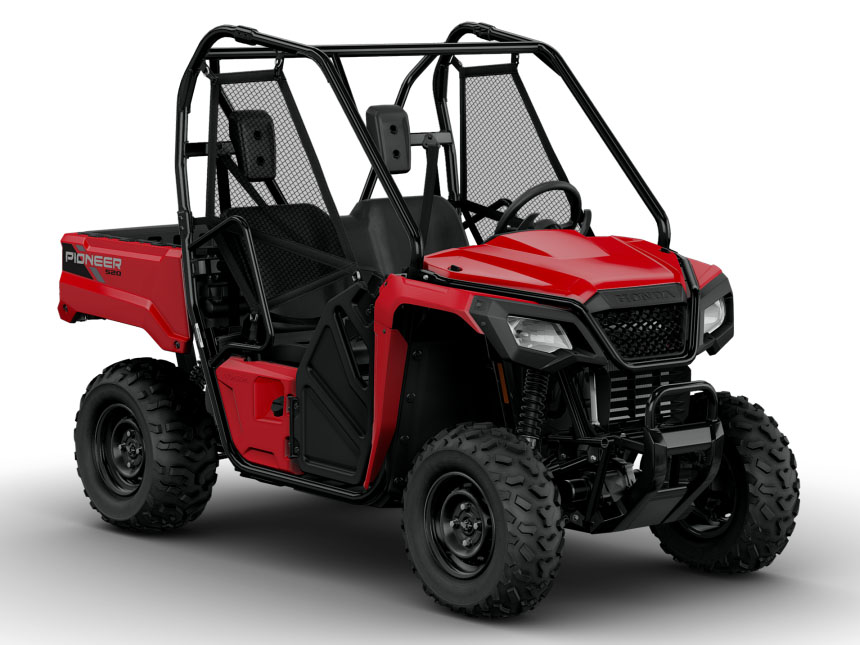
The 2025 Honda Pioneer 500 is a compact utility side-by-side for places where a full-size machine is too wide. Its 50-inch chassis fits routes that exclude most work UTVs, while a five-speed dual-clutch automatic separates it from belt-driven rivals. The trade is modest capability. It seats two, makes about 32 hp and tows 1,000 lb. Our guide to reading ATV and UTV specs explains how those figures affect real use.
The liquid-cooled 518cc single makes about 32 hp. That suits chores, hunting access and moderate trail travel. It moves the 1,075 lb machine adequately, but the Pioneer is not built for fast riding.
Load and terrain matter. Add a passenger, cargo or a trailer, then point uphill, and the available reserve shrinks quickly. Riders looking for speed on a 50-inch trail should consider a sport-focused machine such as the Can-Am Maverick Trail 1000. The Honda’s strength is controlled progress and useful work in a small footprint.
Five-speed DCT and paddle shifters
The transmission is the Pioneer 500’s most distinctive mechanical feature. Honda uses an automatic five-speed dual-clutch transmission instead of a continuously variable transmission. It shifts through real gears, avoids a CVT drive belt and allows the driver to select gears with paddle shifters.
That setup provides direct engagement and useful engine braking. It feels different from a CVT at low speed because individual gear changes remain noticeable. Drivers may need time to adjust, but buyers who do not want a consumable drive belt have a clear reason to choose the Honda.
The 50-inch advantage
Width is the number that defines this model. At exactly 50 inches, the Pioneer can use many width-restricted trails that a 55-inch Kawasaki Mule SX or 58.5-inch Polaris Ranger 500 cannot enter. The 73-inch wheelbase and two-seat layout also make it easier to place around trees, gates and outbuildings.
The narrow chassis provides less cabin room and a smaller stance than a full-size UTV. Drivers should match speed to uneven terrain and side slopes. Without trail restrictions, a wider machine can offer more seating and towing capacity for similar money.
Drivetrain, clearance and towing
Selectable 2WD and 4WD let the driver use two-wheel drive on firm surfaces, then engage four-wheel drive when traction deteriorates. Ground clearance is 8.5 inches. That is workable for maintained trails and ordinary property ruts, but it trails the 10 inches of the Ranger 500 and the Maverick Trail. Deep mud, embedded rocks and heavily rutted routes expose the limit.
The 1,000 lb tow rating covers a light utility trailer or modest property load, though the Ranger 500 and Pioneer 700 are rated for 1,500 lb. The 4.1-gallon fuel tank also means long days away from fuel need planning.
Who it is for
The Pioneer 500 suits an owner, hunter or trail rider who needs two seats and benefits from a 50-inch width. It offers more passenger protection and cargo usefulness than an ATV while fitting many ATV-style routes. Buyers weighing those formats can use our ATV versus UTV guide.
It is less convincing when width does not matter. A family needing three seats, an owner who regularly tows above 1,000 lb or a rider dealing with rough ground will find the limits quickly. The compact Honda is a specialist, and its value depends on access rather than maximum capability per dollar.
How it compares
The Polaris Ranger 500 costs $9,999, which is $200 less than the Honda. It seats three, tows 1,500 lb and has 10 inches of clearance. The Pioneer makes 4 hp more, uses a five-speed DCT and is 8.5 inches narrower. The Polaris is the stronger general-purpose value, while the Honda wins where a 50-inch gate or trail decides the purchase. Compare them directly.
The Kawasaki Mule SX 4x4 costs $8,999. Its 401cc air-cooled single makes 22 hp, and it tows 1,100 lb. The Mule is cheaper and has a steel cargo bed, but it is 55.1 inches wide and has only 6.5 inches of clearance. The Honda brings more power, more clearance and narrow-trail access for another $1,200. Compare the Honda and Kawasaki.
The Maverick Trail 1000 shares the Honda’s 50-inch width but serves a different buyer. It makes 100 hp, has 10 inches of clearance and costs $16,499. It gives up rated towing in exchange for much stronger recreational performance. See both narrow machines side by side.
Where it sits in the Pioneer lineup
The Pioneer 700 is the next utility step at $12,399. It seats three, makes about 36 hp, tows 1,500 lb and raises clearance to 10.5 inches. Its 59.7-inch width rules it out where the Pioneer 500 fits. The Pioneer 700-4 adds flexible four-seat capacity for $13,199. Farther up, the Pioneer 1000 models bring a stronger twin, higher towing capacity and much higher prices. The 500 remains Honda’s access-first option.
Price and value
At $10,199, the Pioneer 500 costs slightly more than the Ranger 500 and $1,200 more than the Mule SX. It does not win on seats, towing or clearance. Its value rests on two features the wider work machines cannot combine: a true 50-inch chassis and Honda’s geared DCT.
If the machine must fit a restricted trail, that pairing can justify the price immediately. If it will spend every day on open acreage, the Ranger offers more capacity for less money. Buyers should pay for the Honda’s narrowness only when they will use it.
Pros and cons
The good: an exact 50-inch width, a beltless five-speed DCT with paddle shifters, selectable 2WD and 4WD, two-seat side-by-side practicality and a useful 1,000 lb tow rating in a compact package.
The catch: only 32 hp, two seats, 8.5 inches of clearance, a small 4.1-gallon tank and less towing capacity than several similarly priced but wider utility rivals.
The verdict
The 2025 Honda Pioneer 500 makes sense when access is the first requirement. It fits 50-inch routes, carries two people and provides light utility capability without resorting to a belt-driven transmission. Few machines combine those traits.
Without a width restriction, its compromises become harder to overlook. Wider rivals seat more, tow more or cost less. Choose the Pioneer because its dimensions solve a real problem, and the compact Honda is a clever tool. Choose it only because it is inexpensive, and stronger values are nearby.
Want to compare it with another compact UTV? Add it to the comparison tool, or browse the full database by width, towing capacity and price.