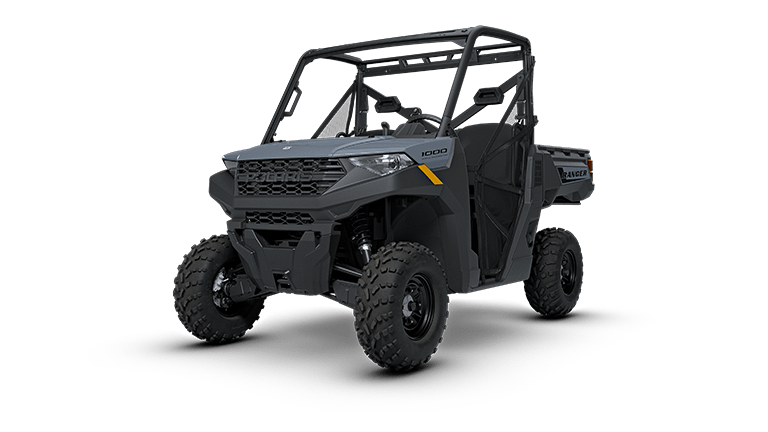
The 2027 Polaris RANGER 1000 is the plain-spoken version of a full-size work UTV. It starts at $14,499, seats three, makes 61 hp, tows 2,500 lb, and has a 1,000 lb gas-assist dump box. That is a compelling core for acreage work, hunting access, chores, and trailer duty. It is also deliberately basic: the open cab, cab nets, halogen lights, manual steering effort, and no-winch equipment list tell you exactly where Polaris held the price.
That honesty is what makes this one worth considering. A buyer who needs climate control, a big touchscreen, or a fast trail machine should skip straight to a better-equipped Ranger family member. A buyer who needs a three-seat machine to start every morning and move real loads may find this is the sensible stopping point. Before shopping, it helps to know which ATV and UTV specifications actually matter.
What is new for 2027?
Polaris’s 2027 material presents the base RANGER 1000 as a carryover work package rather than a ground-up redesign. The headline hardware remains the 61 hp, 999cc ProStar twin; the 1,000 lb Lock & Ride dump box; 2,500 lb towing; and three-across seating. MSRP is $14,499, with Polaris listing a separate $1,195 destination charge.
That does not make the current model stale. It means the buying decision is about configuration rather than chasing a supposed new chassis. The new-model page gives the base machine 25-inch tires, 12 inches of clearance, on-demand AWD, and Turf Mode. Whether that is enough depends mostly on how much slow, tight, or muddy ground you cover—and how much you value power steering.
The engine is for working, not showing off
The liquid-cooled 999cc ProStar SOHC twin produces 61 hp and drives through Polaris’s Gen 2 automatic PVT with high, low, neutral, reverse, and park. There is no clutch pedal and no reason to treat it like a sport side-by-side. Low range is the setting to use when the load gets heavy, the grade gets steep, or a trailer needs careful control; that protects the belt and makes the job calmer.
Selectable 2WD, on-demand AWD, and VersaTrac Turf Mode give the machine a useful range of personalities. Two-wheel drive is the straightforward choice for hard ground. AWD is there when traction matters. Turf Mode is particularly welcome around lawns and maintained property because it lets the rear axle differentiate more freely in turns. None of that substitutes for appropriate tires or sensible load management, but it is a practical drivetrain setup for a working UTV.
The limitation is not hidden: this base trim has no electronic power steering. At speed that matters little. At low speed, with a loaded box, in ruts, or after a long day, it matters a lot more. Buyers who know they will spend their time maneuvering through gates, woods, or uneven fields should price the RANGER 1000 EPS before deciding the base model is the bargain.
Capability: the numbers are genuinely useful
Polaris rates the RANGER 1000 for a 1,000 lb box load, 1,500 lb of total payload, and 2,500 lb of towing. The bed measures 36.75 by 54.25 by 12.5 inches, uses gas assistance for dumping, and accepts Lock & Ride accessories. Those are work numbers, not decorative brochure claims. They are enough for feed, fence supplies, firewood, tools, and a properly matched utility trailer.
The chassis is compact for a full-size machine at 62.5 inches wide, 120 inches long, and 81 inches between the axles. Its 25-inch Carlstar 489 tires and 12 inches of ground clearance are reasonable for two-track, pasture, and maintained trails, but they are not a mud-package substitute. Ten inches of front and rear double-A-arm travel should make the machine compliant over ordinary rough ground; it will not turn a loaded UTV into a fast trail toy.
The 1,487 lb dry-weight figure is useful context for transport and recovery planning, not an operating weight. Add fuel, passengers, cargo, accessories, and any roof or windshield before deciding what your trailer or winch needs to handle.
2027 Polaris RANGER 1000 specifications
| Specification |
2027 RANGER 1000 base |
| Engine |
999cc liquid-cooled ProStar SOHC parallel-twin |
| Factory-rated output |
61 hp |
| Transmission |
Gen 2 automatic PVT, H/L/N/R/P |
| Drive system |
Selectable 2WD, on-demand AWD, VersaTrac Turf Mode |
| Seating |
3 people, three-point harnesses |
| Dry weight |
1,487 lb |
| Width / length |
62.5 in / 120 in |
| Wheelbase |
81 in |
| Ground clearance |
12 in |
| Fuel capacity |
11.35 gal |
| Cargo box |
1,000 lb; 36.75 x 54.25 x 12.5 in |
| Total payload |
1,500 lb |
| Towing capacity |
2,500 lb |
| Tires |
25 in Carlstar 489 on 12 in steel wheels |
| Suspension |
Double A-arm front and rear; 10 in travel each end |
| Steering / lighting |
Tilt wheel, no EPS; halogen headlamps and LED tail lamps |
| Display / charging |
4 in LCD; 660 W charging system, 12V outlet |
| Base MSRP |
$14,499, plus $1,195 destination |
Where it fits against familiar work UTVs
The previous 2025 RANGER 1000 is the closest comparison for a buyer looking at remaining stock. The 2027 base model raises the starting MSRP by $200 and keeps the same basic 61 hp, three-seat, 2,500 lb-tow idea. Check the actual inventory price and equipment before assuming either one is the deal. Compare the two model years →
The Can-Am Defender HD10 makes sense for buyers who want a harder-edged work chassis and more clearance, while the Ranger makes a strong case with its 1,000 lb box and mainstream parts-and-accessory ecosystem. Neither base trim gives you every comfort feature; compare the exact equipment, not only the engine headline. Compare Ranger 1000 and Defender HD10 →
The CFMoto UForce 1000 is the value conversation. It offers an equipment-heavy alternative on paper, while the Polaris is the simpler, familiar work-first choice. Dealer support in your area, the cost of the kit you actually want, and steering feel on a test drive are more useful tie-breakers than a feature count. Compare the two →
The Kawasaki Ridge sits a clear step up in price and performance. That extra spend makes sense for buyers who want more engine and more chassis, not for someone whose hours are mostly hauling supplies at property speeds. Compare Ranger 1000 and Ridge →
Price advice: budget for the machine you will actually use
$14,499 is the starting MSRP, not the driveway price. Polaris separately lists $1,195 for destination; tax, dealer setup, registration, and accessories can change the result sharply. A roof, windshield, winch, storage, and protection package can also erase much of the gap to a better-equipped trim.
The base RANGER 1000 is good value when you truly want its base specification: open cab, cab nets, manual steering, simple 4-inch display, and work capability first. It becomes a false economy when EPS and a winch are immediate must-haves. In that case, price the EPS version and the next trim up before committing. One honest comparison sheet is better than a pile of add-on invoices.
Verdict
The 2027 Polaris RANGER 1000 is an easy recommendation for the buyer who needs a durable-looking, three-seat, full-size work UTV without paying for equipment they will not use. The 61 hp twin, 2,500 lb tow rating, 1,000 lb box, Turf Mode, and sensible overall dimensions cover a lot of real property work.
Just do not call it loaded. No EPS, no winch, and basic lighting are real compromises, not small footnotes. If those omissions fit the job, the base RANGER is refreshingly straightforward. If they do not, step up before the purchase rather than trying to turn the inexpensive trim into the machine you wanted all along.