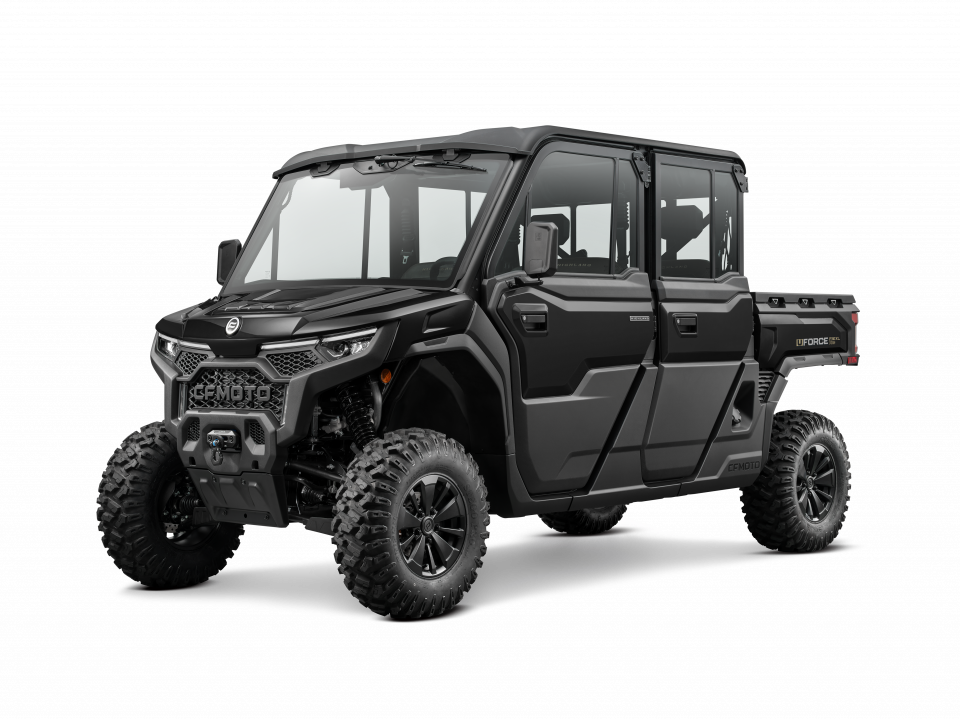
The 2026 CFMOTO UForce U10 XL Pro Highland is the version for buyers whose definition of a crew cab includes an actual crew—and whose weather does not respect the work schedule. It combines six seats, four full doors and a factory climate-controlled cabin with the same 88 hp three-cylinder engine, 1,000 lb power-dump bed and 2,500 lb tow rating found in the shorter Highland.
Its $27,499 starting price is the headline. That is $3,000 more than the three-seat UForce U10 Pro Highland, yet it undercuts several established six-seat factory-cab machines. The number is attractive because the equipment list is unusually complete: heat, air conditioning, power windows, a power tip-out windshield, wiper, sliding rear glass, 150-amp charging, a 4,500 lb winch, touchscreen and audio are already installed.
The trade is size and mass. The XL is 148 inches long, rides on a 112.5-inch wheelbase and weighs 2,374 lb dry. It is 31 inches longer and 425 lb heavier than the standard-wheelbase Highland. This is not simply the same UTV with two occasional seats squeezed behind the driver. It is a long, heavy utility vehicle that needs more room to turn, more trailer underneath it and more care on tight trails.
The second row changes the job it can do
Two three-person bench seats give the U10 XL Pro Highland a genuine reason to exist. A farm crew can move together instead of splitting between vehicles. A family can take one enclosed machine to a winter trailhead. A hunting party can carry people and gear without asking rear passengers to perch in a cargo conversion.
The second row also has four real doors around it. That matters in bad weather because rear passengers are not stepping over a side panel or sharing a drafty half enclosure. Each row benefits from the sealed-cab concept, and power glass windows allow quick ventilation without opening a complete door.
Six-person capacity still deserves a showroom test. Three adults across either bench will sit closer than they would in a pickup, especially in winter clothing. Put the likely driver in place, adjust the steering wheel and then load the actual mix of adults, children or coworkers expected to ride. Check knees, shoulders, head clearance and the path through the rear openings. A six on a specification sheet does not guarantee six equally comfortable positions.
The extra cabin length affects conversation too. The rear row sits farther from the windshield and speakers, and mechanical noise can collect differently in a long enclosed body. A short dealer-lot lap with one occupant will not reveal that. The useful test is all seats occupied, windows closed, fan running and the machine moving at the speed it will see on a gravel road.
A factory cab, not a pile of accessories
The Highland package is most convincing when weather is part of the workload. Factory-installed heat and air conditioning can make early plowing, livestock checks, midsummer property work and wet hunting trips substantially less draining. Climate control also helps clear the glass, which is a safety benefit rather than a comfort trick when damp clothing fogs the windshield.
CFMOTO fits full locking doors with power windows, a power tip-out glass windshield and wiper, plus sliding rear glass. Opening the front glass provides direct airflow in mild weather; opening the rear slider helps air move through the long cabin. The power side windows let front and rear passengers make smaller adjustments without compromising the entire enclosure.
The 150-amp charging system is important because the cab itself creates meaningful electrical demand. HVAC blowers, window motors, a windshield actuator, wiper, audio and lighting all share the system before an owner adds a sprayer, beacon, plow controls or auxiliary lights. The higher-capacity system gives the XL Highland a sensible electrical foundation, though accessory loads still need to be calculated rather than guessed.
Doors and glass add maintenance points. Window switches, seals, latches and the windshield mechanism should be operated during the pre-delivery inspection. Spray and dust will eventually reveal weak sealing or drainage. Buyers paying specifically for all-season comfort should weigh dealer service and parts availability as seriously as horsepower.
The 88 hp triple has more vehicle to move
The 998cc engine is a liquid-cooled DOHC inline-three with 12 valves and Bosch electronic fuel injection. CFMOTO rates it at 88 hp at 7,250 rpm and 69 lb-ft at 6,500 rpm. Those are the same figures quoted for every U10 Pro and U10 XL Pro configuration in the 2026 U.S. range.
In the XL Highland, the engine begins with 2,374 lb of dry vehicle before fuel, occupants, tools or cargo arrive. Six 180-pound occupants would add 1,080 lb; a full 11.8-gallon fuel tank contributes roughly another 70. The point is not that the triple lacks power. It is that a crew vehicle’s operating weight can move far beyond the tidy brochure number, so acceleration and braking should be judged with realistic loading.
Electronic throttle control offers NORMAL and WORK modes. NORMAL is the more immediate calibration for general travel. WORK softens response, which can make it easier to inch toward a trailer, cross rough ground without unwanted pedal movement or manage a loaded bed. It changes delivery, not maximum output.
The OmniDrive automatic CVT provides park, reverse, neutral, high and low ranges through push-button shifting. Low range should be the default for slow towing, steep ground and extended crawling with weight aboard. A powerful engine cannot prevent belt heat when an operator asks high range to creep under a heavy load.
Long-wheelbase manners
The XL Highland is 64 inches wide and 13 inches off the ground, exactly matching the shorter Highland in those dimensions. Its wheelbase, however, stretches from 81.1 to 112.5 inches. Overall length grows from 117 to 148 inches, and the listed turning radius expands from 13.9 to 17.7 feet.
That length has two personalities. On a graded road, broad trail or open property, the long wheelbase can feel settled and predictable. Front and rear occupants are spread between the axles rather than stacked over a short chassis. On switchbacks, between trees or around a crowded barn, the driver must plan the rear axle’s path and allow more space for the body to sweep through a turn.
The drive system offers 2WD, 4WD and locked 4WD, along with a locking rear differential. That gives the driver useful choices: an open rear differential for turf, 2WD for easy surfaces, 4WD for loose ground and full lock when traction becomes scarce. Electronic power steering reduces effort, while hill-descent control helps manage speed on steep drops.
High-clearance independent A-arms provide 11 inches of front wheel travel. Independent double A-arms at the rear provide 10.4 inches. Spring-preload-adjustable oil-damped shocks and front and rear sway bars reflect the machine’s utility brief. The sway bars are especially relevant on a tall, enclosed crew vehicle, where passengers and cab hardware place considerable weight above the frame.
CFMOTO uses 29 x 9-14 front and 29 x 11-14 rear tires on 14-inch aluminum wheels. Four-wheel hydraulic disc brakes are paired with an electronic parking brake. With a potential loaded weight well above 3,000 lb, tire pressure, brake condition and cargo placement deserve routine attention rather than an occasional glance.
Work numbers remain intact
Adding the second row does not shrink the rated cargo bed. The electronic/hydraulic tilt box still carries 1,000 lb, and the machine still tows 2,500 lb. That gives the XL Highland a useful combination: six seats when people are the payload, or a serious bed and receiver when the day is about material and equipment.
Those maximums are not automatically additive. Passengers, bed cargo, accessories and trailer tongue weight all load the chassis. The owner’s manual and safety labels—not the largest figures repeated in an advertisement—should decide the permissible combination. Terrain matters as well: controlling a trailer across a smooth yard is different from stopping it on a loose downhill grade.
The power tilt bed is more than a premium touch. A 1,000 lb rating means the box can hold loads that are unpleasant or unsafe to raise manually. The hydraulic mechanism lets the operator dump dense material without climbing into the bed or wrestling with a heavy latch. As with the cab hardware, it should be cycled during inspection and kept clean around its pivots.
A factory 4,500 lb winch with synthetic rope sits at the front. The XL Highland also includes a roof, full skid plate, mirrors, LED head, tail and backup lights, and a two-inch receiver. These are meaningful inclusions on a work machine because they reduce the list of parts that must be purchased and installed before the first difficult season.
Technology inside the cab
An eight-inch CFMOTO RideSync MMI touchscreen handles vehicle information and supports Apple CarPlay. RideSync app compatibility comes through the T-box, and an MB Quart audio package is standard. USB and 12-volt power, an NFC key and push-button gear selection complete the automotive-style presentation.
The useful question is not whether the screen looks modern in photographs. It is whether the controls remain clear with gloves, glare and a bouncing chassis. Buyers should operate climate settings, drive modes and the transmission while seated normally, then check whether the windshield or screen reflects bright light. Physical tasks should remain easy even when the display is wet or dusty.
Six occupants also bring six phones, gloves, drink bottles and small items. Cabin storage that seems generous with one person can disappear quickly. Load the vehicle mentally during a showroom walkaround: recovery gear, first-aid kit and tools need secure homes before personal belongings begin to fill the space.
2026 CFMOTO UForce U10 XL Pro Highland specifications
| Specification |
UForce U10 XL Pro Highland |
| Engine |
998cc liquid-cooled DOHC 12-valve inline-three |
| Output |
88 hp at 7,250 rpm; 69 lb-ft at 6,500 rpm |
| Fuel system |
Bosch electronic fuel injection |
| Throttle / modes |
Electronic throttle; NORMAL and WORK |
| Transmission |
OmniDrive CVT; P/R/N/H/L with push-button shifting |
| Drive system |
2WD / 4WD / locked 4WD; locking rear differential |
| Steering |
Electronic power steering |
| Front suspension |
High-clearance independent A-arm; 11 in travel |
| Rear suspension |
Independent double A-arm; 10.4 in travel |
| Brakes |
Hydraulic discs; electronic parking brake |
| Tires |
29 x 9-14 front; 29 x 11-14 rear |
| Wheels |
14-inch aluminum |
| Length x width x height |
148 x 64 x 77 in |
| Wheelbase |
112.5 in |
| Turning radius |
17.7 ft |
| Ground clearance |
13 in |
| Dry weight |
2,374 lb |
| Fuel capacity |
11.8 gal |
| Seating |
Six; two three-person benches |
| Cargo-bed capacity |
1,000 lb; electronic/hydraulic tilt |
| Towing capacity |
2,500 lb |
| Winch |
4,500 lb with synthetic rope |
| Cab |
Four full doors, power windows, tip-out windshield, rear slider, HVAC |
| Electrical system |
150-amp charging system |
| Display |
8-inch RideSync MMI touchscreen with Apple CarPlay |
| Base MSRP |
$27,499 |
XL Highland versus the three-seat Highland
The shorter U10 Pro Highland is the obvious first comparison because the two machines share their engine, driveline, suspension travel, 64-inch width, 13-inch clearance, tire sizes, bed rating, towing rating and core cab equipment.
The XL buys three additional seats and two doors for $3,000. It also adds 31.4 inches of wheelbase, 31 inches of overall length and 425 lb of dry weight. The turning circle grows by 3.8 feet. If four or more people genuinely ride together, that exchange is reasonable. If the second row will mostly carry jackets, the shorter machine is easier to transport and maneuver while doing exactly the same work.
The decision should begin with occupancy, not price. A buyer who needs six seats cannot make the three-seat Highland fit by saving $3,000. A buyer who needs two seats most days should not accept a larger trailer and wider turning path merely because the XL looks like more vehicle for the money. Compare both Highland configurations.
XL Highland versus Can-Am Defender MAX Limited
ATVPedia’s 2025 Can-Am Defender MAX HD10 Limited is another six-seat, climate-controlled utility UTV. Our recorded MSRP is $29,999, $2,500 above the CFMOTO. Both tow 2,500 lb, while the CFMOTO claims 88 hp against the Can-Am’s listed 82.
The Can-Am is narrower in our data at 62 inches and has two more inches of ground clearance. Its 121-inch wheelbase is 8.5 inches longer than the CFMOTO’s. Published weight definitions and equipment can vary, so shoppers should confirm current trim specifications rather than treating a cross-brand table as a scale ticket.
CFMOTO’s case rests on included equipment and price. Can-Am counters with an established Defender platform, dealer network and accessory ecosystem. The correct answer is local: compare complete quotes, drive both with the cab closed and ask each dealer how quickly ordinary cab and powertrain parts can be supplied. Compare the XL Highland and Defender MAX Limited.
XL Highland versus Kawasaki Ridge Crew
The 2027 Kawasaki Ridge Crew offers six seats, a 1,000 lb bed and 2,500 lb towing in ATVPedia’s current data. Its 116 hp inline-four is substantially stronger, and its $23,599 base price is lower than the XL Highland’s—but the base Ridge Crew does not include the Highland’s fully enclosed HVAC cabin.
That distinction prevents a simple MSRP verdict. Adding enclosure and climate equipment can radically change a vehicle’s price and weight. The Kawasaki makes more sense for buyers prioritizing engine output and open-cab use. The CFMOTO is the more directly equipped answer when year-round weather protection is mandatory from day one. Compare the U10 XL Highland and Ridge Crew.
Who should buy it
The U10 XL Pro Highland fits crews and families who regularly carry four to six people through cold, heat, rain or dust. Ranches, large properties, resorts, winter job sites and hunting groups can all make a rational case for the rear bench and factory HVAC. It is also compelling when a buyer wants a complete cab on the purchase invoice rather than a months-long accessory project.
Skip the XL if the rear row will be used only a few times a year. The three-seat Highland keeps every major work rating, costs less and is far easier to place on a trailer or thread through a tight property. Skip the Highland package entirely if most use happens in mild weather with the windows and windshield open; the later open-cab U10 XL Pro entry will address that buyer directly.
Before purchasing, measure gates, garage height, trailer deck and ramp angle. Verify trailer payload against the machine’s real fueled and accessorized weight, not 2,374 lb dry. Sit six intended occupants inside, close every door, run the HVAC and drive at realistic speed. A crew-cab UTV is too expensive to evaluate as an empty showroom object.
Verdict
The 2026 CFMOTO UForce U10 XL Pro Highland is not a sport machine wearing work clothes. It is a purpose-built, six-seat utility cab with credible capacity and a remarkably broad standard-equipment list. The 88 hp triple, 1,000 lb power bed, 2,500 lb tow rating and 4,500 lb winch give the comfort features a useful chassis underneath them.
Its compromises are just as clear. At 148 inches long and 2,374 lb dry, it requires space, transport capacity and deliberate low-speed driving. Anyone who does not need the second row will be happier with the shorter Highland. Anyone who does need it, however, gets three additional seats without losing bed capacity, towing capacity or the sealed all-season cabin. That focused combination is what makes the XL Highland more than a stretched trim. Browse more CFMoto models, explore utility UTVs, visit the 2026 model-year hub, or build another matchup in the comparison tool.