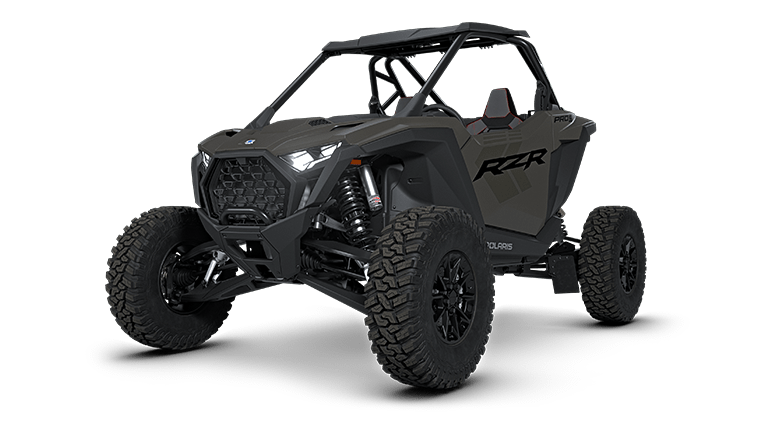
The 2027 Polaris RZR Pro S occupies a useful space that its name does not immediately explain. It is the 74-inch, long-travel branch of Polaris’s 181 hp turbo platform: wider and more suspension-focused than the RZR Pro XP, but less powerful, less costly, and less extreme than the four-cylinder RZR Pro R. The two-seat Sport reviewed here starts at $27,499 plus a $1,345 destination charge.
That price buys the important hardware. The Sport has 32-inch eight-ply tires, 16 inches of ground clearance, a 96-inch wheelbase, manually adjustable Walker Evans shocks, high-assist quick-turn power steering, half doors, a roof, and four-point harnesses. It deliberately leaves out the touchscreen, audio system, rear camera, and computer-controlled suspension of the Ultimate. The result is not cheap, but it is unusually clear about where the money went.
First, the Turbo R and Pro S name change
Polaris introduced the Turbo R name before relabeling the same branch of the RZR family as Pro S for model year 2024. Its own RZR FAQ says there was no significant mechanical difference attached to that rename. In other words, Pro S did not suddenly replace the Turbo R’s 925cc twin with an unrelated engine, and a used Turbo R should not be treated as a different vehicle class just because its graphics say something else.
There have been genuine updates since then. Polaris describes body, comfort, and technology changes for 2025, and the current 2027 design carries a larger 14.7-gallon fuel tank, revised gear-selection mechanism, and fresh-cabin air intakes. The honest summary is that Pro S continues the Turbo R concept while the surrounding machine has evolved. It is neither a rebadged Pro XP nor a less expensive Pro R.
Engine and driveline: familiar numbers, useful delivery
The liquid-cooled, fuel-injected 925cc DOHC parallel twin is turbocharged and rated at 181 hp. An automatic PVT provides park, reverse, neutral, low, and high ranges, and Polaris’s isolated Xtreme Performance driveline gives the driver true on-demand AWD or 2WD.
The number that matters here is not only peak horsepower. Polaris tunes the engine around strong response from roughly 20 to 50 mph, the range where a driver repeatedly accelerates out of corners or across broken desert terrain. Low gearing is there for slower technical climbs. That combination suits a machine intended to cover wide, rough ground without demanding Pro R money.
At an estimated 2,039 lb dry, the RZR Pro S is still a substantial vehicle. Its acceleration does not erase braking distance, side-load, or the extra momentum carried into a rough section. Four-wheel hydraulic discs and engine braking help manage speed, but good sight lines and restraint remain more valuable than an impressive power figure.
The chassis is the reason to choose it
The Pro S measures 74 inches wide, 128 inches long, and 74.4 inches tall. The wheelbase is 96 inches, ground clearance is 16 inches, and the factory tires are 32x10-15 Pro Armor Trekkers on 15-inch aluminum five-lug wheels. Those proportions are the heart of the model: stable, relatively nimble for its width, and able to place a tire over holes and ledges that would consume the travel of a smaller trail UTV.
At the front, boxed dual A-arms work through Walker Evans 2.5-inch velocity needle shocks with 16-position adjustment. Polaris lists 22.25 inches of front wheel travel and 27 inches of usable travel. The rear uses trailing arms and larger Walker Evans 3.0-inch velocity needle shocks, also with 16-position adjustment, for 22.4 inches of wheel travel and 28.3 inches of usable travel.
Those two measurements are not interchangeable. Wheel travel describes suspension movement at the wheel; Polaris’s usable-travel figure accounts for the relationship between tire droop and the skid plate. The larger number is helpful when understood correctly, but it should not be compared blindly with another manufacturer’s wheel-travel claim.
Manual shock adjustment is a sensible fit for the Sport. It gives an owner meaningful control over the setup without adding the cost and complexity of DYNAMIX. Spend time establishing tire pressure and suspension settings for the passenger load and terrain rather than copying someone else’s clicker position. A wide-travel chassis only works well when its setup matches the job.
Cabin and standard equipment
The Sport’s equipment list is more complete than the “base trim” label suggests. It includes painted bodywork, a sport poly roof, front bumper, solid half doors, bolstered seats, a driver’s seat slider, a soft-grip steering wheel, four-point harnesses, LED headlights, and high-assist quick-turn EPS. The larger fuel tank matters on long days because range anxiety changes route choices long before the tank is empty.
What the Sport does not include is equally important. There is no 10.4-inch RIDE COMMAND touchscreen, rear camera, Rockford Fosgate Stage 4 audio system, or DYNAMIX active suspension. Those are central features of the $36,999 Ultimate. The $9,500 MSRP gap is large, but so is the cost of trying to recreate an integrated screen, camera, and audio package after purchase.
Choose the Sport if you want the engine and chassis with a simpler cockpit. Choose the Ultimate if navigation, group-ride tools, audio, camera visibility, and electronically controlled suspension are already on the must-have list. Buying the Sport and then immediately attempting to build an Ultimate one accessory at a time is rarely the cleanest value calculation.
2027 Polaris RZR Pro S Sport specifications
| Specification |
2027 RZR Pro S Sport, two-seat |
| Engine |
925cc liquid-cooled turbocharged DOHC parallel twin |
| Factory-rated output |
181 hp |
| Transmission |
Automatic PVT; P/R/N/L/H |
| Drive system |
Xtreme Performance true on-demand AWD/2WD |
| Seating |
2 bolstered seats; four-point harnesses |
| Estimated dry weight |
2,039 lb |
| Overall size |
128 x 74 x 74.4 in |
| Wheelbase / ground clearance |
96 / 16 in |
| Fuel capacity |
14.7 gal |
| Payload / cargo-box capacity |
730 / 300 lb |
| Tires / wheels |
32x10-15 Pro Armor Trekker, eight-ply; 15 in aluminum |
| Front suspension |
Boxed dual A-arm; 22.25 in wheel / 27 in usable travel |
| Rear suspension |
Trailing arm; 22.4 in wheel / 28.3 in usable travel |
| Shocks |
Walker Evans 2.5 in front / 3.0 in rear; 16-position adjustment |
| Steering / brakes |
High-assist quick-turn EPS; four-wheel hydraulic discs |
| Towing / hitch |
Not rated; no receiver hitch |
| Base MSRP / destination |
$27,499 / $1,345 |
How the RZR Pro S compares
The 2024 RZR Pro XP shares the 181 hp turbo formula and a 96-inch wheelbase, but its 64-inch width is the decisive practical difference. The Pro XP fits more regulated routes and smaller trailers. The Pro S trades that access for a 74-inch footprint and a much larger suspension envelope. Compare RZR Pro S and Pro XP →
The 2025 RZR Turbo R is the direct nameplate predecessor. Used examples deserve consideration because the engine, width, and underlying concept carry forward. The 2027 Pro S has the current body and cabin design, a 14.7-gallon tank, 32-inch tires, and updated equipment, so price the details rather than assuming the two badges are either identical or unrelated. Compare Turbo R and Pro S →
The 2025 RZR Pro R is a different flagship platform. Its naturally aspirated 1,997cc four-cylinder makes 225 hp, while the Pro S uses the 181 hp turbo twin. Both are 74 inches wide, but the Pro R’s engine, driveline character, price, and mission put it a step above rather than making it an interchangeable trim. Compare Pro R and Pro S →
The 2027 RZR XP S is the strongest value comparison in the current range. It is 72 inches wide, makes 114 hp, and starts $5,000 below the Pro S Sport. The XP S is appealing when 25 inches of usable travel and naturally aspirated power are enough; the Pro S earns its premium with 181 hp, larger shocks, more rear travel, and the larger fuel tank. Compare XP S and Pro S →
Width and transport can decide the purchase
A 74-inch sport UTV does not belong on a shopping list until the owner has checked local route limits, gates, garage opening, trailer deck, fender clearance, payload, and tie-down geometry. It will not fit a 50-inch trail and should not be assumed legal on a 64-inch system. The dry weight is also only the starting point for trailer calculations; fuel, passengers’ gear, spare tire, tools, and accessories all add mass.
That constraint is not a flaw in the Pro S. The width is what helps make the suspension and stability possible. It simply means this machine is for wide-open terrain and purpose-matched transport, not for every trail network.
Verdict
The 2027 Polaris RZR Pro S Sport is the rational way into Polaris’s 181 hp, 74-inch long-travel platform. It retains the Turbo R bloodline, adds the current cabin and 14.7-gallon tank, and spends its base price on the engine, shocks, tires, steering, doors, roof, and harnesses that define the ride.
Its limitations are refreshingly visible. The Sport has no active suspension, touchscreen, camera, or factory audio, and its width closes off many regulated trails. If those facts match your priorities rather than conflict with them, the Pro S makes a persuasive case: far more serious than a mid-level trail UTV without forcing the price and complexity of a Pro R flagship.