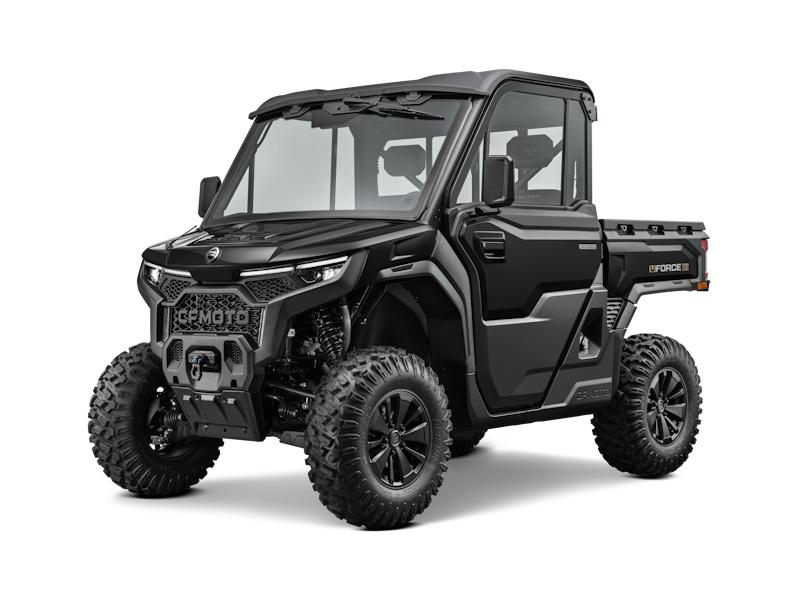
The 2026 CFMOTO UForce U10 Pro Highland asks a simple question: how much is a properly integrated cab worth? CFMOTO’s answer is $7,000. The Highland costs $24,499, while the mechanically equivalent open-cab UForce U10 Pro starts at $17,499.
That is a large jump, but the Highland is not the regular Pro with a loose collection of doors and plastic panels. It has factory-installed heat and air conditioning, full locking doors with power glass windows, a power tip-out glass windshield with a wiper, a sliding rear glass panel and a 150-amp charging system. The pieces were specified to work together, and the vehicle remains the same useful 64 inches wide and 117 inches long.
Beneath the cab, the important utility numbers do not change. The 998cc three-cylinder engine still makes 88 hp and 69 lb-ft. The electronic/hydraulic cargo bed still carries 1,000 lb, towing capacity remains 2,500 lb, and ground clearance is still 13 inches. This is the weatherproof U10 Pro, not a less capable luxury derivative.
The Highland is about the cab
Full doors change how a side-by-side works long before the heater comes on. They block branches, dust and crosswind, give occupants a more familiar sense of enclosure and make it possible for climate control to do useful work. CFMOTO fits power glass windows rather than sliding plastic panels, so ventilation does not require opening an entire door.
The front windshield is glass and electrically tips outward. Opening it introduces airflow without dropping the side windows, while the standard wiper deals with rain, spray and wet snow. The sliding rear glass provides another path for ventilation and can help tune pressure inside the cab. Those details matter because a tightly closed UTV cab can fog quickly when wet clothing and cold glass meet.
Factory HVAC is the feature most buyers are paying for. Heat is easy to appreciate during winter feeding, plowing and hunting season. Air conditioning matters just as much in a dark cab crawling slowly through humid summer weather, where natural airflow is limited. The system also gives the operator a better tool for clearing the windshield than a small accessory fan.
The 150-amp charging system supports the additional electrical demand. It is not permission to attach every light bar, sprayer and heater imaginable without doing the math, but it provides a far more suitable foundation than adapting a basic open machine. CFMOTO also includes a buss bar for accessory connections.
The price of all this is not only money. The Highland weighs 1,949 lb dry, 207 lb more than the open Pro. That extra mass sits largely in glass, doors, climate-control hardware and the roof area. It affects trailer capacity, acceleration, braking and the way the machine responds when the trail leans. The 88 hp engine is strong enough to move it, but the Highland will never feel as airy or light as its open sibling.
Same 88 hp triple, different environment
CFMOTO’s 998cc inline-three uses dual overhead cams, 12 valves, liquid cooling and Bosch electronic fuel injection. Factory output is 88 hp at 7,250 rpm and 69 lb-ft at 6,500 rpm. It is a smoother, more energetic engine than the older 963cc V-twin found in the previous UForce 1000.
The enclosed cab changes how the powertrain is experienced. Glass and a headliner reduce exposure to wind and outside noise, but the doors also keep more mechanical sound in the occupant space. Buyers should drive the Highland at the speeds they expect to use—not just idle around a dealer lot—to judge engine and CVT noise inside the closed cabin. A cab that feels pleasantly substantial at 10 mph can sound different on a long graded road.
Electronic throttle control enables NORMAL and WORK drive modes. NORMAL provides the more direct response for trail use. WORK softens throttle behavior, which is helpful when a boot is moving over rough terrain while the vehicle is carrying material or backing up to a trailer. It does not change the machine’s rated output; it changes how readily that output arrives.
The OmniDrive automatic CVT has park, reverse, neutral, high and low ranges. Selection is electronic and push-button, leaving the center area free of a tall shift lever. Low range remains essential for slow heavy work, steep climbs and controlled towing. Convenience should not become an excuse to leave the transmission in high while forcing the belt to manage a prolonged low-speed load.
Traction and chassis hardware
The drive system offers 2WD, 4WD and locked 4WD, and the rear differential can be locked when maximum traction matters. That range of choices lets an operator protect grass with an open rear differential, use 2WD for easy travel, add the front axle on loose ground and lock the system for difficult sections. Electronic power steering is standard, as is hill-descent control.
At 64 inches wide with an 81.1-inch wheelbase, the U10 Pro Highland is full-size without becoming a crew-cab barge. It can work through ordinary gates and around buildings more easily than the 148-inch-long U10 XL Pro Highland. The standard version also turns in a listed 13.9-foot radius, versus 17.7 feet for the XL.
High-clearance independent A-arms provide 11 inches of front travel, while independent double A-arms at the rear provide 10.4 inches. The oil-damped shocks offer spring-preload adjustment rather than expensive external adjusters. That makes sense on a utility vehicle: owners can compensate for routine load changes without paying for racing hardware that does little for a trailer-positioning job.
CFMOTO fits 29 x 9-14 front and 29 x 11-14 rear tires on 14-inch aluminum wheels. Ground clearance is 13 inches. Front and rear sway bars control body movement, an important consideration with the extra cab weight above the chassis. Four-wheel hydraulic disc brakes and an electronic parking brake handle stopping.
Work capacity survives the comfort upgrade
The cargo bed carries 1,000 lb and tips using an electronic/hydraulic mechanism. A power bed has more value on the Highland than it might first appear: this is already a heavy premium machine, and owners are likely to use it for serious winter or property work. Dumping a dense load at the press of a switch is a functional advantage, not merely a luxury flourish.
Towing capacity is 2,500 lb. The receiver, low range and 69 lb-ft torque rating make that useful, but operators still need to account for tongue weight, occupants, bed cargo and terrain. The rating does not guarantee control of a heavy unbraked trailer on a loose downhill surface.
A factory 4,500 lb winch with synthetic rope sits up front. The Highland also includes a roof, full skid plate, mirrors, LED head, tail and backup lights, plus front and rear sway bars. These items reduce the immediate accessory bill and make the machine ready for recovery or plow-related work without first dismantling a brand-new front end.
The 11.8-gallon fuel tank is generous for a utility UTV. A full tank adds roughly 70 lb to the dry figure, so the real trail and trailer weight is comfortably above two thousand pounds before people or cargo climb aboard. Buyers transporting the Highland should verify trailer payload, tire ratings, tie-down points and the tow vehicle’s limits using real loaded weights.
Cabin technology and everyday usability
The three-person bench is the same basic seating format as the open Pro. One driver and one passenger have useful room; three adults should sit in the actual cab before anyone signs paperwork. Doors and window frames reduce the sense of open space, and winter coats make shoulder room disappear faster than a seating-capacity number suggests.
An eight-inch CFMOTO RideSync MMI touchscreen supports Apple CarPlay and displays vehicle information and diagnostics. RideSync app compatibility comes through the T-box, while MB Quart audio, USB and 12-volt power are standard. An NFC key and push-button shifting add to the automotive feel.
These electronics are appealing, but the best cabin test is deliberately mundane. Wear work gloves. Adjust the temperature, move a window, operate the windshield, select low range and switch drive modes. Look for reflections on the screen and windshield. Check whether a tall passenger’s knees clear the dash and whether the door opening works with muddy boots. Those observations reveal more than cycling through the infotainment menus.
The cab also makes maintenance and dealer support more important. A failed heater valve, window switch or windshield actuator is not likely to stop the machine from moving, but it can undermine the reason someone paid for the Highland. The quality and proximity of the selling dealer should carry real weight in a purchase decision.
2026 CFMOTO UForce U10 Pro Highland specifications
| Specification |
UForce U10 Pro Highland |
| Engine |
998cc liquid-cooled DOHC 12-valve inline-three |
| Output |
88 hp at 7,250 rpm; 69 lb-ft at 6,500 rpm |
| Fuel system |
Bosch electronic fuel injection |
| Throttle / modes |
Electronic throttle; NORMAL and WORK |
| Transmission |
OmniDrive CVT; P/R/N/H/L with push-button shifting |
| Drive system |
2WD / 4WD / locked 4WD; locking rear differential |
| Steering |
Electronic power steering |
| Front suspension |
High-clearance independent A-arm; 11 in travel |
| Rear suspension |
Independent double A-arm; 10.4 in travel |
| Brakes |
Hydraulic discs; electronic parking brake |
| Tires |
29 x 9-14 front; 29 x 11-14 rear |
| Wheels |
14-inch aluminum |
| Length x width x height |
117 x 64 x 77 in |
| Wheelbase |
81.1 in |
| Turning radius |
13.9 ft |
| Ground clearance |
13 in |
| Dry weight |
1,949 lb |
| Fuel capacity |
11.8 gal |
| Seating |
3-person bench |
| Cargo-bed capacity |
1,000 lb; electronic/hydraulic tilt |
| Towing capacity |
2,500 lb |
| Winch |
4,500 lb with synthetic rope |
| Cab |
Full doors, power windows, tip-out windshield, rear slider, HVAC |
| Electrical system |
150-amp charging system |
| Display |
8-inch RideSync MMI touchscreen with Apple CarPlay |
| Base MSRP |
$24,499 |
Highland versus the open U10 Pro
Mechanically, these two are remarkably close. The open U10 Pro has the same power, torque, wheelbase, width, ground clearance, suspension travel, tires, fuel capacity, bed rating and towing capacity. Its roof, side nets and mirrors already provide a useful base equipment level.
The open Pro saves $7,000 and 207 lb. It is the sensible choice for fair-weather use, warm climates and owners who enjoy airflow. The Highland earns its premium when the cab will materially extend the working season or make long days safer and less exhausting. Buying it only because the doors look upscale is poor value; buying it because snow, heat, rain or dust regularly stops work is much easier to justify. Compare the U10 Pro and Highland directly.
Highland versus Polaris Ranger XP 1000 NorthStar
The 2025 Polaris Ranger XP 1000 NorthStar is the established enclosed-cab reference in ATVPedia’s current data. Its listed $30,999 MSRP is $6,500 above the Highland. Both seat three, tow 2,500 lb, have 13 inches of clearance and use an approximately 81-inch wheelbase.
The CFMOTO claims 88 hp to the Polaris’s listed 82 and weighs 91 lb less in our fields. The Ranger is 1.5 inches narrower, and Polaris counters with its mature NorthStar cab ecosystem and dealer footprint. Feature-by-feature, the Highland makes a forceful value case, but buyers should include local parts availability, service experience and final dealer charges rather than treating the MSRP difference as the whole decision. Compare the Highland and Ranger NorthStar.
Highland versus Can-Am Defender MAX Limited
The 2025 Can-Am Defender MAX HD10 Limited costs $29,999 in our data and includes an enclosed climate-controlled cab. Its major advantage is capacity: the MAX has six seats and a 121-inch wheelbase, while the U10 Pro Highland has three seats and an 81.1-inch wheelbase.
That makes the Can-Am the better fit for a larger crew but the less convenient machine in tight yards, narrow woods and shorter trailers. Both tow 2,500 lb. The CFMOTO offers six more listed horsepower, while the Defender MAX is only about 100 lb heavier despite its extra row in our recorded specifications. If three seats are enough, the shorter Highland is the cleaner tool; if four or more people regularly travel together, compare the Can-Am with CFMOTO’s XL Highland instead. See the Highland and Defender MAX comparison.
Who should buy it
Buy the U10 Pro Highland when the vehicle must work through seasons that sideline an open UTV. Snow removal, winter livestock care, dusty summer roads and frequent rain give the HVAC cab a practical purpose. It also suits buyers who need full-size bed and towing capability but do not need the length or six seats of a crew machine.
Skip it if most trips happen in mild weather with the doors or windshield open. The standard U10 Pro preserves every major performance and capacity number while saving enough money for a trailer, implements or several years of maintenance. Buyers who need six seats should go directly to the XL rather than trying to stretch a three-seat cab beyond its intended role.
Verdict
The 2026 CFMOTO UForce U10 Pro Highland is expensive relative to the open Pro, but it is inexpensive relative to many factory-enclosed utility UTVs. More importantly, CFMOTO has not sacrificed the useful part of the machine to create a comfort trim. The 88 hp triple, 1,000 lb power bed, 2,500 lb tow rating, 13 inches of clearance and 4,500 lb winch remain intact.
Its case depends entirely on use. When HVAC, glass and locking doors turn three months of comfortable work into twelve, the $7,000 premium buys something tangible. When those systems will spend most days switched off and open, the extra 207 lb and purchase cost become hard to defend. The Highland is therefore not automatically the best U10 Pro; it is the right one for the buyer whose weather makes the cab earn its keep. Browse more CFMoto models, explore utility UTVs, visit the 2026 model-year hub, or create another matchup in the comparison tool.