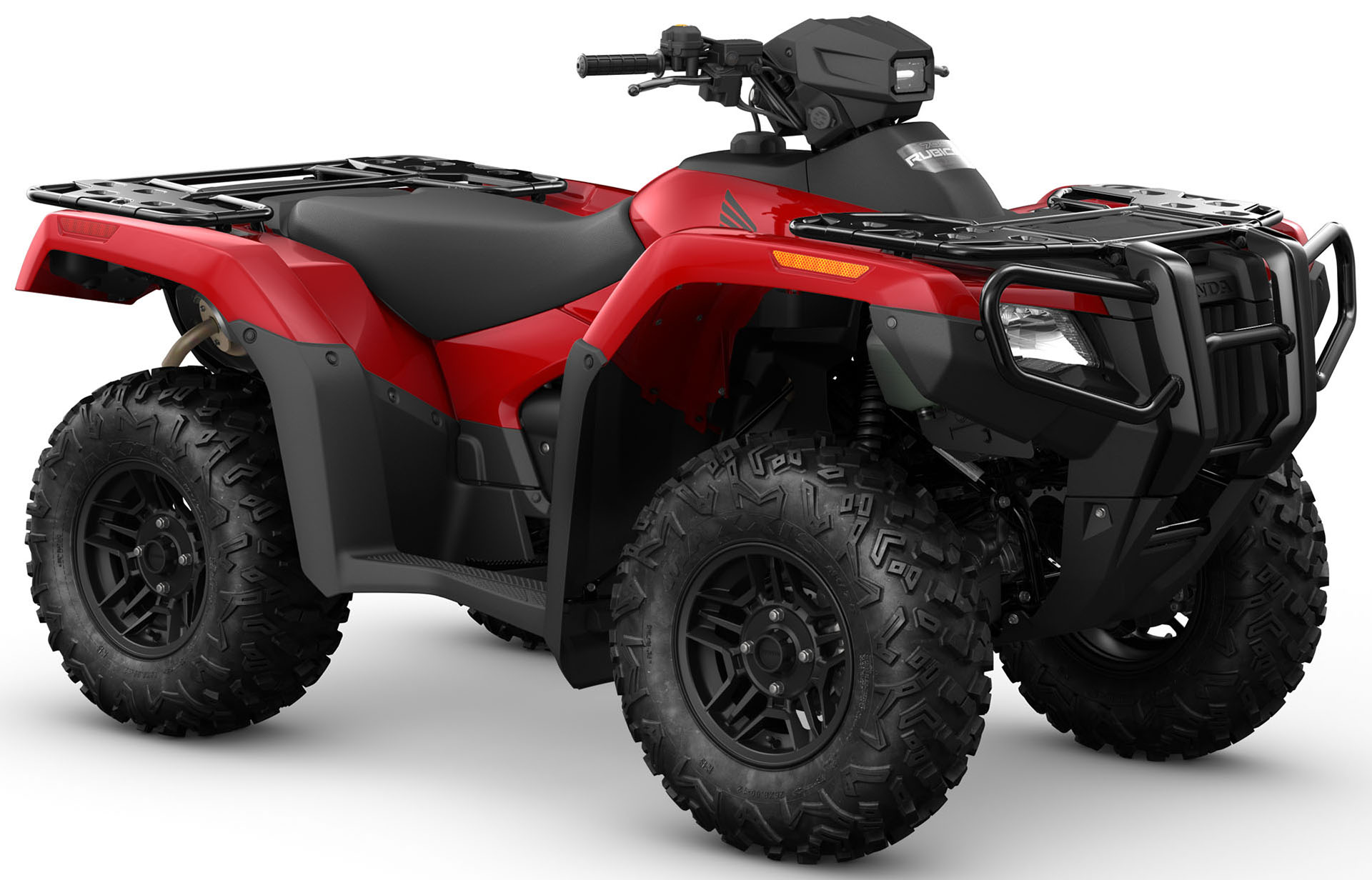
The Honda FourTrax Foreman 520 does not try to win the spec-sheet fight, and that is exactly the point. It is built to start every morning, work all day and keep running long after flashier machines have worn out. Honda’s reputation for reliability is the whole pitch here, and the Foreman backs it up with a real gearbox instead of a belt, a tough solid rear axle and simple, honest engineering. Here is where it shines, where it falls behind on paper, and whether it is the right $7,499 to spend. (Want a primer on the numbers? See our guide to reading ATV specs.)
The Foreman runs a 518cc single making about 32 horsepower. That is modest next to the 40-plus horsepower rivals at this price, but Honda builds the engine for low-end torque and a long life rather than headline power. It lugs happily at low rpm, which is what you want for slow chores and steep pulls, and it stays smooth and quiet. Top speed lands in the mid-to-high 50s in mph, around 55 by most owner accounts, which is plenty for work and trail duty.
A real gearbox, not a belt
Here is the Foreman’s signature feature. Instead of the automatic CVT that most rivals use, it runs a real five-speed gearbox with Honda’s Electric Shift Program. You shift up and down with a push button, there is no clutch lever to manage, and there is no drive belt anywhere in the system. That last point matters to a lot of buyers. A worn or broken CVT belt is one of the most common ATV headaches, and the Foreman simply does not have one. This is a big reason it keeps such a loyal following among people who work their machines hard.
How it rides: TraxLok 4WD and a solid rear axle
Honda keeps the driveline straightforward with TraxLok, which lets you switch between 2WD and 4WD as the ground demands. The rear end uses a solid axle rather than independent suspension, and that is a deliberate choice. A solid axle is tougher, easier to maintain and more stable under a load, though it rides a little firmer than an independent setup and sits lower. Ground clearance is a modest 7.6 inches, so if you ride rocky or deeply rutted trails, keep that number in mind. Power steering is available, but note that it is an option here rather than standard.
Work capability: hauling and towing
The Foreman is a hauler at heart. Honda rates it to tow 848 lb, which reads low against rivals that quote four figures, but Honda is famously conservative with its numbers, and the solid rear axle gives it steady, planted manners with a load on the racks or a trailer on the hitch. For steady property work, feeding, fencing and light towing, it is right in its element.
Who it’s for
The Foreman 520 is the right ATV if reliability and low running costs matter more to you than horsepower or a plush ride. It suits people who keep a quad for many years, who do steady work rather than fast trail riding, and who like the idea of a real gearbox with no belt to service. It is a single-rider machine built to be used and trusted.
It is not the pick if you want the most power for your money, since the same $7,499 buys a stronger Polaris Sportsman 570. It is also not ideal if you want a soft ride and high ground clearance, or if you want standard power steering without paying extra.
How it compares
At $7,499 the Foreman lands in the busiest part of the ATV market. The rivals to weigh:
- Polaris Sportsman 570, $7,499. The exact same price, but with 44 hp, independent rear suspension and On-Demand AWD. More power and a plusher ride, against the Foreman’s belt-free durability. This is the head-to-head that matters. Compare them →
- Honda FourTrax Rancher 420, $6,199. The smaller, cheaper Honda, with less power and size but the same reliability DNA. A great pick if the Foreman is more than you need. Compare them →
- Yamaha Kodiak 450 EPS, $7,699. Similar size, with the durable Ultramatic transmission and standard power steering. The Foreman answers with its gearbox and lower price. Compare them →
Shopping on features? The Can-Am Outlander 500 ($7,199) brings more power and standard DPS steering, and the Suzuki KingQuad 500AXi ($8,749) adds EPS and independent suspension. Compare the Foreman and the Outlander →
Where it sits in the Honda lineup
Honda gives you a clear ladder. Below the Foreman, the FourTrax Rancher 420 ($6,199) is the lighter mid-size option, and the compact FourTrax Recon ($5,249) is the small, easy-handling entry. If you want the Foreman’s toughness with a smoother ride, the FourTrax Foreman Rubicon 520 ($8,999) adds independent rear suspension and a slick automatic DCT. At the top, the FourTrax Rincon 680 ($9,799) is Honda’s big-bore, car-like automatic. Shopping for a young rider? The TRX90X ($3,349) is the youth starter.
Price and value: is it worth it?
At $7,499 the Foreman is priced right alongside stronger, better-equipped rivals, so on a pure feature count it can look like it gives up ground. The value is not on the spec sheet. It is in the years of low-drama ownership, the belt-free driveline, and Honda’s excellent resale, which means you get a good chunk of your money back when you sell. For a lot of buyers, that trade is worth more than a few extra horsepower.
So is it worth it? If you want a machine you can buy, work hard and forget about, yes. If you shop by horsepower, ride comfort or standard features, a rival like the Sportsman 570 will look like the better deal on paper, and you will have to decide how much Honda’s durability record is worth to you.
Pros and cons
The good: a rugged five-speed gearbox with no drive belt to fail, Honda’s strong reliability and resale record, torquey low-rpm manners, and a tough solid rear axle for hauling.
The catch: only about 32 hp, a low 7.6 inches of ground clearance and a firmer ride, power steering that costs extra, and a conservative 848 lb tow rating on paper.
The verdict
The Honda FourTrax Foreman 520 is the ATV you buy with your head, not your spec sheet. It gives up power and features to rivals at the same price, then wins the long game with a belt-free gearbox, a durable solid axle and a reliability record few can match. If you want the flashiest numbers, look elsewhere. If you want a workhorse that will still be running strong in ten years, the Foreman is one of the safest bets in the class.
Want to see how it stacks up against a specific rival? Drop it into the side-by-side comparison tool, or browse the full database to filter by power, towing and price.