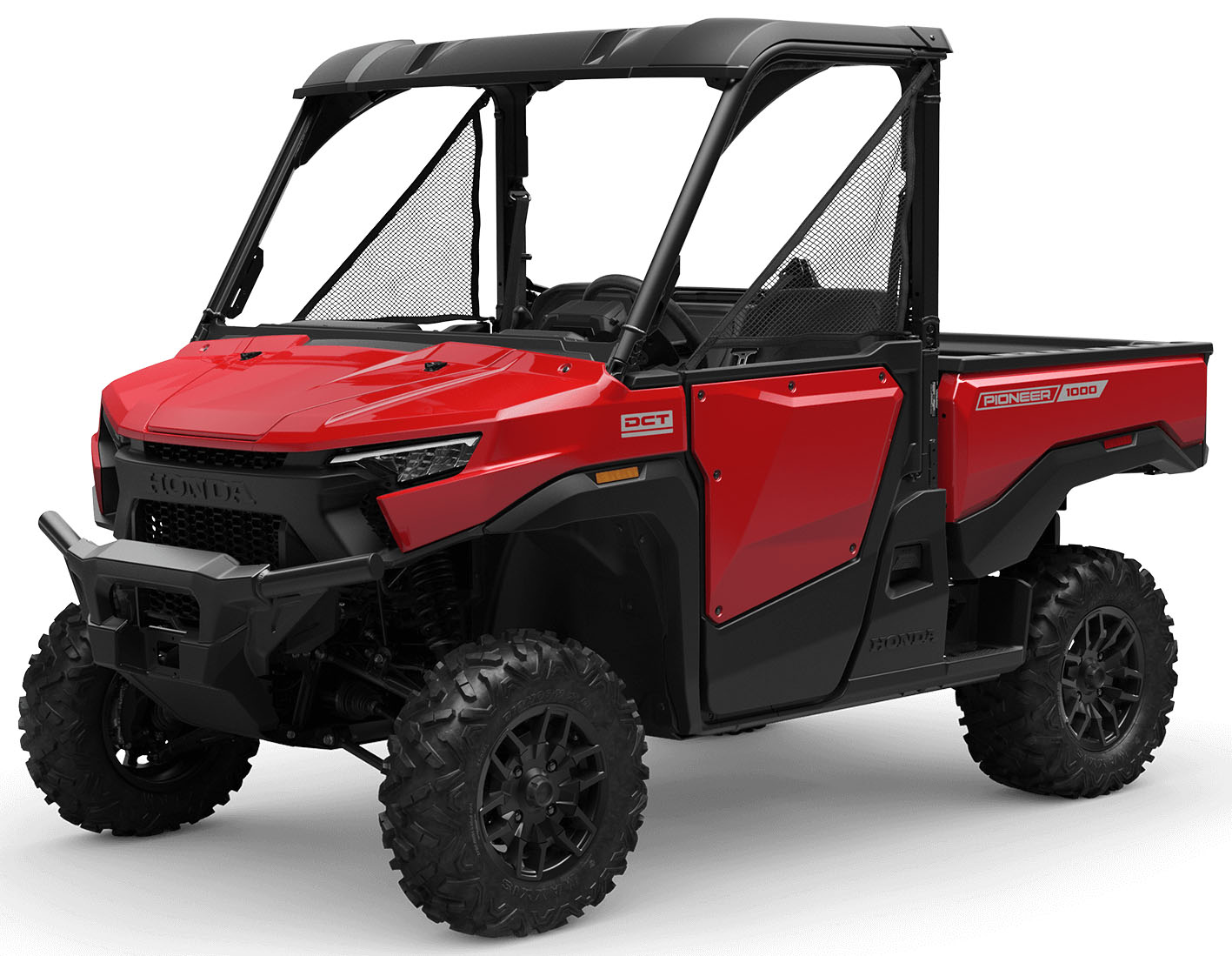
The 2026 Honda Pioneer 1000 Deluxe is the three-seat workhorse in Honda’s substantially revised Pioneer 1000 family. It keeps the familiar 999cc longitudinal twin, six-speed Dual-Clutch Transmission, 2,500-lb tow rating, and full-size dump bed, but nearly everything the driver touches or commands has been reconsidered. Throttle-by-wire enables new drive modes, cruise control, a variable speed limiter, a programmable speed-limiter key, and smoother shifting. Honda also adds stronger EPS assistance, LED headlights, a five-inch display, more storage, revised heat management, and new Pro-Connect mounting points.
This model is easy to misidentify because “Pioneer 1000 Deluxe” no longer describes every Deluxe seating layout. The vehicle reviewed here is model SXS10M3D, with one contoured bench and room for three. The separate Pioneer 1000-5 Deluxe adds two QuickFlip rear seats, while the older Pioneer 1000-6 Deluxe Crew uses a stretched six-seat cabin. The three-seater is the one for buyers who want maximum bed availability without carrying a second row every day.
At $20,999 plus $1,295 destination, it is not the cheapest route to a 1,000-lb bed or 2,500-lb tow rating. Its argument rests on the geared DCT, compact 80.2-inch wheelbase, redesigned controls, and a useful balance between work capacity and trail manners.
Price and what Deluxe includes
Honda’s published total is $22,294 before setup, tax, registration, accessories, and dealer charges. Hero Red and Black Forest Green share the base price; TrueTimber Atera Camo may affect the actual dealer total. A roof, windshield, winch, and enclosed cab should be priced as accessories rather than assumed from photography.
Deluxe equipment includes EPS, black aluminum wheels, 27-inch Maxxis Big Horn 2.0 tires, LED headlights, a hydraulic-assist tilting bed, a three-person bench, doors and side nets, and the revised digital instrument package. The new five-inch display is mounted with the steering assembly so core information remains in the driver’s sightline as the wheel is adjusted.
The $20,999 MSRP also needs context. A base 2027 Polaris Ranger 1000 costs much less in the current database, while Honda’s own 2026 Pioneer 1000-5 Deluxe is $1,400 more. The Honda earns its premium through DCT engineering and the redesigned control package, not through a published horsepower advantage.
A genuine 2026 redesign
Honda describes this as the Pioneer 1000’s first major update in roughly a decade. The headline mechanical addition is throttle-by-wire. Replacing a direct throttle cable allows the engine and transmission controls to coordinate response, shifting, cruise control, and speed management rather than treating each function separately.
The variable speed limiter is useful for jobs that require a repeatable ceiling, and cruise control reduces the small corrections needed on long property roads. A programmable speed-limiter key gives an owner a way to restrict performance for a particular operator. None of those features makes supervision optional, but they are practical tools rather than dashboard decoration.
Honda also claims smoother DCT shifting and more responsive power delivery. The EPS motor now supplies 50 percent more torque and is tuned for consistent effort in rocks, mud, or a heavily loaded bed. New door latches target rattles, seat-area heat isolation is improved, cupholders are larger, USB-C connectivity is added, and under-seat storage grows.
Outside, the squared bodywork and LED headlights make the 2026 model easy to distinguish from the 2025 Pioneer. The cargo box gains Honda Pro-Connect attachment points, giving accessories repeatable mounting positions instead of asking owners to drill a new bed.
Three seats versus five and six
The three-seat configuration is not merely the cheapest Pioneer 1000 Deluxe. It is the most direct utility layout. All 34.8 by 54.2 inches of bed floor remain dedicated to cargo because there are no rear seats folded beneath it. On 49-state models the bed is rated for 1,000 lb; California models are limited to 600 lb.
The 2026 Pioneer 1000-5 Deluxe uses Honda’s QuickFlip system to turn part of the bed into two rear seats. That flexibility suits owners who occasionally carry four or five people, but the choice between passengers and unobstructed cargo is built into the design. The three-seater is simpler when nearly every trip involves tools, feed, firewood, fencing supplies, or a full cargo box.
The six-seat Deluxe Crew is a different proposition again. Its long cab and 116.4-inch wheelbase make passenger space the priority. The three-seat model’s 80.2-inch wheelbase is 36.2 inches shorter than the crew entry already in the database. That difference matters on a trailer, in a barn, and around a tight wooded turn.
Three-across seating also has limits. The center occupant changes shoulder room and access to controls, and three adults in winter clothing can make the bench feel less generous than the number suggests. Buyers who regularly carry several full-size passengers should sit in every position before assuming a bench replaces a larger crew cab.
Engine and six-speed DCT
The longitudinally mounted 999cc parallel twin is liquid-cooled and uses Unicam SOHC heads with four valves per cylinder. PGM-FI feeds the engine through a 46mm throttle body. Honda emphasizes broad midrange and top-end performance but does not publish an official horsepower figure.
That omission matters. The 72 hp figure in ATVPedia is an editorial estimate retained for comparison continuity, not a Honda rating. Shoppers should resist dealer pages that repeat an uncited number as factory data. On this machine, gearing, load response, and usable traction are more informative than an unofficial peak figure.
The six-speed DCT is the model’s defining hardware. It uses gears and two clutches rather than a conventional belt CVT. Drivers can leave it in automatic or choose manual shifts. Sport behavior holds gears longer, while Tow/Haul changes the control strategy for heavier work. Paddle control gives the driver direct input without a foot clutch.
A DCT is not automatically superior for every job. CVTs make low-speed ratio changes seamlessly and dominate the utility UTV market for good reason. Honda’s transmission appeals to buyers who prefer positive gear engagement, selectable shifts, and no drive belt in the primary transmission. Test driving at crawling speed and under engine braking is more useful than arguing from transmission labels alone.
Driveline and traction choices
Direct front and rear driveshafts connect the transmission to the axles. The driver can select Turf, 2WD, 4WD, or differential lock with one control. Turf Mode reduces surface damage on lawns and maintained ground. Four-wheel drive adds front traction, while differential lock is reserved for the situations that need maximum wheel coupling.
Honda’s current family information describes a push-button drive system, while the model page also emphasizes a single selector. The operating sequence matters less than using the least aggressive mode that maintains progress. Locked differentials help in deep mud and cross-axle terrain, but they increase steering effort and can damage sensitive surfaces.
The new drive modes work with throttle-by-wire and DCT logic. They do not create more peak engine power; they change how readily the vehicle delivers it and how the transmission responds. That distinction is worth understanding before treating every mode label as a separate performance specification.
Suspension, tires, and dimensions
Independent double-wishbone suspension provides 10.6 inches of front travel and 10.0 at the rear. Dual 230mm hydraulic discs are used at both ends. The tires are Maxxis Big Horn 2.0s, sized 27x9-14 front and 27x11-14 rear on black aluminum wheels.
Ground clearance is 13.8 inches, a strong number for a utility machine on 27-inch tires. The wheelbase is 80.2 inches and turning radius 15.4 feet. At 119.1 inches long and 64.0 inches wide, the Pioneer remains compact beside a crew UTV but is not a width-restricted 50-inch trail machine.
Honda lists curb weight at 1,781 lb, including standard equipment, operating fluids, and a full fuel tank. That is a more useful starting point for trailer calculations than an estimated dry figure. Fuel capacity is 8.1 gallons.
An early 2026 Honda brochure lists different preliminary dimensions, tires, throttle-body size, and fuel capacity. The current model page and current one-page specification sheet agree on the numbers used here: 119.1-inch length, 64.0-inch width, 8.1 gallons, Maxxis Big Horn 2.0 tires, and a 46mm throttle body. Current production information takes precedence over preliminary brochure copy.
Bed, towing, and work use
The bed measures 34.8 inches long, 54.2 wide, and 12.1 deep. Its hydraulic-assist tilt mechanism reduces the effort required to dump a load. Honda rates capacity at 1,000 lb for 49-state versions and 600 lb for California models, a difference that should be preserved in any comparison rather than hidden in a footnote.
Towing capacity is 2,500 lb. Tow rating, bed capacity, and occupant capacity are separate limits, not numbers to maximize simultaneously. Tongue weight, passenger mass, accessories, terrain, speed, and braking distance all affect a safe working load. Tow/Haul mode helps the powertrain respond appropriately; it does not increase the chassis rating.
The three-seat Pioneer is most persuasive as a mixed-use machine. It can tow and haul at full-size utility-UTV levels, yet its DCT, suspension travel, and compact wheelbase make recreational trail driving credible. Buyers who only carry cargo may find a less expensive CVT work UTV sufficient. Buyers who only ride trails may prefer a lighter recreation model with more suspension.
2026 Honda Pioneer 1000 Deluxe specifications
| Specification |
2026 three-seat Pioneer 1000 Deluxe |
| Engine |
999cc liquid-cooled longitudinal Unicam SOHC parallel twin |
| Factory horsepower |
Not published by Honda; ATVPedia estimate is 72 hp |
| Fuel system |
PGM-FI; 46mm throttle body |
| Transmission |
Six-speed automatic DCT with manual operation |
| Drive system |
Turf / 2WD / 4WD / differential lock; direct driveshafts |
| Seating |
3-person contoured bench |
| Curb weight |
1,781 lb |
| Overall size |
119.1 x 64.0 x 80.0 in |
| Wheelbase / turning radius |
80.2 in / 15.4 ft |
| Ground clearance |
13.8 in |
| Fuel capacity |
8.1 gal |
| Bed size |
34.8 x 54.2 x 12.1 in |
| Bed capacity |
1,000 lb (49-state) / 600 lb (California) |
| Towing capacity |
2,500 lb |
| Tires |
27x9-14 front / 27x11-14 rear Maxxis Big Horn 2.0 |
| Suspension travel |
10.6 in front / 10.0 in rear |
| Brakes |
Dual 230mm hydraulic discs front and rear |
| Base MSRP / destination |
$20,999 / $1,295 |
How the Pioneer 1000 Deluxe compares
The 2025 Pioneer 1000-5 Deluxe is the flexible used or leftover alternative in the current database. Its QuickFlip rear seats raise passenger capacity to five, while the 2026 three-seater keeps the full bed permanently available and adds the redesigned throttle-by-wire controls, cruise control, speed limiting, stronger EPS, new display, lighting, storage, and accessory mounting. Compare the three- and five-seat Pioneers →
The 2025 Pioneer 1000-6 Deluxe Crew seats six and uses a 116.4-inch wheelbase. The new three-seat Deluxe is 36.2 inches shorter between the axles and about 229 lb lighter by the database figures. Choose the Crew when passengers are the daily load; choose the three-seater when cargo space and maneuverability matter more. Compare three-seat and Crew models →
The 2027 Polaris Ranger 1000 matches the Honda’s three-seat count, 1,000-lb box, and 2,500-lb tow rating for $6,500 less at base MSRP. It is lighter and narrower, but the base trim in the database lacks EPS and uses a belt CVT. The Honda brings DCT, more ground clearance, longer suspension travel, aluminum wheels, and the new electronic control suite. Compare Pioneer and Ranger 1000 →
The 2025 Can-Am Defender HD10 is another three-seat, 1,000-lb-box, 2,500-lb-tow alternative. Its 82 hp database figure and lower price favor the Can-Am on paper, while the Pioneer counters with its gear-driven DCT, smaller turning circle, stronger clearance figure, and redesigned driver aids. Compare Pioneer and Defender HD10 →
The 2026 Yamaha Viking EPS costs $6,700 less and includes a roof, EPS, three-position On-Command drive, and a ten-year belt warranty. Its 600-lb bed, 1,500-lb tow rating, 47 hp estimate, and 8.1 inches of travel sit below the Honda’s work and chassis capacities. The Yamaha is the value choice; the Pioneer is the higher-capacity, higher-spec machine. Compare Pioneer and Viking EPS →
Verdict
The 2026 Honda Pioneer 1000 Deluxe is a thoughtful redesign of the three-seat utility format. Honda retains the durable core—a 999cc twin, gear-driven six-speed DCT, 1,000-lb bed, and 2,500-lb towing—while adding electronic features that solve real workday problems. Cruise control, selectable response, speed limiting, stronger EPS, and improved heat management are easier to appreciate after hours in the seat than another decorative trim package.
Its weaknesses are price and specialization. A Ranger 1000 performs the same headline hauling and towing tasks for much less, the Pioneer 1000-5 carries two extra people, and the Crew is better when six seats are routinely occupied. Honda also leaves shoppers without an official horsepower figure, so performance comparisons require more care than copying a dealer claim.
For owners who want three-across seating, an always-available full bed, serious work ratings, and a transmission with actual gears, the redesigned Pioneer makes a coherent case. It is not the cheapest utility UTV and should not pretend to be. Its value lies in doing work without reducing the driver’s experience to a cargo specification sheet.