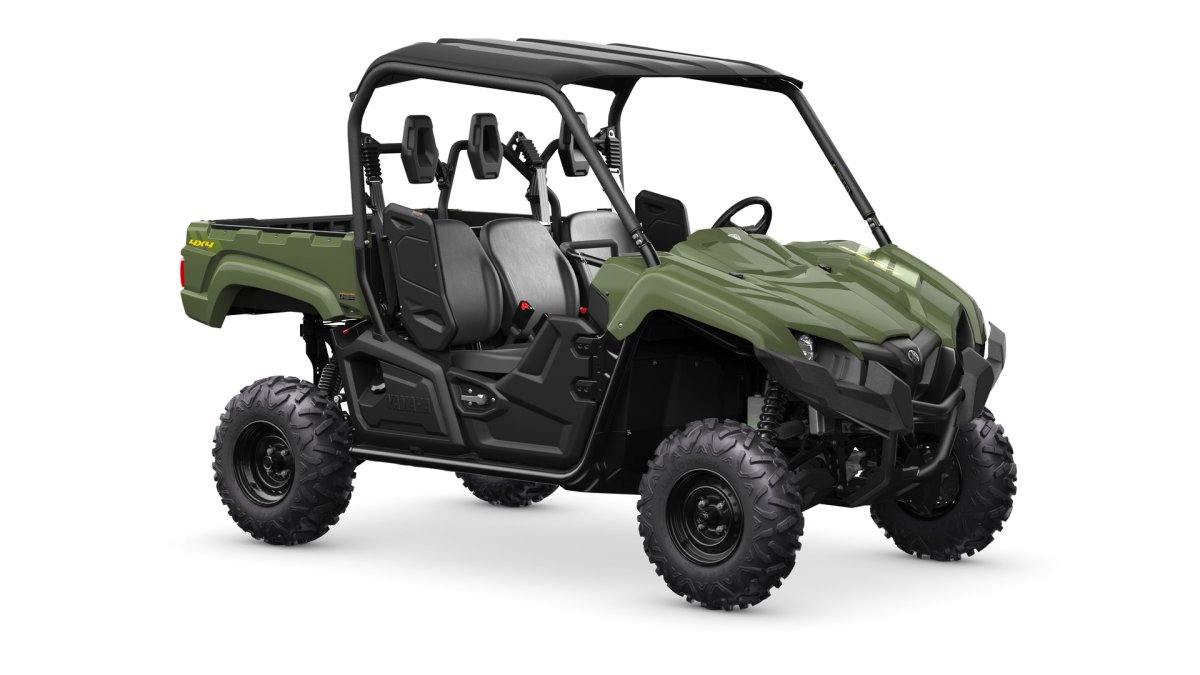
The 2026 Yamaha Viking EPS is one of the more straightforward three-seat utility UTVs still sold in the United States. It starts at $14,299, plus a separate $1,400 destination charge, and puts the money into the pieces that affect a long workday: power steering, a 600-lb steel dump bed, a 1,500-lb towing rating, a real three-person cabin, and Yamaha’s locking On-Command drive system.
This is not a high-horsepower crossover or a feature-stuffed luxury crew machine. The Viking EPS uses a 686cc liquid-cooled single, an Ultramatic belt CVT, 25-inch tires, and 8.1 inches of travel at each end. That leaves it with an old-school utility personality: deliberately sized, simple to understand, and best suited to a property, camp, hunting ground, or work site where a three-person bench and a dependable dump bed are more valuable than headline acceleration.
Price and mission: buy the right kind of simple
With destination, the starting figure is $15,699 before tax, registration, dealer costs, or accessories. That is competitive with entry three-seat work UTVs, particularly because EPS is standard. It does not, however, turn the Viking into an all-inclusive package. A windshield, mirrors, winch, cab equipment, lighting, or extra protection should be selected for the conditions you actually use rather than assumed to be fitted.
The Viking makes the most sense when three adults regularly ride together and the vehicle has real chores between trail outings. Its 61.8-inch overall width is much easier to place than a 64- or 65-inch machine, but it remains too wide for a 50-inch route. Check gates, bridges, trailer rails, and storage dimensions using the overall width—not an optimistic visual estimate.
686cc power with no invented horsepower number
Yamaha’s liquid-cooled, fuel-injected 686cc SOHC single uses a four-valve head and 10.0:1 compression. The company describes the engine as broad and usable; it does not publish a current factory horsepower figure. That is worth saying plainly. A peak number copied from an older listing or a dealer page would add false precision, not useful information.
The engine drives through Yamaha’s Ultramatic V-belt CVT with low, high, neutral, and reverse, plus all-wheel engine braking. Its centrifugal wet clutch and constant-tension belt design are backed by Yamaha’s 10-year belt warranty. Engine braking in 4WD mode and reverse is useful when the vehicle is loaded or descending, because it helps the driver manage speed before relying solely on the hydraulic brakes.
On-Command has three positions: 2WD, limited-slip 4WD, and fully locked-differential 4WD. The locked setting belongs on the slow, low-traction part of the job, not on every surface by default. Keeping the vehicle in the least aggressive mode that accomplishes the task is easier on the ground and makes steering feel more natural.
Work credentials that are actually published
The stamped-steel dump bed is rated for 600 lb and includes tie-down hooks, a rubber mat, and rails with integrated mounting points. It can be unlatched and tilted from either side. The center-mounted two-inch receiver hitch has a 1,500-lb towing rating. Those are concrete factory numbers, which matters more than vague claims that a UTV is “work-ready.”
The bed and hitch do not remove the need to match loads to terrain, tongue weight, trailer brakes, and the vehicle’s own condition. But they give a buyer a trustworthy starting point. A gardener hauling tools and material, a landowner moving fencing supplies, or a hunting camp carrying gear will understand the Viking’s value immediately.
The chassis uses independent double-wishbone suspension with 8.1 inches of travel front and rear, 11.8 inches of maximum clearance, and 25-inch tires. It is competent on rutted roads and ordinary trails, though it is not intended to be driven like a longer-travel sport SxS. The quieter, slower line that keeps a load stable is often the faster way to finish a working day.
Cabin comfort: a useful three-across layout
The Viking EPS seats three, with padded headrests, three-point seatbelts, a central passenger handhold, an adjustable driver’s seat, and an offset middle seat. A pass-through floor makes it easier to enter or exit on either side, and the factory suntop is standard. Those are small advantages until the machine is used for several hours, when a cramped center position or an awkward ingress becomes the part everyone remembers.
EPS is standard rather than an upgrade. That matters in tight turns, on rough ground, and during a long day that includes many low-speed maneuvers. A latching glovebox, four in-dash cupholders, a gated dash-mounted shifter, and a conventional parking brake are not glamorous, but they support the Viking’s central job: reducing friction in routine use.
2026 Yamaha Viking EPS specifications
| Specification |
2026 Yamaha Viking EPS |
| Engine |
686cc liquid-cooled SOHC single; four valves; Yamaha Fuel Injection |
| Factory-rated output |
Yamaha does not publish a current horsepower figure |
| Transmission |
Ultramatic V-belt CVT; L/H/N/R; all-wheel engine braking |
| Drive system |
On-Command 2WD / limited-slip 4WD / locked 4WD |
| Seating |
3 |
| Cargo bed / towing |
600 lb dump bed / 1,500 lb tow rating |
| Wet weight |
1,475 lb |
| Overall width / length / height |
61.8 / 122.1 / 75.8 in |
| Wheelbase / ground clearance |
84.1 / 11.8 in |
| Fuel capacity |
9.7 gal |
| Tires |
25 x 8-12 front; 25 x 10-12 rear |
| Suspension travel |
8.1 in front / 8.1 in rear |
| Warranty |
Six-month limited factory warranty; 10-year belt warranty |
| Base MSRP / destination |
$14,299 / $1,400 |
How it compares
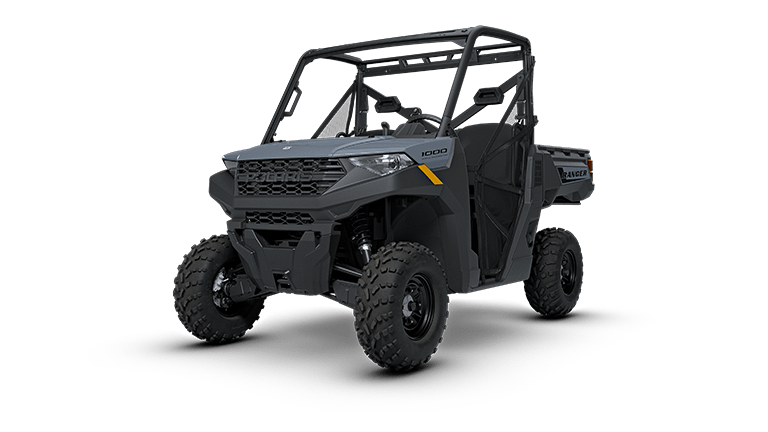
The 2027 Polaris Ranger 1000 is the more powerful, higher-capacity three-seat work alternative. It has a 61-hp twin, 1,000-lb dump box, 2,500-lb towing rating, and 1,500-lb payload rating. The Viking is narrower and uses a simpler 686cc single, while the Ranger is the choice when published hauling and towing numbers drive the purchase. Compare them →
The 2027 Can-Am Defender XT HD10 is another three-seat utility machine, but it moves significantly upmarket in power, capacity, price, width, and equipment. The Viking is the lighter, narrower, more modestly priced option for a buyer who does not need an 80-hp triple, 1,000-lb box, 2,500-lb tow rating, factory winch, or roof-level protection package. Compare them →
The 2025 Honda Pioneer 700 is a similarly sized three-person utility SxS with a 1,500-lb towing rating. Honda’s automotive-style three-speed transmission gives it a different feel, while the Yamaha answers with standard EPS, a 600-lb bed, a larger fuel tank, and a direct, familiar CVT layout. Compare them →
The 2026 Honda Pioneer 520 is the narrow-access alternative. It is only 50 inches wide, seats two, and has a 450-lb dump bed with a 1,000-lb tow rating. Choose the Honda when trail width is the hard constraint; choose the Viking when a third seat, more bed capacity, and a 1,500-lb tow rating matter more than access through a narrow gate. Compare them →
Verdict
The 2026 Yamaha Viking EPS is a well-judged three-seat utility UTV for buyers who value predictable, published work ratings and straightforward controls over a complicated feature list. Standard EPS, a 600-lb dual-side-tilt steel bed, 1,500-lb tow rating, three-across cabin, 61.8-inch width, and Yamaha’s locking 4WD give it a solid everyday identity.
It will not replace a high-capacity Ranger or Defender for heavy trailer work, and its 686cc single is not the machine to buy for outright performance. Yamaha’s choice not to publish a current horsepower number is another reason to shop it by the work it has to do, not a spec-sheet drag race. For a three-person property and trail SxS that stays compact enough to be easy to live with, the Viking EPS remains a credible, practical answer.