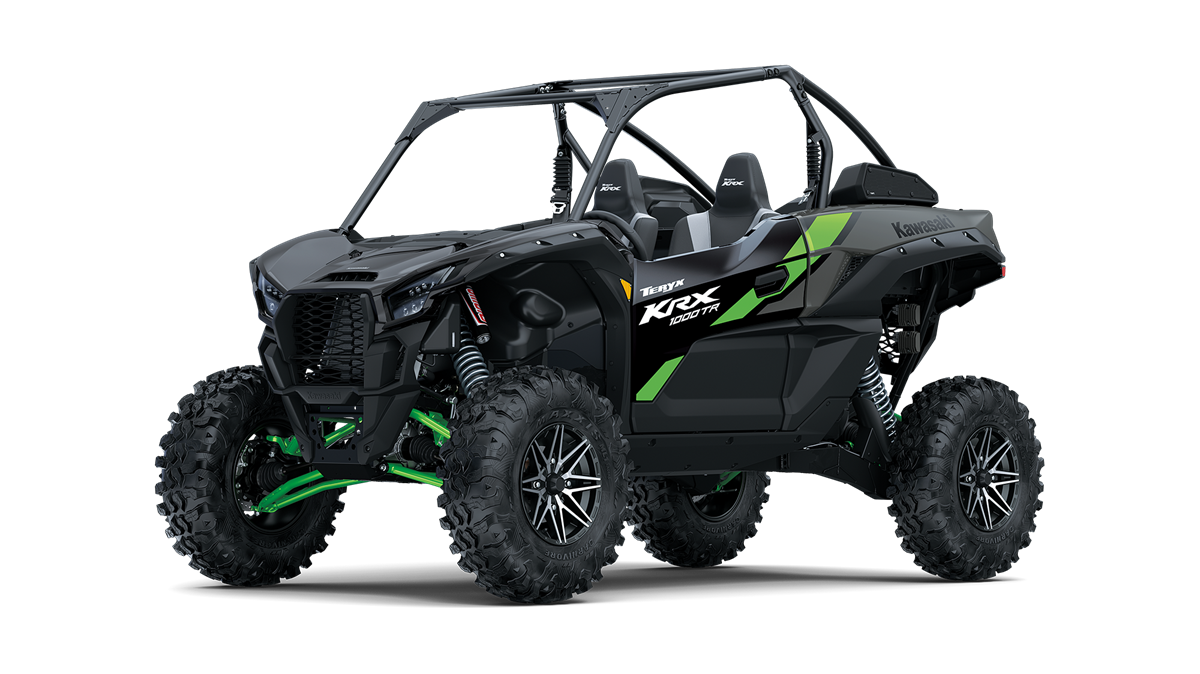
The 2027 Kawasaki Teryx KRX 1000 TR solves a specific problem: the standard KRX is too wide for many 64-inch trail systems. Kawasaki has narrowed the new two-seat TR to 63.8 inches while keeping the naturally aspirated 999cc twin, 110 hp output, CVT, locking front differential, 31-inch Maxxis tires, and substantial Showa shocks that define the KRX.
This is more than a wheel-offset exercise. Kawasaki changed the suspension-arm dimensions and mounting angles, reshaped the front bodywork, and slimmed the rear fenders. Travel falls from the standard KRX’s 18.6 inches front and 21.1 rear to 17.0 and 18.6 inches, but the TR gains access to routes where a 68.1-inch machine may never get past the gate. Its $21,199 base MSRP is also $1,000 lower than the standard model.
The result is not a better KRX for everybody. It is a more useful one for riders whose maps, gates, trailers, or wooded terrain make width a real constraint.
Price and standard equipment
The base MSRP is $21,199. Kawasaki adds a $1,320 destination charge, bringing the published subtotal to $22,519 before tax, registration, setup, dealer charges, and accessories. Buyers should price the completed machine, because a roof, windshield, winch, audio system, and navigation display are not quietly included at that figure.
The mechanical package is strong for a base sport UTV. Fifteen-inch alloy beadlock wheels, 31-inch Maxxis Carnivore eight-ply tires, Showa 2.5 piggyback shocks, speed-sensitive EPS, two power modes, a locking front differential, LED lighting, and steel skid plates are standard. Full doors provide more coverage than skeletal nets, although the open cabin still needs weather accessories if the machine will see cold or wet seasons.
The price gap to the 68.1-inch standard KRX is unusual because narrow variants sometimes command a premium. Here, the TR costs less. The standard model’s extra money buys wider geometry and more wheel travel, not a stronger engine or richer cockpit. That makes the decision depend on terrain rather than trim hierarchy.
A real 63.8-inch chassis, not a narrow wheel package
Kawasaki shortened the front upper and lower A-arms and placed them at a more upright angle. At the rear, the upper and lower control arms are shorter, while the trailing arms remain common with the wider KRX. The main frame also remains unchanged. This is a sensible way to create a narrower member of the family without discarding the proven central structure.
The body had to follow the suspension. A reshaped front cover and slimmer rear fender flares keep the exterior within the new 63.8-inch envelope. That detail matters: pulling wheels inward is of little value if the plastic still catches a gate or tree.
Factory width should still be treated carefully. A nominal 64-inch trail may use fixed barriers, while enforcement and measurement practices differ by location. Mirrors, rock sliders, wheel spacers, aftermarket tires, and different wheel offsets can erase the 0.2-inch margin. Confirm the route’s actual rule before buying and measure the finished vehicle after modifying it.
Overall length is 130.9 inches, height is 75.0 inches, and wheelbase is 99.4 inches. Standard ground clearance is 14.2 inches, rising to a listed 14.8 inches at maximum preload. The TR is narrow relative to the original KRX, not small in every dimension.
Suspension: less travel, deliberately different tuning
The front double-wishbone suspension provides 17.0 inches of travel. The rear four-link trailing-arm system provides 18.6 inches. Both ends use Showa 2.5 piggyback shocks with adjustable preload and 24-position compression adjustment.
Those figures are lower than the standard KRX, but Kawasaki did not simply install shorter arms and call the job finished. The company describes softer low- and mid-speed damping intended to improve comfort on trail-speed impacts. At the rear, compression damping builds as suspension speed increases, helping the vehicle resist bottoming on harder hits.
That tuning direction suits the TR’s purpose. Narrow wooded routes usually reward compliance, accurate placement, and traction more than maximum jump capacity. Riders who spend most of their time in fast desert chop or broad, rough terrain may still prefer the wider standard KRX for its stance and extra rear travel. The TR’s value is retaining serious hardware while fitting a more restrictive trail class.
The 31x10R15 Maxxis Carnivore tires are the same size front and rear and use eight-ply-rated construction. They bring useful rock and puncture resistance, while identical sizing simplifies carrying a spare. Beadlock wheels secure the outer bead when pressures are reduced, but they do not remove the need to inspect fasteners and follow the maintenance schedule.
Engine, CVT, and traction controls
The liquid-cooled 999cc parallel twin uses DOHC cylinder heads, eight valves, electronic fuel injection, and twin 50mm throttle bodies. Kawasaki rates it at 110.0 hp at 8,500 rpm and 75.2 lb-ft at 7,000 rpm under ISO 4106. Those are the same headline output figures as the standard KRX 1000.
Power goes through a CVT with centrifugal clutch and high, low, neutral, and reverse ranges. A centrifugal clutch helps control belt engagement, while low range is the correct choice for sustained slow crawling, steep work, or deep terrain. The TR is not turbocharged, and it is not trying to match the acceleration of a 200 hp Maverick X3. Its appeal is tractable power in a chassis built around rough-trail control.
Selectable 2WD and 4WD are joined by a locking front differential. Kawasaki also includes downhill engine braking and two power modes. Those systems let the driver tailor response and traction without replacing sound line choice. Differential lock is valuable when one front tire unloads, but steering effort and driveline load increase when everything is tied together.
Hydraulic disc brakes use twin-piston calipers on the two 258mm front rotors and a single-piston caliper on the rear rotor. Speed-sensitive electric power steering varies assistance with vehicle speed. The combination should make low-speed placement manageable without leaving the steering vague as pace rises.
Weight, cargo, and day-to-day usefulness
Kawasaki lists an estimated dry weight of 1,801.5 lb and curb weight of 1,900.7 lb. The TR is not notably lighter than the standard KRX despite its narrower suspension. That is important when choosing a trailer and tow vehicle: add fuel, occupants, recovery gear, accessories, spare tire, and tie-down equipment rather than planning around dry weight alone.
The rear bed measures 14.6 by 33.1 by 9.1 inches and carries up to 351 lb. Total payload is 781 lb. That is useful space for tools, a cooler, jackets, and recovery equipment, but it does not turn the KRX into a work-focused Mule. Kawasaki publishes no towing capacity for the TR, so dealer listings or receiver accessories should not be mistaken for a factory tow rating.
Fuel capacity is 10.6 gallons. Two bucket seats, adjustable steering, passenger handholds, and a multifunction digital display cover the essentials. The central question remains where the vehicle will be used: the TR trades some open-terrain stance for a width that unlocks more routes.
2027 Kawasaki Teryx KRX 1000 TR specifications
| Specification |
2027 Teryx KRX 1000 TR |
| Engine |
999cc liquid-cooled DOHC 8-valve parallel twin |
| Factory-rated output |
110.0 hp at 8,500 rpm / 75.2 lb-ft at 7,000 rpm (ISO 4106) |
| Fuel system |
DFI with two 50mm throttle bodies |
| Transmission |
CVT with centrifugal clutch; H/L/N/R |
| Drive system |
Selectable 2WD/4WD with locking front differential; shaft drive |
| Drive features |
Two power modes and downhill engine braking |
| Seating |
2 bucket seats |
| Estimated dry / curb weight |
1,801.5 / 1,900.7 lb |
| Overall size |
130.9 x 63.8 x 75.0 in |
| Wheelbase / ground clearance |
99.4 / 14.2 in standard (14.8 in maximum preload) |
| Fuel capacity |
10.6 gal |
| Cargo bed / payload |
351 / 781 lb |
| Towing |
Not rated by Kawasaki |
| Tires / wheels |
31x10R15 Maxxis Carnivore 8PR / 15 in alloy beadlocks |
| Suspension travel |
17.0 in front / 18.6 in rear |
| Shocks |
Showa 2.5 piggyback; preload and 24-position compression adjustment |
| Brakes |
258mm hydraulic discs; dual front / single rear calipers |
| Base MSRP / destination |
$21,199 / $1,320 |
How the KRX 1000 TR compares
The standard 2027 Kawasaki Teryx KRX 1000 is 68.1 inches wide and has 18.6 inches of front travel and 21.1 at the rear. It costs $1,000 more but shares the TR’s 110 hp engine, CVT, front differential lock, tires, beadlock wheels, cargo ratings, and core frame. Choose the standard model when wider routes and high-speed stability matter; choose the TR when the 64-inch envelope determines where you can ride. Compare both KRX versions →
The 2027 Polaris RZR XP 1000 Sport is a direct 64-inch rival. It starts $1,200 lower and makes 114 hp, while the current database lists a much lower dry weight. The Kawasaki counters with 31-inch rather than 29-inch tires, beadlock wheels, more suspension travel, and a 351-lb cargo bed. The RZR is the lighter, sharper value proposition; the KRX is the heavier-duty trail chassis. Compare KRX TR and RZR XP →
The 2027 Can-Am Maverick X3 X DS also measures 64 inches wide, but its 200 hp turbo triple and $29,999 MSRP place it in another performance and price tier. The Can-Am is for buyers prioritizing acceleration and high-speed desert capability. The naturally aspirated Kawasaki costs $8,800 less and makes its case with trail manners, cargo usefulness, and simpler power delivery. Compare KRX TR and Maverick X3 →
The 2025 Honda Talon 1000X takes a different mechanical route with a geared six-speed dual-clutch transmission rather than a CVT. It is 64 inches wide, weighs less, and provides direct shift control; the KRX offers more torque, larger tires, more ground clearance, and a more generous cargo rating. This comparison is as much about transmission preference as output. Compare KRX TR and Talon 1000X →
Verdict
The 2027 Kawasaki Teryx KRX 1000 TR is a convincing answer to the original KRX’s most practical limitation. At 63.8 inches, it enters a common trail-width class without abandoning the 110 hp twin, locking front differential, 31-inch tires, beadlock wheels, or adjustable Showa 2.5 shocks. The revised arms, bodywork, and damping make it a genuine chassis variant rather than a badge-and-color exercise.
There are costs to the narrower stance. The standard KRX offers more travel and a broader footprint for open terrain, while the RZR XP 1000 Sport is cheaper and lighter. The TR also remains a 1,900-lb-class machine once fueled, and its attractive base price does not include the weather and recovery accessories many owners will add.
For riders whose trails actually enforce a 64-inch limit, those objections do not erase the point. The KRX 1000 TR keeps the family hardware that matters and changes the dimension that previously kept it out. That makes it one of the most meaningful KRX additions for 2027—and a model to buy for access, not merely because it is the newest badge in the range.