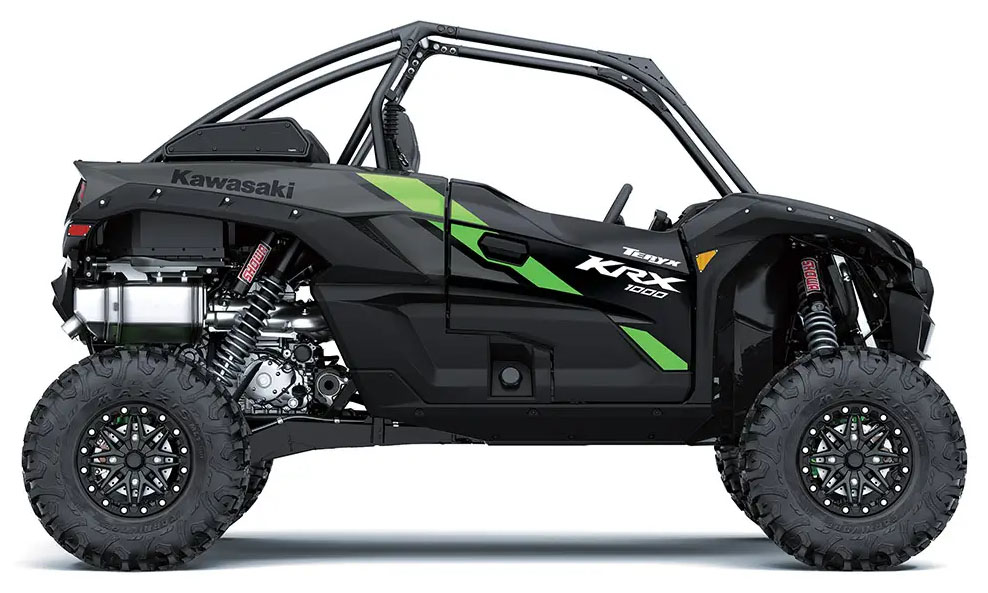
The 2027 Kawasaki Teryx KRX 1000 is the conventional wide-track KRX, and that distinction matters this year. Kawasaki has introduced a less expensive, 63.8-inch KRX 1000 TR for tighter trails, while the standard KRX stays 68.1 inches wide and starts at $22,199 before a $1,320 destination charge. It is the two-seat choice for riders who want the full-width chassis, 31-inch tires, 110-hp parallel-twin, and long-travel suspension without stepping into electronic shocks or a special-edition package.
That is a sensible lane. The standard KRX is not a bargain and it is not a 50-inch trail machine. It is a substantial sport UTV: 1,794.9 lb estimated dry, nearly 99 inches of wheelbase, and a 68.1-inch stance. But it offers the hardware that matters on rough, open terrain—18.6 inches of front travel, 21.1 inches at the rear, 31-inch Maxxis Carnivores, beadlock wheels, a locking front differential, and downhill engine braking. For anyone learning to sort a real riding requirement from brochure language, how to read ATV and UTV specifications is a useful starting point.
The important 2027 decision: standard KRX or the new TR?
The most useful change to understand is not engine output; it is chassis width. The new KRX 1000 TR starts at $21,199 and measures 63.8 inches wide. It has trail-focused comfort settings, 17.0 inches of front travel and 18.6 inches at the rear. The standard KRX costs $1,000 more before destination, is 68.1 inches wide, and has more travel: 18.6 inches front and 21.1 inches rear.
Neither is automatically better. The TR is the correct answer when access, trailer width, and narrow wooded routes make five inches a genuine problem. The standard KRX is the more stable, more open-terrain option. Do not buy the standard model because its name sounds more serious, then discover the trails you use do not accept it. Likewise, do not buy the TR merely for price if your terrain rewards the broader stance and extra rear travel.
Engine and driveline: direct, naturally aspirated power
Kawasaki rates the 999cc, liquid-cooled DOHC parallel-twin at 110.0 hp and 75.2 lb-ft. DFI uses twin 50mm throttle bodies, and the engine drives through a CVT with centrifugal clutch, high, low, neutral, and reverse. Kawasaki includes two power modes, selectable 2WD/4WD, a locking front differential, and engine braking.
The 110-hp engine is not positioned as an answer to the 200-plus-horsepower turbo UTVs. That is not a flaw. In a terrain-first vehicle, useful response, control on descents, and predictable traction can be more valuable than an output figure that needs a long straight to enjoy. The KRX is still very fast by ordinary trail standards; the point is that it makes its case through suspension and chassis confidence, not through a turbocharger.
The locking front differential deserves respect. It is there to keep the machine moving on a loose climb, a ledge, or a deeply rutted approach—not to cure a bad line or overconfidence. Use the least aggressive drive setting that gets the job done, and let tire placement do as much work as the dashboard switch.
Suspension and chassis: the standard KRX advantage
The front end uses double wishbones, while the rear has Kawasaki’s four-link trailing-arm layout. Showa 2.5 piggyback shocks have fully adjustable preload and 24-position compression adjustment. Travel is 18.6 inches front and 21.1 inches rear. Those are substantial, practical figures, particularly because the rear trailing-arm layout gives the KRX room to work through broken terrain rather than merely absorbing a small bump.
The 31 x 10.00R15 Maxxis Carnivore tires and 15-inch alloy beadlock wheels match the vehicle’s purpose. They are not 32- or 33-inch specialty rock tires, and the standard KRX is not the Rock Edition. That actually makes the vehicle easier to place: it is the broad-use sport trim, not a package pretending every rider has the same terrain.
Kawasaki lists 14.2 inches of standard ground clearance, or 14.8 inches at maximum preload. The 1,794.9-lb estimated dry weight and 1,894.1-lb curb weight put the numbers in perspective. This is a large, heavy machine. A capable suspension makes it composed, not lightweight. Respect trailer capacity, recovery planning, braking distances, and the physical space required to turn it around.
Cargo and equipment: enough for a trail day, not a work UTV
The small rear bed is rated for 351 lb, and Kawasaki lists 781 lb of payload. Its dimensions are 14.6 by 33.1 by 9.1 inches. That is useful for recovery gear, a cooler, tools, and spares. It is not a substitute for the cargo box of a Defender, Ranger, or Mule.
Kawasaki does not publish a towing rating for the KRX. The record correctly shows towing as not rated rather than copying a hitch number from a dealer advertisement. Standard equipment includes steel skid plates with drain holes, LED headlights and taillights, EPS, a multifunction digital meter, and the associated warning and drive-mode information. A winch, roof, windshield, audio, and interactive display are accessories, not items to quietly assume are included in the $22,199 price.
2027 Kawasaki Teryx KRX 1000 specifications
| Specification |
2027 standard Teryx KRX 1000 |
| Engine |
999cc liquid-cooled DOHC 8-valve parallel-twin |
| Factory-rated output |
110.0 hp at 8,500 rpm / 75.2 lb-ft at 7,000 rpm (ISO 4106) |
| Transmission |
CVT with centrifugal clutch; H/L/N/R |
| Drive system |
Selectable 2WD/4WD with locking front differential; shaft final drive |
| Drive features |
Two power modes and downhill engine braking |
| Seating |
2 bucket seats |
| Estimated dry / curb weight |
1,794.9 / 1,894.1 lb |
| Width / length / height |
68.1 / 130.1 / 74.8 in |
| Wheelbase / clearance |
98.8 / 14.2 in standard (14.8 in maximum preload) |
| Fuel capacity |
10.6 gal |
| Cargo bed / payload |
351 lb / 781 lb |
| Towing |
Not rated by Kawasaki |
| Tires / wheels |
31 in Maxxis Carnivore; 15 in alloy beadlock wheels |
| Suspension |
Showa 2.5 piggybacks; 18.6 in front / 21.1 in rear travel |
| Standard equipment |
EPS, LED lighting, steel skid plates with drain holes, digital meter |
| Base MSRP / destination |
$22,199 / $1,320 |
How it compares
The new 2027 Kawasaki Teryx H2 is the much faster in-house alternative. Its supercharged four makes 250 hp and its price begins $10,700 higher before destination. The KRX is the more restrained, naturally aspirated machine for riders who value a known chassis and a lower entry point. Compare them →
The 2027 Polaris RZR XP S is a relevant wide-trail cross-shop. It has a 72-inch stance, 114 hp, 25 inches of usable travel, and a slightly higher MSRP before destination. Compare access, suspension preferences, dealer support, and actual riding terrain—not only peak travel. Compare them →
The 2027 Can-Am Maverick X3 X DS offers 200 turbocharged horsepower in a 64-inch layout. It costs significantly more, but its pace and trail-width story are entirely different from the naturally aspirated KRX. Compare them →
The 2025 Kawasaki Teryx KRX 1000 remains a reasonable used or leftover comparison. The current standard KRX’s value depends on real price, condition, and equipment. A low-mile older KRX with the right accessories can be worth more than a new base model with an inflated dealer add-on list. Compare model years →
Verdict
The 2027 Kawasaki Teryx KRX 1000 is still a compelling two-seat sport UTV because it is clear about what it is. It has a strong 110-hp naturally aspirated twin, a 68.1-inch chassis, long Showa suspension, 31-inch tires, beadlocks, a locking differential, 351 lb of bed capacity, and useful payload. It is not a stripped price leader once the $1,320 destination charge is included, and it does not include a winch, roof, or towing rating.
For riders whose trails accommodate its width and who want a stable, long-travel, naturally aspirated KRX rather than the new narrow TR or a turbo sport UTV, the standard model remains the right center of the family. Buy it for that deliberate combination—not because the name KRX sounds like a catch-all solution.