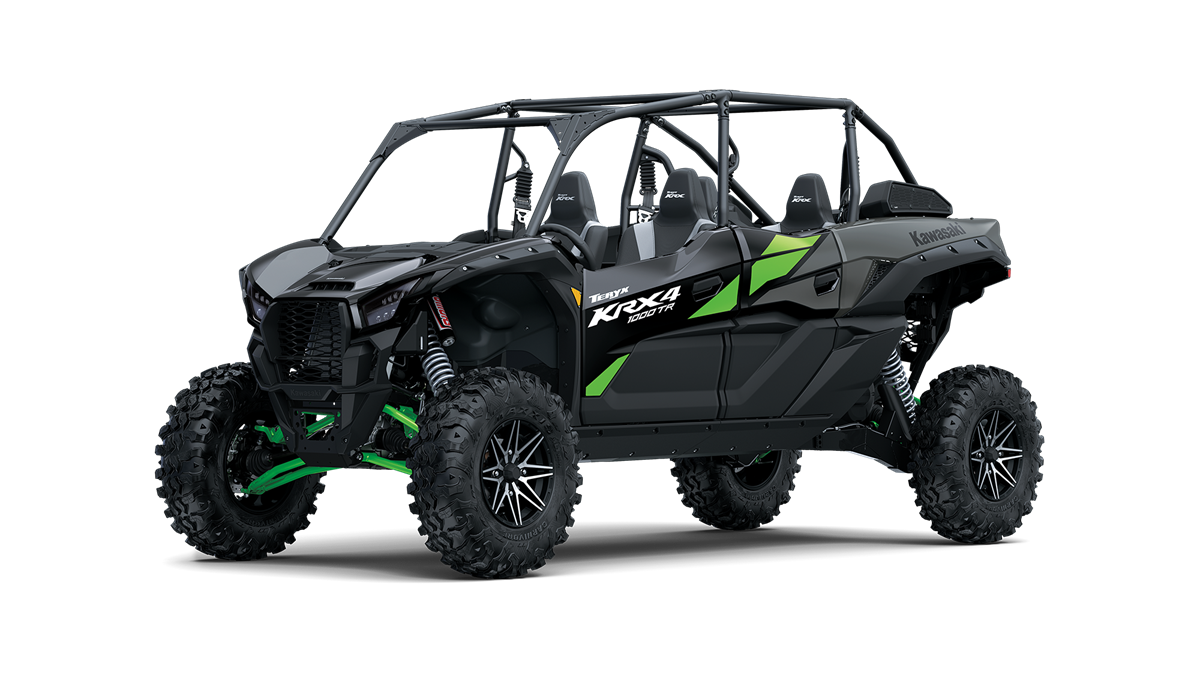
The 2027 Kawasaki Teryx KRX4 1000 TR brings four adults into the 64-inch KRX equation. It measures 63.8 inches wide—4.3 inches narrower than the standard KRX4—yet retains the 999cc parallel twin, 110 hp rating, locking front differential, 31-inch Maxxis Carnivore tires, and four full-size seats that make the long-wheelbase model appealing for family and group rides.
This is not the two-seat TR with a bench squeezed behind the driver. The KRX4 TR stretches to a 126.4-inch wheelbase, exactly 27 inches longer than the two-seat machine, and its estimated dry weight rises by 222.7 lb. Those figures change how it fits a trailer, turns through switchbacks, and carries speed over crests. The rear passengers gain genuine space and a more settled platform, but the driver gives up some of the shorter model’s agility.
At $24,199 before a $1,420 destination charge, the KRX4 TR costs $3,000 more than the two-seat TR and $1,000 less than the wider standard KRX4. That pricing makes its mission unusually clear: pay for the second row, then choose narrow access or maximum suspension travel.
Price and equipment
Kawasaki’s published subtotal is $25,619 before tax, registration, setup, dealer charges, and accessories. A roof, windshield, winch, audio system, and navigation display are not part of the base specification, so a useful out-the-door comparison should include the same accessories on every candidate.
The chassis hardware is not bare-bones. Showa 2.5 piggyback shocks, 15-inch alloy beadlock wheels, 31-inch eight-ply Maxxis Carnivore tires, speed-sensitive EPS, selectable power modes, a locking front differential, downhill engine braking, LED lighting, steel skid plates, and full doors are standard. Kawasaki offers Smoky Gray/Super Black and Grayish Blue/Super Black finishes, both with TR badging.
The $25,199 standard KRX4 is only $1,000 more and uses the same destination charge. It offers the wider 68.1-inch stance and longer suspension travel. The TR is therefore not a budget trim in the usual sense; it is a lower-priced geometry choice for riders who need a 64-inch-class vehicle.
Four seats and 27 extra inches of wheelbase
The cleanest way to understand the KRX4 TR is beside the two-seat KRX 1000 TR. Both are 63.8 inches wide, 75 to 76 inches tall, and use the same engine, driveline, tires, brakes, ground clearance, and suspension-travel figures. The two-seat model has a 99.4-inch wheelbase. The four-seater measures 126.4 inches—an exact 27-inch increase.
That length gives the KRX4 a real second row rather than occasional jump seats. It also spreads occupants across a longer platform, which can make fore-aft movement feel calmer over rolling terrain. The penalty arrives in tight switchbacks, breakover situations, and trailer fit. A narrow body helps between trees, but it cannot make a 157.9-inch-long vehicle pivot like the 130.9-inch two-seater.
The dry-weight figures reinforce the distinction: 2,024.2 lb for the four-seat TR against 1,801.5 lb for the two-seat version. Curb weights are 2,125.6 and 1,900.7 lb. Add four occupants, fuel, tools, a spare, recovery equipment, and accessories before choosing a trailer or tow vehicle. The number printed under “dry weight” is not the mass that will leave your driveway.
Payload rises from 781 lb on the two-seat TR to 1,001 lb here, an increase of 220 lb. That helps, but four adults can consume the difference quickly. Payload includes occupants, cargo, accessories, and other carried weight; it is not 1,001 lb available after everyone climbs aboard.
The 63.8-inch trail conversion
Kawasaki reaches the narrower stance with shorter front A-arms and more upright mounting angles. The rear upper and lower control arms are shorter as well, while the trailing arms keep the dimensions and mounting positions used on the standard models. The core frame remains unchanged.
The bodywork was revised around those mechanical changes. A reshaped front cover allows the shorter A-arms to use their full stroke, and slimmer rear fender flares remain inside the tire edges. This matters more than it sounds: width compliance depends on the vehicle’s widest fixed point, not just the distance between tire centers.
Kawasaki lists the stock vehicle at 63.8 inches, leaving only 0.2 inch beneath a nominal 64-inch rule. Trail authorities may measure differently, and accessories can erase that margin. Wheel spacers, different offsets, wider tires, mirrors, and side protection all deserve attention before assuming every 64-inch gate is open.
The TR’s 23.3-foot turning radius is the same published figure as the standard KRX4. Kawasaki says the narrower tread helps initiate turns more quickly, but wheelbase remains the dominant fact in a very tight corner. The four-seat TR is easier to place between obstacles than the 68.1-inch KRX4; it is not the most maneuverable way to carry two people.
Suspension and ground clearance
Front double wishbones provide 17.0 inches of wheel travel. The rear four-link trailing-arm suspension provides 18.6 inches. Showa 2.5 piggyback shocks have fully adjustable preload and 24-position compression adjustment at both ends.
The standard KRX4 has 18.6 inches front and 21.1 rear, so the TR gives up 1.6 and 2.5 inches respectively. Kawasaki compensates in part with softer low- and mid-speed damping intended to follow roots, branches, packed dirt, and loose gravel more closely. Rear compression damping builds as impact speed increases to support the chassis when the trail opens up.
Standard ground clearance remains 14.2 inches, with 14.8 inches listed at maximum preload. That preserved clearance is a useful engineering result of the revised mounting angles. Maximum preload is not free height, though: it changes ride attitude and available droop, and should be set for load rather than used as a permanent shortcut around poor line choice.
The long wheelbase gives the KRX4 a larger breakover challenge than the two-seat model even though both quote the same clearance. Skid plates with drain holes protect the underside, but a careful diagonal approach can matter more than another fraction of an inch at the center of the chassis.
Engine, CVT, and traction
The 999cc liquid-cooled parallel twin uses DOHC heads, eight valves, DFI, and two 50mm throttle bodies. Kawasaki rates it at 110.0 hp at 8,500 rpm and 75.2 lb-ft at 7,000 rpm under ISO 4106. The output is unchanged from the two-seat TR and standard KRX4.
An automatic CVT with centrifugal clutch supplies high, low, neutral, and reverse. Low range is the sensible choice for prolonged slow crawling, steep climbs, or heavy going. Four occupants do not reduce the published horsepower, but the extra vehicle and passenger mass changes acceleration and braking; expectations should be set accordingly.
On-the-fly selectable 2WD and 4WD are joined by a locking front differential. Two power modes let the driver soften or sharpen response, and engine braking helps manage descents. The driveline suits technical trail use because it emphasizes controlled engagement and useful low-speed torque rather than a huge turbo number.
The KRX4 TR is not slow in ordinary trail terms, but it is not a four-seat desert missile. Buyers comparing it with a 200 hp Maverick X3 MAX should be honest about whether they need acceleration across open ground or composure and access in wooded terrain.
Tires, brakes, and cargo
All four tires are 31x10R15 Maxxis Carnivore eight-ply radials on 15-inch alloy beadlock wheels. Matching sizes simplify spare-tire planning. Beadlocks permit lower trail pressures without relying only on the outer bead seat, though fastener checks and correct torque remain part of ownership.
Braking comes from twin 258mm front discs with two-piston calipers and twin 258mm rear discs with single-piston calipers. Speed-sensitive electric power steering assists a rack-and-pinion system. Those details are shared with the wider KRX4 and appropriate for a four-seat machine whose curb weight starts above 2,100 lb.
The cargo bed measures 14.6 by 33.1 by 9.1 inches and carries 351 lb—the same bed rating as the two-seat TR. It is enough for a cooler, tools, jackets, and recovery kit, not a work-UTV load. Kawasaki lists towing capacity as N/A, so an accessory receiver should not be read as factory permission to tow an assumed amount.
2027 Kawasaki Teryx KRX4 1000 TR specifications
| Specification |
2027 Teryx KRX4 1000 TR |
| Engine |
999cc liquid-cooled DOHC 8-valve parallel twin |
| Factory-rated output |
110.0 hp at 8,500 rpm / 75.2 lb-ft at 7,000 rpm (ISO 4106) |
| Transmission |
CVT with centrifugal clutch; H/L/N/R |
| Drive system |
Selectable 2WD/4WD with locking front differential; shaft drive |
| Seating |
4 |
| Estimated dry / curb weight |
2,024.2 / 2,125.6 lb |
| Overall size |
157.9 x 63.8 x 76.0 in |
| Wheelbase / turning radius |
126.4 in / 23.3 ft |
| Ground clearance |
14.2 in standard / 14.8 in maximum preload |
| Fuel capacity |
10.6 gal |
| Cargo bed / payload |
351 / 1,001 lb |
| Towing |
Not rated by Kawasaki |
| Tires / wheels |
31x10R15 Maxxis Carnivore 8PR / 15 in alloy beadlocks |
| Suspension travel |
17.0 in front / 18.6 in rear |
| Shocks |
Showa 2.5 piggyback; preload and 24-position compression adjustment |
| Base MSRP / destination |
$24,199 / $1,420 |
How the KRX4 1000 TR compares
The 2027 two-seat KRX 1000 TR is the choice when two seats are enough. It saves $3,000, 222.7 lb of dry weight, and exactly 27 inches of wheelbase while keeping the same width, output, tires, and suspension travel. The KRX4 answers with two genuine rear seats and 220 lb more payload capacity. Compare the two- and four-seat TR models →
The standard 2027 KRX4 1000 costs $1,000 more and is 68.1 inches wide. Its 18.6 inches of front travel and 21.1 rear beat the TR’s 17.0 and 18.6, while engine output, four-seat capacity, tires, bed rating, and maximum payload remain the same. Buy the TR for width-controlled routes; buy the standard KRX4 for its broader stance and extra travel when access permits.
The 2025 Honda Talon 1000X-4 is a lighter 64-inch alternative with a geared six-speed dual-clutch transmission and paddle shifting. The Kawasaki is longer, heavier, and more expensive in the current database, but brings larger tires, more clearance, more travel, and 110 versus 104 hp. The deciding difference may be CVT smoothness versus the Honda’s direct-shifting character. Compare KRX4 TR and Talon 1000X-4 →
The 2025 Yamaha Wolverine RMAX4 1000 is the recreation-focused comparison. The database lists it at 64 inches wide, 108 hp, and $23,799, with a 2,000-lb tow rating that the KRX4 lacks. The Kawasaki offers the more aggressive tire, beadlock, suspension, and ground-clearance package; the Yamaha makes a stronger case for mixed recreation and utility. Compare KRX4 TR and Wolverine RMAX4 →
The 2025 Can-Am Maverick X3 MAX X rs Turbo RR brings 200 hp and a longer 135-inch wheelbase, but its 72-inch width rules it out of the trails this Kawasaki targets. It also costs substantially more. This is less a trim comparison than a test of priorities: high-speed open-terrain performance or four-seat access through a 64-inch corridor. Compare KRX4 TR and Maverick X3 MAX →
Verdict
The 2027 Kawasaki Teryx KRX4 1000 TR has a clear reason to exist. It carries four adults in a 63.8-inch-wide package without surrendering the KRX family’s 110 hp twin, front differential lock, 31-inch tires, beadlocks, useful ground clearance, or adjustable Showa shocks. The suspension and body changes are substantive, and the $1,000 saving over the wider KRX4 is welcome.
The compromises are equally clear. It is long, heavy, and less agile than the two-seat TR; it gives up travel and stance to the standard KRX4; and the base price leaves common weather and recovery accessories on the options list. A nominal 64-inch width also provides almost no buffer for modifications.
If four seats and regulated trail access are both non-negotiable, those tradeoffs make sense. If most trips carry only two people, the shorter TR is easier to transport and place. If trails are wide and rough, the standard KRX4 remains the more capable suspension package. The KRX4 TR earns its keep precisely where those alternatives fail: bringing a full second row through a 64-inch gate.