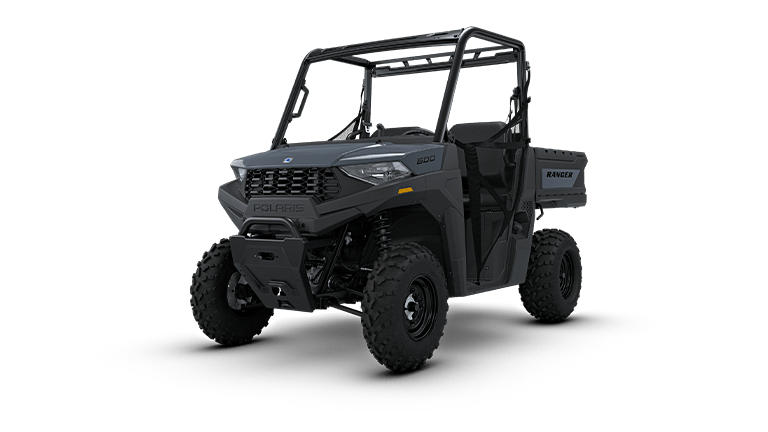
The 2027 Polaris Ranger 600 is easier to understand once the badge is ignored. Underneath the new name is the familiar Ranger SP 570 platform: a 567cc, 44-hp mid-size utility side-by-side with a 56-inch stance, two-person bench, 500-lb dump box, and 1,500-lb tow rating. Polaris is unusually direct about the change, describing it as a new model name with no significant difference in engine size, horsepower, or performance.
That honesty is useful. The Ranger 600 should not be sold as a clean-sheet machine, and the number on its bed does not indicate displacement. Its appeal is the same one that made the SP 570 useful: it fits where a full-size Ranger feels bulky, yet it can still move a meaningful trailer or box load. The base model starts at $11,999, with a separate $1,145 destination charge.
Price and trim choice
The published starting total is $13,144 before setup, tax, title, registration, accessories, and any dealer-specific pricing. That is not entry-level ATV money, but the Ranger 600 is a proper two-seat utility UTV with a gas-assist dump bed, receiver hitch, selectable all-wheel drive, full-body skid plate, and a more substantial payload rating than the smallest machines in the segment.
This review covers the base two-seat model in Stealth Gray. It does not include electronic power steering or a winch. The $14,499 Premium trim adds EPS, LED headlights, a full-coverage front bumper, and USB charging. That $2,500 jump is large enough to deserve a real decision: buyers who spend all day maneuvering slowly or expect to add the missing equipment may find Premium easier to justify, while occasional property users may prefer the simpler base machine.
The Ranger 600 name versus the SP 570
Polaris says the Ranger 600 is the same vehicle previously called Ranger SP 570 and that parts and accessories remain compatible. The 2027 update is chiefly a name and graphics change. That means an owner shopping between leftover SP 570 inventory and a new Ranger 600 should compare model year, price, warranty timing, and exact equipment—not expect a larger engine because the badge moved from 570 to 600.
The engine remains a liquid-cooled, fuel-injected 567cc ProStar DOHC single rated at 44 hp. It drives through Polaris’s Gen 2 automatic PVT with high, low, neutral, reverse, and park, followed by shaft final drive. Low range is the proper choice for slow towing, steep terrain, or sustained work. This is a practical powertrain intended to deliver usable response rather than headline acceleration.
AWD, Turf Mode, and the chassis
The driveline offers on-demand AWD, 2WD, and VersaTrac Turf Mode. In AWD, the front wheels engage automatically when the rear begins to lose traction. Turf Mode unlocks the rear differential so tight turns are less likely to scrub grass or mark finished ground. That spread of modes makes sense on a machine expected to alternate between lawns, gravel, mud, and wooded access routes.
Front suspension uses MacPherson struts with 9 inches of travel; the independent dual-A-arm rear provides 10 inches. Ground clearance is 11 inches, and the base machine rolls on 25-inch Carlstar 489 tires fitted to stamped-steel 12-inch wheels. None of those numbers makes it a sport UTV, but they are well matched to uneven property tracks and moderate trail use.
The 56-inch width is a core advantage. It is narrower than a full-size Ranger 1000, making it easier to thread through trees, store in a modest building, and transport on smaller equipment. It is still too wide for a regulated 50-inch trail, so buyers should not confuse “mid-size” with 50-inch trail legal.
A useful bed and honest capacity numbers
The Lock & Ride-compatible gas-assist dump box measures 33.3 by 48.7 by 12.3 inches and carries up to 500 lb. Polaris lists a 1,000-lb total payload rating and a 1,500-lb towing capacity through the standard 2-inch receiver. Those figures make the Ranger 600 capable of real property work without pretending it replaces a full-size 1,000-class UTV.
Capacity numbers are limits, not instructions to load every system to its maximum simultaneously. Passenger weight, cargo, accessories, hitch load, terrain, and braking distance all matter. The 1,168-lb estimated dry weight also means trailer selection should include fuel, fitted accessories, and tie-down equipment rather than relying on the catalog number alone.
Comfort and daily ownership
The base model has a two-person flip-up bench with three-point restraints, tilt steering, cab nets, halogen headlights, LED taillights, a DC outlet, and a four-inch multicolor LCD. A 660-watt stator and Polaris PULSE electrical system provide a reasonable foundation for work accessories. The steel front bumper includes an integrated winch mount, although the winch itself is optional.
EPS is the omission buyers will notice most. Steering effort is not automatically objectionable on a compact two-seat UTV, but repeated tight turns, rough ground, and front-axle traction make the difference more apparent. A dealer test drive at low speed is more informative here than comparing feature tables.
2027 Polaris Ranger 600 specifications
| Specification |
2027 Ranger 600 base |
| Engine |
567cc liquid-cooled DOHC single; electronic fuel injection |
| Claimed output |
44 hp |
| Transmission |
Gen 2 automatic PVT; H/L/N/R/P; shaft final drive |
| Drive system |
On-demand AWD / 2WD / VersaTrac Turf Mode |
| Seating |
Two-person flip-up bench |
| Estimated dry weight |
1,168 lb |
| Overall size |
108 x 56 x 74 in |
| Wheelbase / ground clearance |
73 / 11 in |
| Fuel capacity |
9.5 gal |
| Box / payload capacity |
500 / 1,000 lb |
| Towing |
1,500 lb; standard 2-inch receiver |
| Suspension travel |
9 in front / 10 in rear |
| Tires |
25 x 8-12 front; 25 x 10-12 rear |
| Starting MSRP / destination |
$11,999 / $1,145 |
How it compares
The 2026 Polaris Ranger 500 is the lower-cost entry point. It gives away 16 hp to the Ranger 600 and lacks the same mid-size trail emphasis, but it is the more economical answer for lighter chores. The 600’s 44-hp engine, 56-inch width, and longer-travel suspension make it the more versatile work-and-play choice. Compare them →
The 2026 Honda Pioneer 520 is only 50 inches wide and uses a geared five-speed transmission rather than a belt CVT. It is the better fit for narrow access and buyers who specifically want Honda’s paddle-shiftable gearbox. The Ranger offers more bed capacity, a higher tow rating, more suspension travel, and considerably more cabin and cargo width. Compare them →
The 2025 Polaris Ranger SP 570 is the Ranger 600’s direct predecessor in name. Polaris says the 2027 vehicle is largely unchanged mechanically, so leftover pricing and exact trim equipment matter more than the badge. The newer page is valuable for current specifications and price, not because “600” denotes a new engine. Compare them →
The 2027 Polaris Ranger 1000 moves to a 61-hp twin, three seats, a 1,000-lb box, 1,500-lb payload, and 2,500-lb tow rating. It is the stronger work platform, but it is wider, heavier, and more expensive. The Ranger 600 is easier to place where space and maneuverability matter more than maximum capacity. Compare them →
Verdict
The 2027 Ranger 600 is a proven mid-size Polaris with a clearer new name, not a new 600cc breakthrough. That is not a criticism. Its 44 hp, 56-inch width, 500-lb bed, 1,500-lb tow rating, and selectable Turf Mode create a useful balance for acreage work, hunting access, and relaxed trail use.
The base trim makes most sense when price and mechanical simplicity matter more than steering assistance. Buyers who immediately want EPS, LED lighting, a better bumper, and USB power should compare the Premium total before adding accessories one at a time. Either way, shop it as the evolved name for the SP 570 platform and judge it by the work it can do—not the number printed on the side.