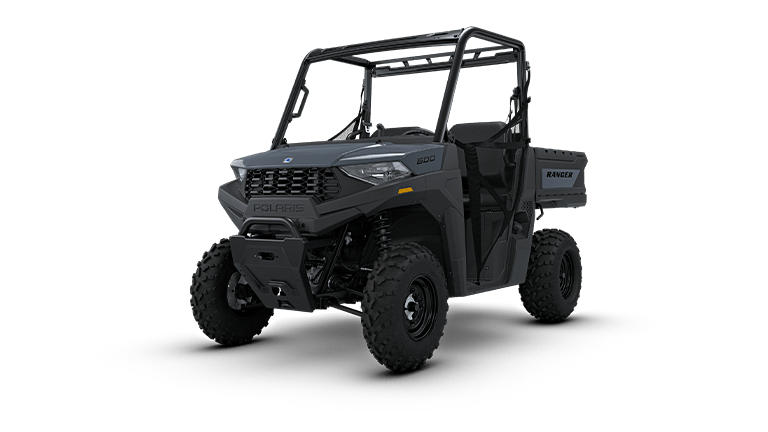
The 2025 Honda Pioneer 700 sits between a narrow two-seat runabout and a full-size utility UTV. It carries three people, tows 1,500 lb and uses an automotive-style three-speed automatic instead of a belt-driven CVT. At $12,399, it offers straightforward work capability without the bulk or price of a 1,000cc machine. Its 675cc single makes about 36 hp, and stronger rivals sit close in price. Our guide to reading ATV and UTV specs explains how to weigh those figures.
The liquid-cooled 675cc single-cylinder engine makes about 36 hp. That is enough for property travel, carrying three occupants and pulling moderate loads at sensible speeds. It favors predictable utility work over acceleration.
The engine’s ceiling appears when fully loaded or climbing a long grade with a trailer. There is less reserve than in the 44 hp Polaris Ranger SP 570 or 52 hp Can-Am Defender HD7. For routine chores and measured trail travel, the Honda is adequate.
Three-speed automatic: no CVT belt
Honda uses an automatic three-speed transmission with a torque converter. It works through fixed gears rather than varying ratios with a drive belt, giving the Pioneer a more automotive feel than the CVT-equipped competition.
The design appeals to buyers who do not want a belt to inspect or replace. Three ratios are not as seamless as a CVT across every speed, and shifts remain part of the experience. The transmission is meaningful, but it does not erase the engine’s modest output.
Three seats and compact dimensions
The standard Pioneer 700 seats three across one row. It suits an owner who needs passengers but not a second row, while keeping the rear dedicated to the tilt bed.
At 59.7 inches wide with a 76.8-inch wheelbase, the Honda is compact for a three-seat utility machine. It is 1.7 inches wider than a Ranger SP 570 and considerably narrower than a 62-inch Defender HD7. The width remains too great for 50-inch trail restrictions. Buyers who must fit those routes need the Pioneer 500, accepting its lower towing capacity and two-seat cabin.
Drivetrain, clearance and work capability
Selectable 2WD and 4WD let the driver use two-wheel drive on firm ground, then bring in the front wheels when traction deteriorates. Ground clearance is 10.5 inches, enough for typical property ruts and moderate trail obstacles. It exceeds the Pioneer 500 by two inches but does not match the 11 inches or more offered by some larger competitors.
The 1,500 lb tow rating covers a useful utility trailer, yard equipment or moderate property loads. It matches the Ranger SP 570 and Yamaha Viking EPS. The tilting bed is the other core work feature, making loose loads easier to unload. The dataset does not list a bed-capacity figure, so buyers should confirm that rating separately rather than assuming it matches a rival.
Fuel capacity is 7.9 gallons, almost twice the Pioneer 500’s figure. Its 1,290 lb weight remains manageable beside larger full-size machines, although trailer and tow-vehicle ratings still need checking.
Who it is for
The Pioneer 700 fits owners and hunting camps needing three seats and moderate towing without the weight and price of a 1,000cc UTV. It particularly suits buyers who value a geared automatic and Honda’s ownership reputation.
It is less suitable for drivers focused on speed, repeated maximum-load towing or deep-rut clearance. Families needing four people should choose the 700-4. Those who usually travel alone may find the narrower Pioneer 500 easier to place. If you are deciding between this format and an ATV, our ATV versus UTV guide covers the practical differences.
How it compares
The Polaris Ranger SP 570 costs $11,299, which is $1,100 less. It seats three, tows 1,500 lb and weighs 60 lb less. Its 567cc single makes 44 hp, but the driveline uses a CVT. The Polaris wins on price and power, while the Honda offers the torque-converter automatic and 0.5 inch more clearance. Compare them directly.
The Can-Am Defender HD7 costs $12,999. It makes 52 hp and tows 2,500 lb, giving it a substantial work advantage for another $600. The Defender is 175 lb heavier and 2.3 inches wider, while its PRO-TORQ transmission is a CVT. The Can-Am is stronger on raw capability. The Honda answers with compact dimensions and fixed gears. See the Honda and Can-Am comparison.
The Yamaha Viking EPS costs $15,499. It makes 47 hp and tows the same 1,500 lb. The Yamaha is 141 lb heavier and 2.1 inches wider, but includes EPS and a 600 lb bed. The Honda saves $3,100. Compare the Honda and Yamaha.
Where it sits in the Pioneer lineup
The Pioneer 500 costs $10,199 and is the access-first model. It seats two, measures exactly 50 inches wide and tows 1,000 lb. The Pioneer 700-4 shares the 700’s 36 hp engine, transmission, width, wheelbase and tow rating, but adds QuickFlip seating for four. It weighs 68 lb more and costs $13,199.
The Pioneer 1000-5 Deluxe is a major step at $20,300. Its 999cc twin makes 72 hp, the six-speed DCT provides more ratios, and towing rises to 2,500 lb. The standard 700 remains the middle choice for three-person utility use.
Price and value
At $12,399, the Pioneer 700 occupies a difficult price point. The Ranger SP 570 costs less and makes more power. The Defender HD7 costs only $600 more while adding 16 hp and another 1,000 lb of towing.
The Honda combines three seats, a geared automatic, a tilt bed and compact dimensions with the brand’s strong ownership reputation. That can justify the price for moderate work. Buyers judging only output and towing will find better numbers elsewhere.
Pros and cons
The good: three seats, a beltless three-speed torque-converter automatic, selectable 2WD and 4WD, a 1,500 lb tow rating, a tilt bed and manageable dimensions for a utility UTV.
The catch: only 36 hp, no 50-inch trail access and less capability per dollar than some close rivals. Buyers needing four seats must pay more for the 700-4.
The verdict
The 2025 Honda Pioneer 700 is a straightforward middleweight work machine. It carries three people, handles moderate towing and avoids a CVT belt, all without growing into a full-size 1,000cc platform.
Its biggest weakness is the competition. Several rivals offer more power or towing at a similar price. Choose the Honda because the geared automatic, compact packaging and ownership reputation matter. If maximum output per dollar is the priority, compare carefully before buying.
Want to compare it with another utility UTV? Add it to the comparison tool, or browse the full database by seating, towing capacity and price.