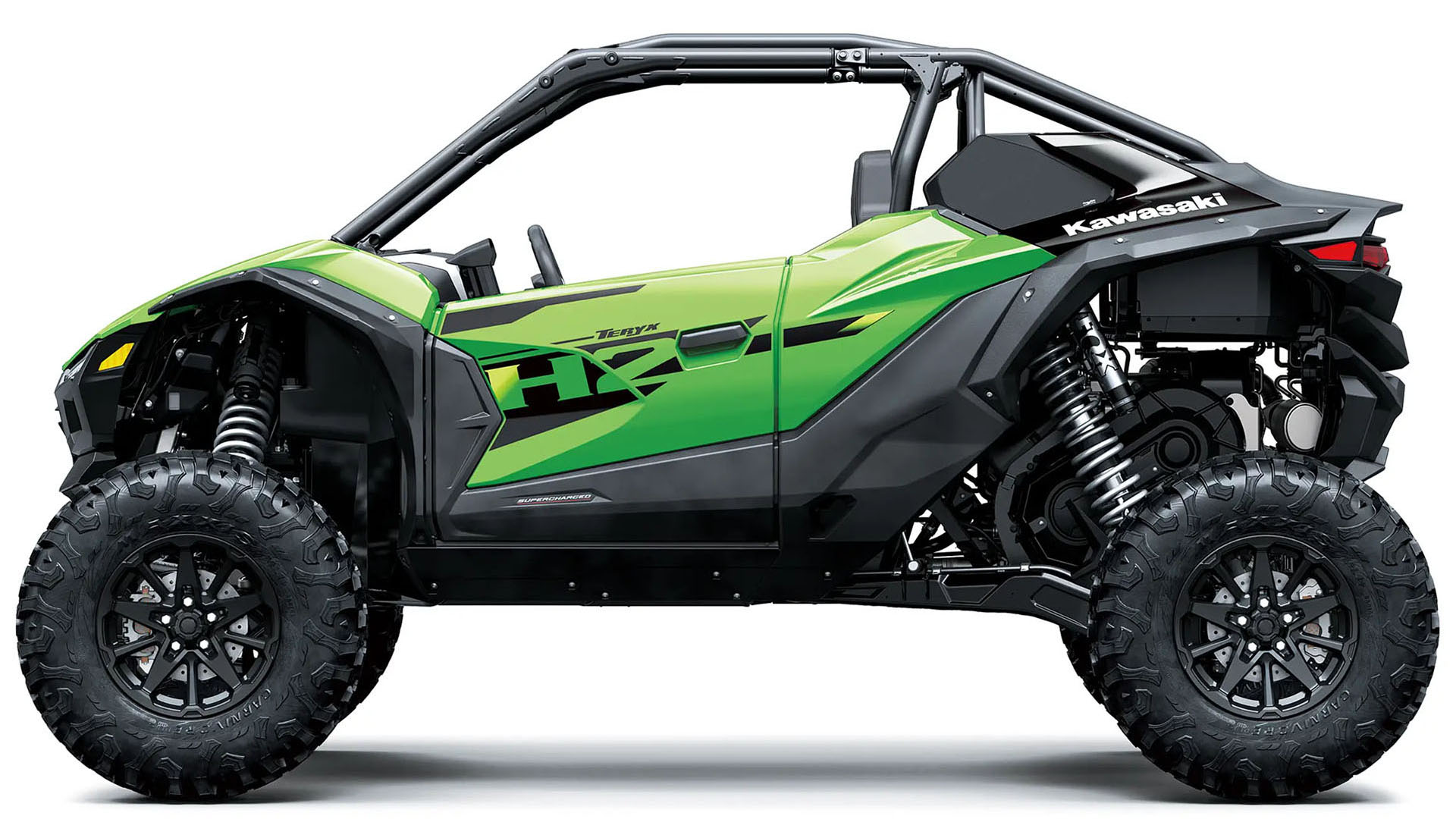
The 2027 Kawasaki TERYX H2 is not a four-seat Teryx with two seats removed. It is a new, dedicated two-seat flagship with Kawasaki’s 999cc supercharged inline-four, an official 250 hp rating and a $32,899 MSRP before its listed $2,395 destination charge. In a segment where extreme side-by-sides routinely cost much more, that number will attract attention. The rest of the specification explains why it should also attract careful thought.
At 74 inches wide, 134.1 inches long and roughly 2,086 lb dry, this is an open-terrain sport UTV. It is not meant for restricted-width trail systems, casual first-time drivers or a rider whose usual job is pulling implements. Kawasaki gives it 33-inch tires, 23.2 inches of front travel, 24.0 inches at the rear, a locking front differential, traction control and selectable power modes because the H2 is intended to cover rough ground fast. The two-seat format makes it substantially shorter and lighter than the existing four- and five-seat H2s, but it does not make it a small machine.
That distinction matters. The right buyer is an experienced rider who has room to use a 74-inch, 250 hp side-by-side, wants Kawasaki’s supercharged engine and is willing to budget for safety gear, transport, maintenance and recovery equipment. For anyone who rides narrow wooded trails, carries a group or needs a utility machine first, the impressive output figure is beside the point.
What is new for 2027
The TERYX H2 is new to Kawasaki’s 2027 lineup as its own two-passenger model. It shares the H2 family name and supercharged engine concept with the prior four- and five-seat machines, but its 101-inch wheelbase, two bucket seats, 74-inch width and 2,085.9 lb claimed dry weight make it a distinct vehicle rather than a trim label.
Kawasaki’s base H2 is deliberately not the Limited eS. The regular model has mechanically adjustable FOX 3.0 Internal Bypass shocks, conventional 16-inch aluminum wheels and a 7-inch color TFT display with RIDEOLOGY THE APP POWERSPORTS connectivity. The Limited eS adds Live Valve shocks, chassis-orientation hardware, a sway-bar disconnect, beadlock wheels, a roof, Garmin equipment and audio. Those upgrades may be worthwhile for a specific buyer, but they are not standard on this $32,899 version and should not be assumed from a photograph or a dealer listing.
The base model is offered in Lime Green or Ice Gray. This review covers the base two-seat TERYX H2 in Kawasaki’s published U.S. specification, not the Limited eS and not a TERYX4/5 H2.
Supercharged four-cylinder power, with controls that deserve to be used
The engine is a liquid-cooled, DOHC, 16-valve 999cc inline-four with Kawasaki’s supercharger and DFI fuel injection through four 40 mm throttle bodies. Kawasaki rates it at 250.0 hp at 9,000 rpm and 146.3 lb-ft of torque at 8,800 rpm. Its power claim is measured under ISO 4106, which Kawasaki notes is different from the SAE standard used for many cars, so cross-category horsepower comparisons should retain that caveat.
Either way, 250 hp in a two-seat side-by-side is serious output. This is not an engine that needs to be made exciting with aggressive marketing language. It needs a driver who can make smooth throttle inputs, read terrain and leave enough margin for the vehicle’s speed and weight. Helmets, the standard four-point belts, driver training and a realistic first-rides plan are part of the purchase, not accessories for later.
Kawasaki builds useful restraint into the package. KTRC traction control, Full/Mid/Low power modes and an economical-riding indicator are standard. No electronic aid changes physics, but lower power modes can be an intelligent way to learn the machine, manage an unfamiliar surface or hand it to a competent but less experienced driver. The sensible approach is to choose a setting before the ride gets demanding, not after the rear tires have already lost composure.
The transmission remains a CVT with high, low, neutral and reverse, and Kawasaki specifies engine braking. That decision keeps the H2 distinct from the DCT-based Can-Am Maverick R. A CVT is not inherently less capable in this application; it is simply a different ownership and driving experience. Ask the dealer about belt inspection, cooling, service intervals and warranty terms, then follow the owner’s manual rather than treating the 250 hp headline as permission to neglect the drivetrain.
Chassis, suspension and trail access
The H2 uses selectable 2WD/4WD with a locking front differential and shaft final drive. That gives the driver rear-drive behavior when conditions allow, front traction for loose climbs and a locked-front option when the obstacle genuinely calls for it. Engage the appropriate mode before the difficult section. A locked differential can improve forward progress, but it cannot compensate for bad line choice, excessive speed or tires that are not suited to the ground.
Up front, the double-wishbone suspension has FOX 3.0 Internal Bypass shocks with adjustable compression damping and adjustable spring preload, providing 23.2 inches of wheel travel. The rear’s four-link trailing-arm suspension uses the same shock family and delivers 24.0 inches of travel. These are serious, manually tunable components—not the base-model version of an electronic suspension system. A careful owner can set preload and compression for driver weight, cargo and riding terrain, but should record baseline settings and make changes one at a time rather than guessing.
Maxxis Carnivore Plus 33 x 10.00R16 tires sit on 16-inch aluminum wheels. The tire size helps produce 16.9 inches of maximum ground clearance, or 16.1 inches at standard ride height, and makes the H2 look ready for rough country because it is. It also raises replacement cost, makes a proper spare-tire plan important and reinforces the access issue: a 74-inch-wide UTV will not fit the 50-, 60- or 64-inch routes common in many public trail networks. Verify width rules, gates, trailer dimensions and riding-area requirements before putting down a deposit.
Braking comes from 270 mm dual hydraulic front discs with three-piston calipers and 270 mm rear discs with two-piston calipers. That is substantial hardware, but it does not lessen the effect of 2,218.2 lb of curb weight with fuel and standard equipment. Leave room, brake smoothly and reduce speed well before a blind rise, off-camber turn or tight downhill. The machine’s capability does not erase the responsibility of managing its momentum.
A useful base package, with clear limits
Kawasaki has not made the base H2 bare. It gets electric power steering, all-LED lighting, a 7-inch full-color TFT instrument panel, smartphone connection through RIDEOLOGY THE APP POWERSPORTS, skid plates with drain holes, ERGO-FIT adjustment, a DC outlet, two USB ports, four cup holders and additional storage. The TFT shows drive mode, power mode, boost pressure, CVT temperature and the information a driver needs to monitor the vehicle, rather than serving only as a decorative screen.
The cargo bed is small but real: 14.6 x 33.1 x 9.1 inches, rated for 300 lb. Kawasaki lists a 732 lb payload capacity and a 14.8-gallon tank. This is enough capacity for recovery gear, tools, water and day-ride supplies if they are packed securely and kept sensible. It does not turn the H2 into a utility side-by-side, and Kawasaki does not publish a towing rating for it. Buyers who need a trailer machine should start with a utility UTV whose rated tow capacity, hitch equipment and gearing suit the work.
There are no beadlock wheels, plastic roof, installed navigation system, audio package, front camera or electronic suspension on the base H2. That is not a flaw; it is how Kawasaki puts the supercharged engine and long-travel chassis below the Limited eS price. The important thing is to price the accessories you genuinely need before deciding that the base machine is the less expensive ownership plan.
2027 Kawasaki TERYX H2 specifications
| Specification |
TERYX H2 |
| Engine |
999cc liquid-cooled, DOHC, 16-valve inline-four with Kawasaki supercharger |
| Output |
250.0 hp at 9,000 rpm; 146.3 lb-ft at 8,800 rpm (ISO 4106 horsepower rating) |
| Fuel system |
DFI with four 40 mm throttle bodies, dual injection and supercharger |
| Transmission |
CVT with H/L/N/R and engine braking |
| Drive system |
Selectable 2WD/4WD with locking front differential; shaft final drive |
| Driver aids |
KTRC traction control; Full/Mid/Low power modes; economical-riding indicator |
| Front suspension |
Double wishbone; FOX 3.0 Internal Bypass shocks; 23.2 in travel |
| Rear suspension |
Four-link trailing arm; FOX 3.0 Internal Bypass shocks; 24.0 in travel |
| Tires |
Maxxis Carnivore Plus 33 x 10.00R16 front and rear |
| Wheels |
16-inch aluminum |
| Brakes |
270 mm front discs with 3-piston calipers; 270 mm rear discs with 2-piston calipers |
| Length x width x height |
134.1 x 74.0 x 72.8 in |
| Wheelbase |
101.0 in |
| Ground clearance |
16.9 in maximum / 16.1 in standard |
| Estimated dry weight |
2,085.9 lb (2,088.1 lb California model) |
| Curb weight |
2,218.2 lb (2,220.4 lb California model) |
| Fuel capacity |
14.8 gal |
| Cargo-bed capacity |
300 lb |
| Payload capacity |
732 lb |
| Seats |
2 high-backed bucket seats with 4-point belts |
| Colors |
Lime Green or Ice Gray |
| Base MSRP |
$32,899, plus $2,395 destination charge listed separately |
TERYX H2 versus the alternatives
The 2027 Can-Am Maverick R X is the closest rival for a buyer deciding between two-seat, 240-plus-hp sport UTVs. The Can-Am has 240 hp, a seven-speed DCT, a 78.1-inch width, 25 inches of travel and a $39,699 MSRP. The Kawasaki is less expensive, four inches narrower and uses a CVT; the Can-Am has the more unusual transmission and slightly more travel. Neither is suitable for width-restricted trails. Compare the TERYX H2 and Maverick R X.
The 2027 Polaris RZR Pro R Boost Ultimate is the output-first alternative. Its 275 hp turbocharged four, active DYNAMIX suspension, 74-inch width and $49,999 MSRP put it in a higher price bracket. The TERYX H2 gives up 25 hp and the Polaris’s active damping, but costs $17,100 less before destination. That difference can fund a great deal of safety, transport and riding equipment. See the TERYX H2 and Pro R Boost comparison.
Within Kawasaki, the 2026 Teryx4 H2 is for the buyer who needs passenger capacity more than a compact footprint. It carries four people, is much longer on a 126-inch wheelbase and is listed at $37,199 in the site’s existing data. The new two-seat H2 is the straightforward choice for a driver-plus-one mission; the Teryx4 earns its extra cost and mass only when those extra seats will really be filled. Compare the two Kawasaki H2s.
The existing 2025 Can-Am Maverick R is another useful inventory comparison. It shares the broad idea of a 999cc, 240 hp, two-seat flagship and a 77-inch-class footprint, but its DCT architecture, published equipment and actual dealer availability need a trim-by-trim check. A discounted previous-year machine may be the sensible financial answer, but only after confirming its warranty start date, installed equipment and out-the-door price. Compare the Maverick R and TERYX H2.
Price and buying advice
Kawasaki lists $32,899 MSRP and a $2,395 destination charge for the base 2027 TERYX H2. Ask for a written out-the-door quote that separates destination, setup, registration, financing and each accessory. A trailer capable of carrying a 134.1-inch-long, 74-inch-wide machine, strong tie-downs, recovery gear, communications, a fire extinguisher and suitable protective equipment are practical parts of the budget, not optional afterthoughts.
Buy the TERYX H2 if you ride open terrain with one passenger, have legal access for a 74-inch sport UTV and want a high-output supercharged four without immediately paying for the Limited eS feature set. It is especially appealing for a buyer who prefers a CVT, wants manually adjustable FOX 3.0 shocks and values the shorter 101-inch wheelbase over a multi-seat H2’s passenger capacity.
Choose something else if your local routes impose narrow width limits, your usual rides need more than two seats, or a towing and cargo mission comes first. The sensible machine is the one that fits the land and the job. A 250 hp H2 that remains on the trailer because it cannot pass the gate is a very expensive specification sheet.
Verdict
The 2027 Kawasaki TERYX H2 is a confident, well-defined answer to the high-performance two-seat market. It delivers the H2 family’s 250 hp supercharged four, a 74-inch stance, huge travel, 33-inch tires, usable electronic controls and a genuine base-package price below its closest 2027 power rivals.
It should not be sold as a universal recreational side-by-side. The width, output, weight and lack of a tow rating make that case impossible. But for an experienced open-terrain driver who wants a two-seat supercharged H2 with conventional, adjustable FOX 3.0 suspension, the base TERYX H2 looks like the sharpest value in Kawasaki’s new flagship family. Browse more Kawasaki UTVs, visit the 2027 model-year hub, explore sport UTVs, or add the TERYX H2 to the comparison tool.