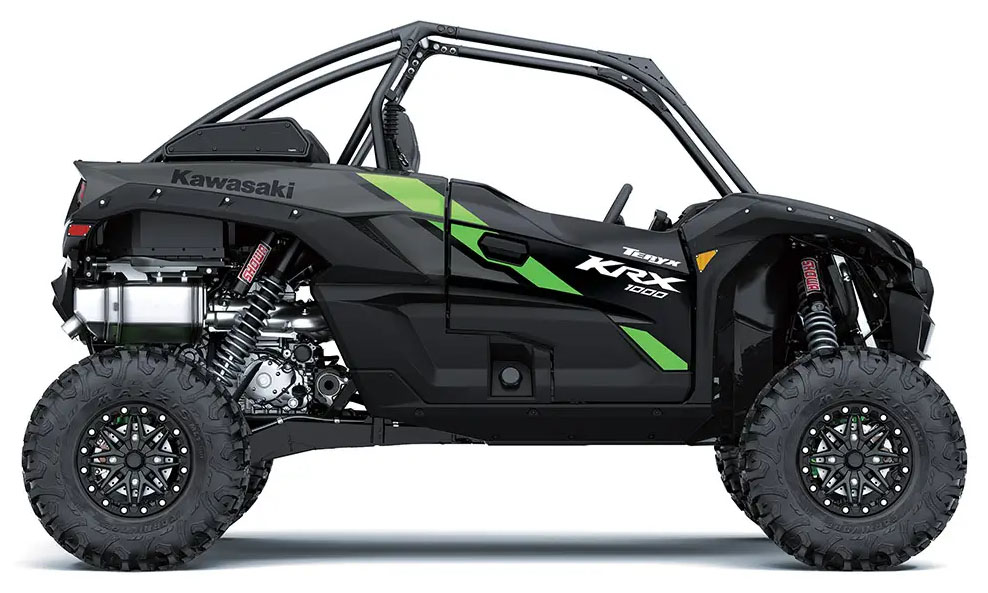
The Kawasaki Teryx KRX 1000 plays a different game from most sport side-by-sides. Where machines like the RZR chase dune-speed thrills, the KRX is built to crawl over rocks, shrug off punishment and carry you deep into the backcountry and back. It is big, heavy and seriously tough, riding on 31-inch tires with a huge fuel tank for range. Here is what it does better than almost anything, where its size counts against it, and who should spend the $22,199. (Torn between an ATV and a side-by-side? Our ATV vs UTV guide can help.)
The KRX runs a 999cc parallel-twin making about 112 horsepower. That is a strong number, but the KRX is a heavy machine at close to 1,900 lb, so it feels more muscular than frantic. The engine has real low-end torque for clawing up rock ledges and steep, loose climbs, and the automatic CVT keeps things simple when you are picking a line through a boulder field. Flat out it will run to around 70 mph, a touch behind lighter rivals, but outright speed was never the KRX’s mission.
Built for rocks and backcountry
This is where the KRX earns its badge. It rolls on aggressive 31-inch tires and carries 14.4 inches of ground clearance, so it clears obstacles that would hang up lesser machines. The long 98.8-inch wheelbase gives it stability on off-camber climbs, the skid protection and heavy-duty cage are made to take hits, and the big 10.6-gallon fuel tank means you can range far from the trailer without worrying about the next fill-up. This is a machine designed to go where the trail gets ugly and keep going.
Suspension and ride
Kawasaki fits Fox 2.5 Podium shocks with long travel, and the payoff is a composed, planted ride over rough and rocky ground. The KRX soaks up sharp hits and stays settled at speed, and its weight, usually a downside, actually helps it feel glued down on technical terrain. It is not a nervous machine, and that confidence is a big part of its appeal for backcountry riders.
Width: where it fits and where it doesn’t
The one thing to plan around is size. At 68.5 inches wide the KRX is one of the widest machines in its class, which is great for stability but shuts it out of tighter trail systems. If your riding is open desert, rock country, mountain two-tracks or wide trails, it is right at home. If your local trails cap at 50 or 60 inches, this is not the machine, and you should look narrower.
Who it’s for
The Teryx KRX 1000 is the right side-by-side if you ride rocks, mountains and rough backcountry, and you value toughness and range over outright speed. It suits riders who punish their machines on technical terrain, who want big tires and clearance from the factory, and who would rather have a tank than a rocket. It seats two, so it is built for you and one passenger on a serious adventure.
It is not the pick if you chase dune-speed runs, if you need to fit narrow trails, or if you want the lightest, quickest machine for the money. For those riders, faster and narrower rivals make more sense.
How it compares
At $22,199 the KRX sits right in the thick of the sport class, but it stands apart on character. The rivals worth weighing:
- Polaris RZR XP 1000, $21,299. Lighter, quicker and built for dune and desert speed. The KRX counters with more clearance, bigger tires and a tougher build for the rough stuff. This is the key comparison. Compare them →
- Honda Talon 1000R, $22,699. A desert-sport machine with a smooth automatic DCT gearbox. Faster feeling and more refined on the highway-speed stuff, less of a dedicated crawler. Compare them →
- Yamaha YXZ1000R SS, $22,299. The enthusiast’s driver’s machine, with a high-revving triple and paddle-shift gearbox. A completely different feel from the KRX’s low-speed muscle. Compare them →
Want more straight-line speed? The turbocharged Can-Am Maverick X3 Turbo ($22,899) and the naturally aspirated 130 hp Arctic Cat Wildcat XX ($21,999) both feel quicker on open ground, though neither is the dedicated crawler the KRX is. Compare the KRX and the X3 →
Where it sits in the Kawasaki lineup
Kawasaki gives you a clear range. If the KRX is more machine than you need, the Teryx S LE ($16,499) and four-seat Teryx4 S LE ($18,199) are the friendlier V-twin recreation models, lighter and easier on the wallet. At the other extreme, the 2026 Teryx4 H2 ($37,199) brings a supercharged 250 hp four and claims the most powerful production side-by-side title. If you need to work rather than play, the six-seat Mule PRO-FXT 1000 ($16,499) tows 2,000 lb and hauls a crew.
Price and value: is it worth it?
At $22,199 the KRX is priced with the sport-class pack, and what you get for the money is durability and capability rather than lap times. The 31-inch tires, high clearance, big tank and tough build are exactly what rock and backcountry riders would add anyway, so getting them from the factory is real value if that is your terrain. If your riding is fast and open, a lighter machine gives you more thrills for the same money.
So is it worth it? For rock crawlers and backcountry explorers, yes. It is one of the toughest, most capable technical machines in the class straight off the showroom floor. For dune and desert speed hunters, a lighter or turbocharged rival will feel like the better buy.
Pros and cons
The good: excellent rock-crawling and technical ability, 31-inch tires and 14.4 inches of clearance from the factory, composed Fox 2.5 suspension, and a big fuel tank for real backcountry range.
The catch: it is heavy at close to 1,900 lb, at 68.5 inches wide it is shut out of tight trails, and it feels less quick than lighter rivals despite a strong 112 hp.
The verdict
The Kawasaki Teryx KRX 1000 is the sport side-by-side for people who measure a machine by where it can go, not how fast it gets there. It crawls, climbs and takes abuse better than most, and it carries the tires, clearance and range for real backcountry adventures out of the box. Make sure 68.5 inches fits your trails and that you want toughness over top speed, and the KRX is one of the most capable machines in its class.
Want to see how it stacks up against a specific rival? Drop it into the side-by-side comparison tool, or browse the full database to filter by power, width and price.