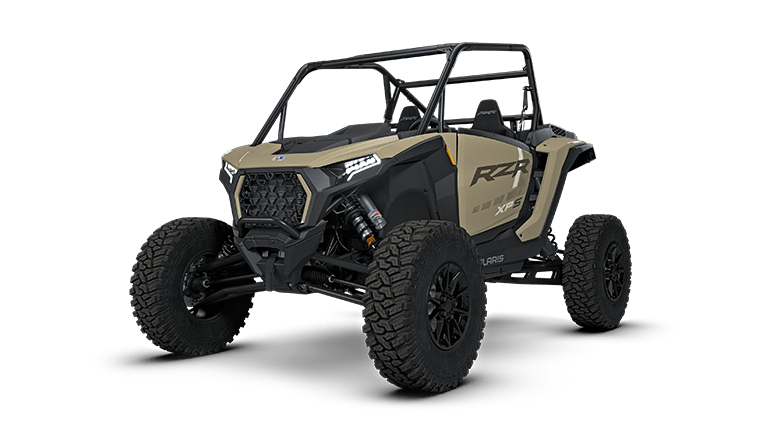
The 2027 Polaris RZR XP S is not a cheaper Pro R and it is not a wide version of the ordinary RZR XP with a tire package. It is the 72-inch, two-seat trail machine for riders who want big suspension room, 32-inch tires, and a 114 hp engine without stepping into the extreme-price end of the sport UTV market. The Sport starts at $22,499, plus $1,345 destination, and puts its money in chassis hardware rather than screens and speakers.
That makes the base trim easier to judge than many sport machines. You get standard EPS, full doors, LED lights, a front bumper, full skid protection, 2.5-inch Walker Evans shocks, and 25 inches of usable travel. You do not get factory audio, a rear camera, a touchscreen, electronic suspension, or a winch. For a rider who would rather spend on tires, fuel, and trail time, that is a reasonable split. For someone who expects a loaded cabin at this price, it is a clear reason to inspect the Ultimate before ordering. If you are comparing every big number at once, our guide to reading ATV and UTV specs is a useful starting point.
What changed for 2027?
Polaris’s current 2027 material presents the RZR XP S as a continuation of its current 72-inch platform, not as a separate ground-up redesign. The key package remains: a 114 hp, 999cc ProStar 1000 DOHC twin; 32-inch Pro Armor Trekker 2.0 tires; a 90-inch wheelbase; 16 inches of clearance; and 25 inches of usable travel.
That is not a knock. It is a reminder to buy the actual specification, not a model-year badge. The biggest decision is Sport versus Ultimate, then two-seat versus four-seat. The two-seat Sport in this review is the clean baseline: robust suspension and protective hardware, a 4-inch color display with analog dials, and no bundled entertainment or camera equipment.
The engine: enough power, with useful modes
The ProStar 1000 is a liquid-cooled, fuel-injected 999cc DOHC parallel twin rated at 114 hp. It uses an automatic PVT transmission with park, reverse, neutral, low, and high ranges, plus geared reverse. Three selectable drive modes—Rock, Standard, and Sport—change the power delivery to suit technical terrain or a more immediate response.
There is a good practical case for this engine rather than a larger flagship motor. On a narrow, technical route, the ability to meter power cleanly and put it through a durable driveline matters at least as much as a headline output figure. Use low range for slow climbs and repeated technical work; save Sport mode for the terrain where its sharper response is genuinely useful. It is still a 1,726 lb dry machine on 32-inch tires, not a lightweight trail buggy, so deliberate inputs are part of the experience.
High-performance true on-demand AWD/2WD is standard. It gives the RZR the traction flexibility riders expect without turning the cabin into a control panel. The important point is simple: AWD helps the machine move forward; it does not change the laws of braking, cornering, or off-camber recovery.
Why the XP S chassis matters
The XP S earns its name with width and suspension. At 72 inches wide and 90 inches between the axles, it is built for stability and room to work over broken ground. The 32-inch, eight-ply Pro Armor Trekker 2.0 tires give it more rollover capacity than a 64-inch trail machine, while 16 inches of ground clearance gives the skid plate real breathing room.
The front uses dual A-arms with a stabilizer bar and 19 inches of wheel travel. The rear has trailing arms, a stabilizer bar, and 21 inches of wheel travel. Polaris quotes 25 inches of usable travel at both ends. Its definition is important: usable travel is measured from full droop between the tire and skid plate, so it should not be compared as though it were wheel-travel data.
The standard 2.5-inch Walker Evans setup is the right kind of non-electronic hardware for this trim. Front velocity shocks and rear needle shocks have 16-position clicker adjustment. That offers owners room to tune for their weight, passenger, terrain, and pace without pretending a few clicks can replace correct spring setup or careful driving. Full doors, the front bumper, and a full skid plate reinforce the same intent: a ride-fast, ride-far machine that expects contact with real terrain.
Equipment: a deliberately honest Sport trim
Polaris includes several things riders should not have to buy back later: quick-turn EPS, retractable three-point belts, bolstered bucket seats with a driver slider, tilt steering, LED head and tail lights, illuminated controls, full doors, a front bumper, and a full skid plate. The 660-watt charging system and six-position PULSE bar also make accessory wiring less of a headache.
The omissions should be part of the deal conversation. The Sport’s center-mounted information display is a 4-inch color display plus rotary speedometer and tachometer—not a touchscreen. It does not include an audio system, connected services, rear camera, electronic suspension control, or a winch. Those omissions are not defects if the price and simple cockpit are the point. They are expensive surprises if you assume every $22,499 sport UTV comes loaded.
2027 Polaris RZR XP S 1000 Sport specifications
| Specification |
2027 RZR XP S 1000 Sport |
| Engine |
999cc liquid-cooled ProStar 1000 DOHC parallel-twin |
| Factory-rated output |
114 hp |
| Transmission |
Automatic PVT, P/R/N/L/H; geared reverse |
| Drive system |
High-performance true on-demand AWD/2WD |
| Drive modes |
Rock, Standard, Sport |
| Seating |
2 bolstered bucket seats; retractable 3-point belts |
| Dry weight |
1,726 lb |
| Width / length / height |
72 / 122 / 75.5 in |
| Wheelbase |
90 in |
| Ground clearance |
16 in |
| Fuel capacity |
9.5 gal |
| Payload |
740 lb |
| Cargo box |
300 lb; 28 x 22 x 7 in |
| Tires / wheels |
32 x 10-15 Pro Armor Trekker 2.0; 15 in cast aluminum |
| Front suspension |
Dual A-arm, stabilizer bar, 19 in wheel travel; Walker Evans velocity shocks |
| Rear suspension |
Trailing arm, stabilizer bar, 21 in wheel travel; Walker Evans needle shocks |
| Usable travel |
25 in front and rear |
| Steering / braking |
Quick-turn EPS; four-wheel hydraulic discs |
| Standard protection |
Full doors, front bumper, full skid plate |
| Base MSRP |
$22,499, plus $1,345 destination |
How it compares
The 2027 RZR XP 1000 Sport is the in-house alternative for riders whose trails and trailer space demand a 64-inch machine. Both use 114 hp and a 90-inch wheelbase, but the XP S pays for its wider stance, 32-inch tires, and much larger suspension envelope. Compare RZR XP and XP S →
The 2026 RZR XP S 1000 is relevant when dealers still have one on the floor. The factory fundamentals are close enough that inventory price, warranty start date, exact equipment, and color should decide the value conversation—not a casual assumption that the newer badge is a different machine. Compare 2026 and 2027 XP S →
The Can-Am Maverick R X occupies a different, much more expensive part of the sport UTV world. Its turbo triple and dual-clutch transmission bring a very different powertrain experience. The RZR XP S is the more relevant choice when 72-inch trail capability and a roughly $22,000 starting point are the actual brief. Compare them →
The Kawasaki Teryx H2 is another power-and-price step upward. It makes sense for a buyer hunting supercharged performance; it is not the value alternative to an XP S Sport. Compare RZR XP S and Teryx H2 →
Price advice: do not accidentally buy an Ultimate in accessories
The listed $22,499 MSRP excludes Polaris’s $1,345 destination charge as well as tax, setup, registration, and dealer fees. Then there are the purchases sport-UTV owners commonly make: a windshield, roof, spare-tire solution, communication gear, a winch, extra lighting, and sometimes audio. Price that list before declaring the Sport a bargain.
The Sport is the smart spec when you genuinely want the mechanical package without the tech bundle. It already has the two expensive things that are difficult to retrofit well—wide-travel chassis hardware and EPS. If a touchscreen, camera, and audio are non-negotiable, the Ultimate can be the more coherent purchase. If 72 inches will not fit the routes you actually ride, neither trim solves the real problem; look at the 64-inch RZR XP instead.
Verdict
The 2027 Polaris RZR XP S 1000 Sport is a focused trail machine. It brings 114 hp, 32-inch tires, 16 inches of clearance, 25 inches of usable travel, standard EPS, full doors, and genuine underbody protection to a price that stays well below flagship sport UTV territory.
Its compromise is also its appeal. The Sport does not pretend to be a rolling entertainment system. It gives serious riders the chassis pieces first and asks them to decide which electronics and accessories are worth paying for. Confirm that 72-inch width works where you ride, then drive one on the kind of terrain that matters to you. If the fit is right, this is a very persuasive middle ground between a narrow trail model and an all-out flagship.