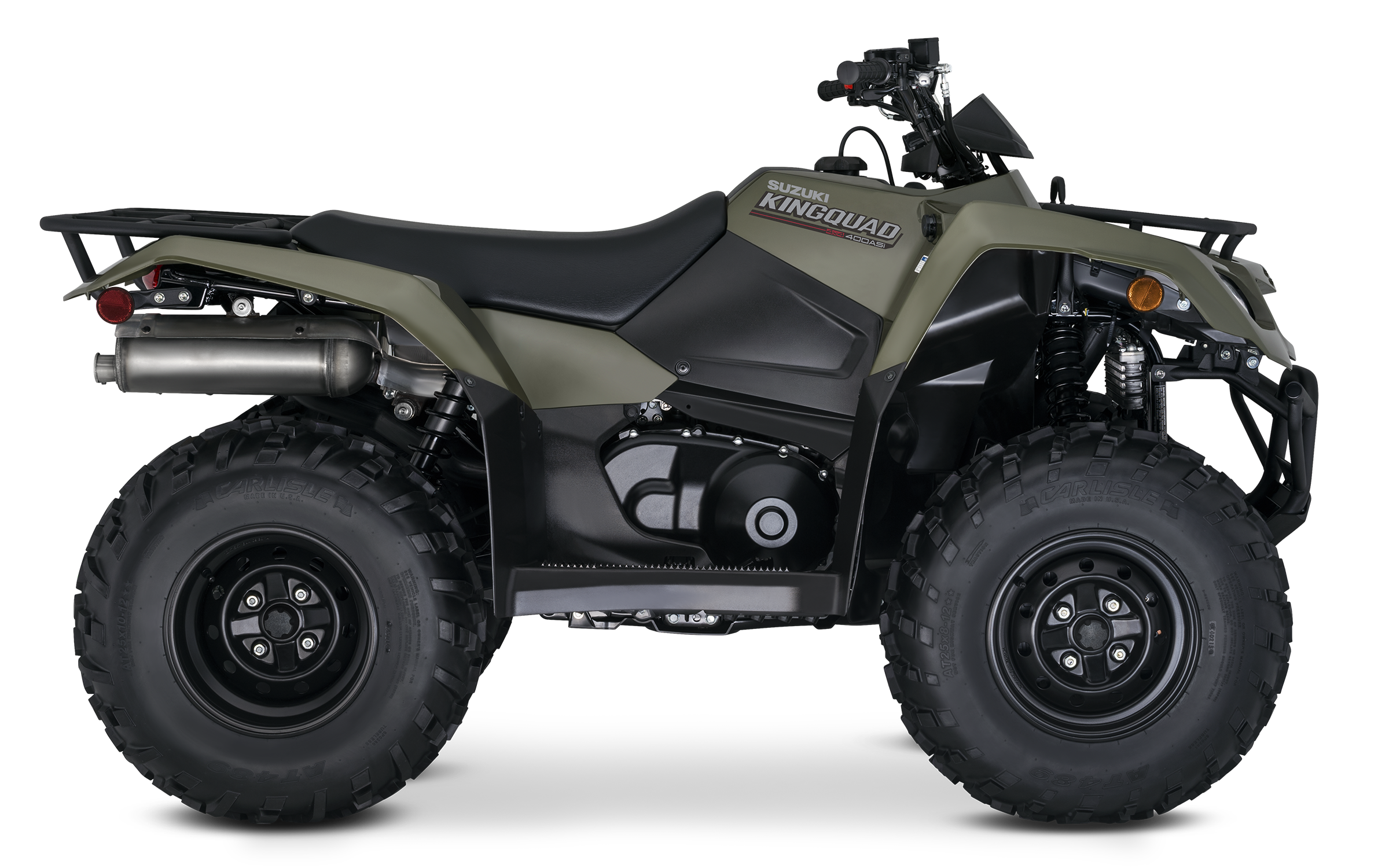
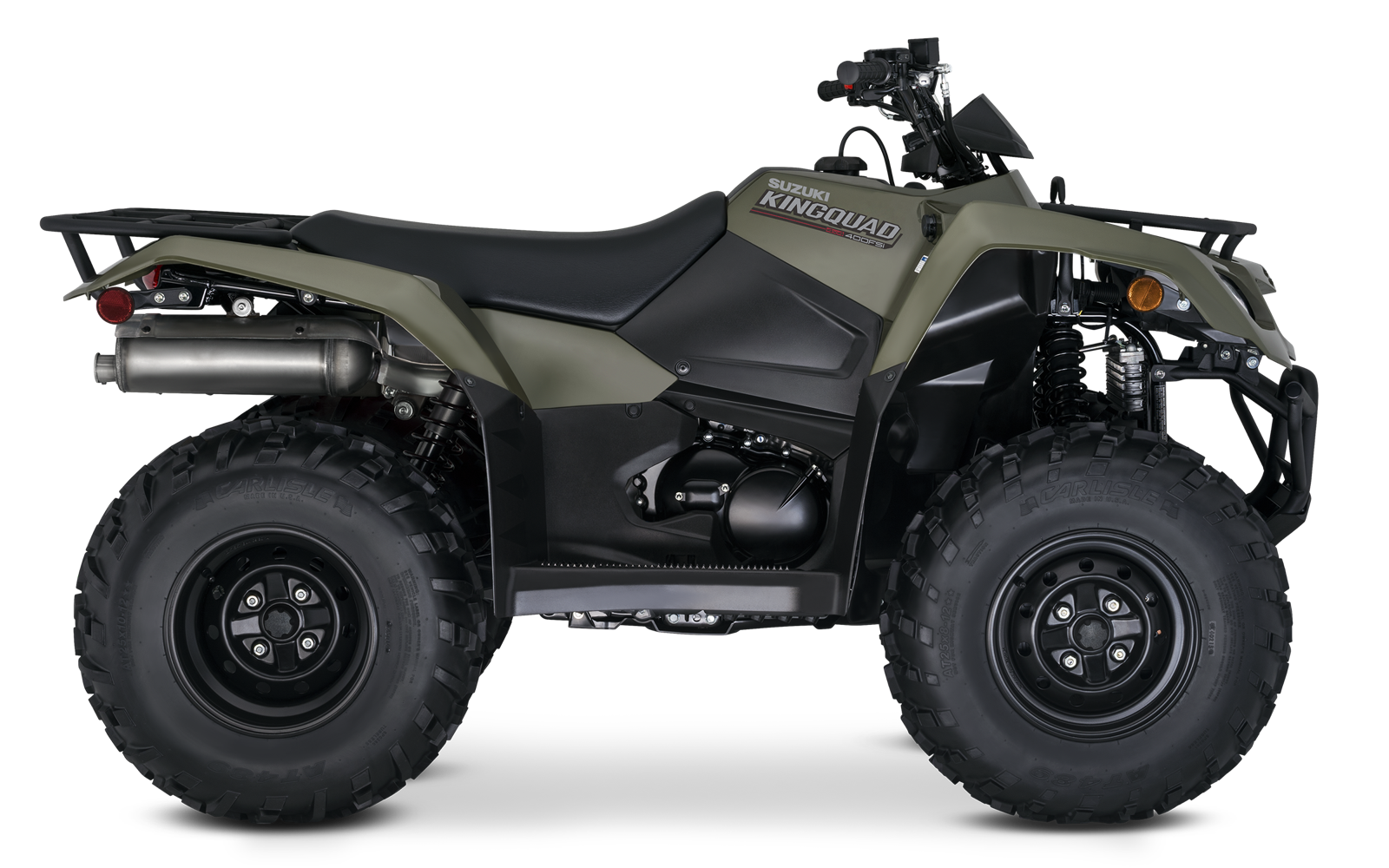
The 2026 Suzuki KingQuad 400ASi is a compact, traditional utility ATV for riders who prefer a simple 4WD machine to a large, expensive, electronically dense one. It starts at $7,099 plus a $600 destination charge, runs a fuel-injected 376cc single through Suzuki’s Quadmatic CVT, and keeps its overall width to 45.1 inches. That is a useful shape for woods, chores and a truck bed, not a vague “does everything” pitch.
There are two important limits to understand up front. This is the base 400ASi, so it does not have EPS. And Suzuki’s current US product page does not publish a towing or rack-load rating. The steel racks and winch-ready mounting are useful, but they should not be turned into made-up capacity numbers. Buyers who need a trailer-first ATV should buy from a manufacturer that publishes the needed rating.
Price and purpose: compact 4WD without feature creep
With destination, the basic starting figure is $7,699 before registration, dealer charges, accessories, and any freight surcharge the dealer confirms. Suzuki notes that a freight surcharge can apply to certain MY25 and MY26 models, so it is worth requesting an out-the-door worksheet rather than stopping at the base MSRP.
At 45.1 inches wide and 81.1 inches long, the KingQuad 400ASi is compact enough to be easy to position through trees, beside fences, and on a 6.5-foot truck bed. It is still not a 50-inch class trail ATV everywhere, so route rules always win, but its footprint is much less imposing than a typical 48-inch-plus utility quad. This is a practical advantage, not just an aesthetic one.
The 376cc engine: torque and control over peak numbers
Suzuki uses a fuel-injected 376cc, air-cooled OHC four-valve single with the Suzuki Advanced Cooling System. An oil cooler and thermostat-controlled fan help control heat during low-speed work and hauling. The engine management includes slip-control logic that adjusts fueling and timing to support grip in loose conditions.
Suzuki does not publish a current horsepower number for this model. It is better not to invent precision where the factory has declined to provide it. The useful shopping question is whether the 400-class single has enough torque and range selection for the work, access routes, and tire size you expect to run. For ordinary property work and steady trail riding, it has a sensible, deliberately modest character; it is not a substitute for a 500- or 700-class ATV when fast loaded running is a core part of the job.
Quadmatic is an automatic V-belt CVT with high and low ranges plus reverse. The gated shift lever is easy to understand, and shaft drive avoids the routine chain adjustment of a sport ATV. Suzuki also describes an engine-braking system that reduces freewheeling on descents. Those are practical strengths for a utility machine, not decorative feature-list additions.
2WD, 4WD, and a limited-slip front differential
A handlebar lever selects 2WD or 4WD. In 4WD, the torque-sensing limited-slip front differential sends power toward the front wheel with traction. It is not a selectable full differential lock, so set expectations correctly: it adds useful traction and keeps steering relatively light, but it does not produce the same behavior as a locked front end in a severe obstacle.
That is not a fault. For the mixed hard ground, dirt roads, wet leaves, and occasional rough sections that define many real ATV days, the system is appropriately simple. Use 2WD when it is enough, switch to 4WD before the machine is already stuck, and avoid relying on the front end to rescue an over-ambitious load or line choice.
Chassis, racks, and the value of published limits
The KingQuad has independent double-wishbone front suspension and a swingarm rear with twin shocks. Suzuki lists 6.7 inches of travel at both ends, 9.8 inches of clearance, and 25-inch Carlisle tires on steel wheels. It is a stable, sensible arrangement for a compact utility ATV, but it lacks the rear independent suspension, larger tires, and long travel found on more expensive models.
Steel front and rear racks, full floorboards, winch-ready mounts and wiring, a front DC outlet, and an LCD dash all support normal working use. The omission is not the equipment; it is the missing factory capacity rating. Since Suzuki does not state a 2026 towing or rack-load number on the current US page, this review will not infer one from a previous brochure or another KingQuad. That is a real consideration when comparing it against models with published limits.
The 24-month limited warranty is a point in Suzuki’s favor. It is materially longer than the standard coverage attached to some competing utility ATVs and gives a new buyer more time to identify an issue in normal seasonal use. One specification needs caution: Suzuki prints 265 kg beside 628 lb for curb weight, but those figures do not convert. The catalog preserves the stated pound figure while withholding a precise weight winner in comparisons involving this ASi.
2026 Suzuki KingQuad 400ASi specifications
| Specification |
2026 KingQuad 400ASi |
| Engine |
376cc air-cooled-with-SACS OHC four-valve single; electronic fuel injection |
| Factory-rated output |
Suzuki does not publish a current horsepower figure |
| Transmission |
Quadmatic automatic V-belt CVT; high/low range and reverse |
| Drive system |
Selectable 2WD / 4WD; torque-sensing limited-slip front differential; shaft drive |
| Curb weight |
628 lb as printed by Suzuki; its accompanying 265 kg figure conflicts |
| Overall width / length / height |
45.1 / 81.1 / 48.0 in |
| Wheelbase / ground clearance |
50.0 / 9.8 in |
| Fuel capacity |
4.2 gal |
| Towing / rack capacity |
Not rated by Suzuki on the current US product page |
| Tires |
25 x 8-12 front; 25 x 10-12 rear |
| Suspension travel |
6.7 in front / 6.7 in rear |
| Warranty |
24-month limited warranty |
| Base MSRP / destination |
$7,099 / $600 |
How it compares
The 2026 Kawasaki Brute Force 450 4x4 is a similarly sized 4WD automatic with a 443cc liquid-cooled single, a 43.3-inch width, and published 1,050-lb towing and 225-lb rack ratings. The Suzuki has a longer two-year warranty, while the Kawasaki is the clearer work-capacity choice because its limits are stated. Compare them →
The 2027 Polaris Sportsman 500 is wider at 48 inches but adds an independent rear suspension, 1,350-lb towing rating, a factory 2,500-lb winch, and a published 33-hp output. The KingQuad is the smaller, simpler choice; the Polaris brings more standard work equipment. Compare them →
The 2027 Can-Am Outlander 500 offers a stronger 650cc single at a lower entry price, but that representative trim is rear-wheel drive. The Suzuki costs more because it brings selectable 4WD and a limited-slip front differential, which can be the deciding capability on wet ground or uneven trails. Compare them →
The 2027 Yamaha Grizzly EPS is a higher-priced 686cc alternative with EPS, independent rear suspension, 26-inch tires, more travel, and a published 1,322-lb towing rating. The KingQuad is the budget and compact-footprint choice; the Yamaha is the more capable option for riders who value steering assist and rough-terrain composure. Compare them →
Verdict
The 2026 Suzuki KingQuad 400ASi makes sense for a rider who wants a compact, fuel-injected 4WD ATV with a high/low CVT, shaft drive, 25-inch tires, a no-nonsense rack layout, and unusually strong factory warranty coverage. Its 45.1-inch width and straightforward controls are the features that will matter every time it is loaded, parked, or guided through a tight route.
It is not the right ATV for shoppers who need EPS, independent rear suspension, a full front differential lock, or published trailer and rack capacities. Suzuki’s missing work ratings should be treated as a shopping constraint, not filled in with guesswork. Within those boundaries, the KingQuad 400ASi remains a clean, honest entry point into 4WD utility ATV ownership.