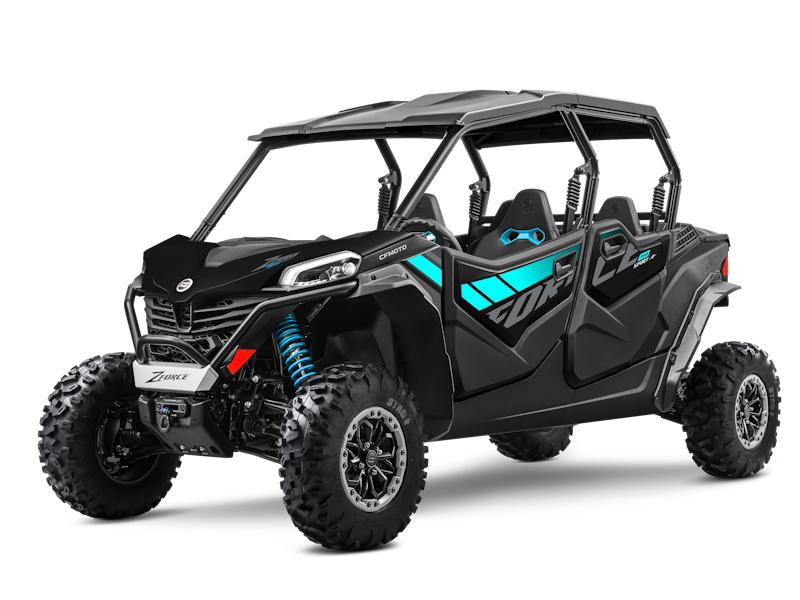
The 2026 CFMOTO ZForce 950 Sport 4 is an unusually straightforward four-seat sport side-by-side. It has an 83 hp V-twin, a 60-inch stance, a real second row, adjustable piggyback shocks, beadlock wheels, a roof and a 4,500 lb winch. The base price is $18,999. There is no turbocharger, giant touchscreen or six-figure power claim to explain away.
That clarity is useful because four-seat UTVs can become confused products. Some are stretched desert racers. Others are work machines with extra seats. The ZForce sits between those poles. It is built for families and groups who want to ride briskly on ordinary off-road trails, yet it stays narrow enough for many 60-inch routes and inexpensive enough to compete with higher-trim two-seaters.
The important compromise is also clear. Four people, a 120-inch wheelbase and 1,700 lb of dry vehicle ask a lot from 83 hp and 13.1 inches of rear travel. This is not the machine for chasing 200 hp four-seat flagships across open desert. It is a value-oriented recreational UTV whose strongest argument is the amount of useful hardware included before the accessory catalog opens.
Four seats change more than the passenger count
CFMOTO lists the Sport 4 at 151 inches long, 60 inches wide and 74 inches high. The wheelbase measures 120 inches. Those numbers matter more than the shared ZForce name because they define how the machine will fit on a trailer, turn between trees and cross a sharp breakover.
Against the current two-seat ZForce 950 Sport in the same U.S. brochure, the four-seater adds exactly 30 inches of overall length and 30 inches of wheelbase. Dry weight rises by 264 lb, from 1,436 to 1,700 lb. The 60-inch width, 12-inch ground clearance and suspension-travel figures do not change.
That makes the Sport 4 more stable in pitch than a short two-seater. A long wheelbase can feel settled over rolling terrain and reduce the tendency to teeter across closely spaced holes. It also makes tight switchbacks, abrupt crests and deeply crowned trailer ramps more demanding. The center of the chassis can contact ground where the shorter Sport clears, even though both machines have the same published clearance.
The practical test is not whether four seats sound useful. It is whether the owner will actually fill them. A second row adds length and weight on every trip, including solo rides. Families who routinely carry children or another couple get obvious value. A rider who brings passengers twice a year may be happier with a shorter machine and a second vehicle rental when the group arrives.
An 83 hp V-twin with honest expectations
The engine is a 963cc liquid-cooled, four-stroke SOHC V-twin with eight valves and Bosch electronic fuel injection. CFMOTO rates it at 83 hp at 7,500 rpm and 63 lb-ft at 5,000 rpm. It is the same published output used by the 2026 ZForce 950 Trail and two-seat 950 Sport.
Eighty-three horsepower is healthy for recreational trail riding. It should provide enough response to climb, slide the rear tires on loose ground and carry four adults without making every open section feel like a transport stage. The number becomes less impressive only when the ZForce is compared with modern turbo machines that cost far more and require a wider, heavier chassis to use their output.
Weight is the qualifier. The Sport 4 carries about 20.5 lb of dry vehicle for every claimed horsepower. Passengers, fuel, tools and recovery gear push the working ratio higher. Drivers moving from a two-seat 950 Sport should expect the same engine character but less urgency, especially on long grades or at elevation.
Electronic throttle offers NORMAL and SPORT modes. SPORT should make the pedal react more quickly; NORMAL should make power easier to meter over rocks, roots and low-grip climbs. Neither setting creates additional peak horsepower. With four occupants aboard, smooth pedal work can be more valuable than a sharp initial hit because every abrupt movement is multiplied across two rows of people.
CVT and four-wheel-drive controls
A CVTech automatic CVT supplies park, reverse, neutral, high and low ranges. The drive system provides selectable 2WD, 4WD and locked 4WD. The layout is conventional, which is a compliment in a recreational machine: the driver can choose a range and traction setting without working through a menu.
High range suits ordinary moving trails. Low range should be used when speed stays low but load stays high - prolonged climbs, deep mud, technical crawling or recovery work. That keeps the belt from being asked to slip its way through a situation better handled by lower gearing.
The front differential lock is for terrain that needs it, not a default setting for every dirt road. Locked four-wheel drive can increase steering effort and tire scrub. Standard electronic power steering reduces the work at the wheel, while CFMOTO’s dual-mode assistance lets the system adapt to the driving context.
The combination is not exotic, but it is complete. An owner does not need to pay for EPS or proper four-wheel-drive selection after purchase. The remaining question belongs on a test drive: how smoothly does the clutch engage at parking-lot speed, and how much engine braking is available on the terrain the buyer actually rides?
Suspension hardware is a major value point
The front suspension uses dual arched A-arms with 12.1 inches of travel. At the rear, dual A-arms and an adjustable toe-control link provide 13.1 inches. Both ends use high-pressure gas shocks with piggyback reservoirs and three-position compression adjustment. Front and rear sway bars are standard.
Three compression positions are less intimidating than a bank of high- and low-speed clickers, and they are enough to make useful changes. A group carrying four adults can try the firmer setting to resist bottoming and excess body movement. A lightly loaded vehicle on choppy ground may work better in a softer position. Spring preload still needs to be appropriate for the actual load; a compression adjuster cannot correct a badly sagged chassis.
The travel numbers are respectable for a 60-inch recreational UTV, but they should not be confused with long-travel desert suspension. Four occupants add heat and repeated load to the shocks. The rear row also sits farther from the vehicle’s pitch center, so passengers can experience more vertical movement than the driver over a series of whoops.
This is where a loaded test ride matters. An empty dealer demo can feel controlled while a family trip exposes soft rear ride height or a tendency to use all the travel. Buyers should ask how to set preload for their normal passenger weight and whether the dealer will help establish a baseline before delivery.
Tires, wheels, brakes and clearance
CFMOTO fits 27 x 9-14 front and 27 x 11-14 rear CST tires. They mount to 14-inch cast aluminum wheels with beadlocks. A functional beadlock is meaningful for riders who lower pressure for rocks or soft ground because it mechanically secures the tire bead to the wheel. It is also hardware that many competitors reserve for a package or accessory list.
The 12-inch ground-clearance figure is adequate rather than exceptional. Arched front arms help preserve space around obstacles, but the 120-inch wheelbase leaves a long middle section to protect. The standard full-length HDPE skid plate is therefore more than a brochure bullet point.
Hydraulic disc brakes work at all four corners, and CFMOTO lists a parking brake. At 1,700 lb dry, the machine can be well over a ton once four adults, fuel and equipment are aboard. Brake feel, pedal consistency and downhill control deserve evaluation at realistic weight.
Larger tires may look tempting, but they change more than stance. Added rotating mass affects clutching, braking, steering and driveline load. They can also raise the vehicle’s center of gravity. The stock 27-inch package is part of the balance behind the published gearing and suspension setup.
Cabin space and the second-row reality
The Sport 4 has four bucket seats beneath a full roof. Half doors, an adjustable driver’s seat and tilt steering are standard. Rear passengers receive the protection of a proper cage and doors rather than temporary jump seats in a cargo bed.
Still, four-seat comfort is personal. Adults should sit in the back before a deposit is placed. Check knee clearance against the front seat, foot placement, shoulder room and how easy it is to enter while wearing riding boots. A child seat or booster must be evaluated against the vehicle and restraint manufacturer’s instructions, not assumed safe because the seat appears wide enough.
The long roof provides useful weather coverage, while the half doors reduce mud and brush intrusion without sealing the cabin. In dusty group riding, rear occupants may experience more recirculated dust than the driver. Helmets, eye protection and careful spacing remain important even when the bodywork looks substantial.
A five-inch LCD presents the primary vehicle information. CFMOTO RideSync compatibility is provided through the T-Box, and the cabin includes USB and 12-volt power. The screen is modest beside the tablet-style displays now offered elsewhere, but a small, legible display is not a serious disadvantage if navigation stays on a phone and the vehicle controls remain physical.
Recovery gear and included protection
The factory equipment list is where the price starts to make sense. The Sport 4 includes a 4,500 lb winch with synthetic rope, roof, half doors, fender flares, front bumper, HDPE skid plate, LED headlights and taillights with backup lights, a rear cargo-box cover, electrical bus bar and two-inch receiver.
The larger winch is specific to the four-seat configuration in CFMOTO’s 2026 table. The two-seat Sport and Trail use 3,500 lb units. A 4,500 lb rating is appropriate for a machine that will be much heavier when occupied, although safe recovery still requires rated attachment points, a damper, gloves and an understanding of line angles.
The two-inch receiver needs careful wording. CFMOTO publishes the receiver as standard equipment but does not give the Sport 4 a towing-capacity number in the 2026 U.S. brochure. A receiver can carry an accessory without establishing how much trailer weight the chassis, brakes and cooling system are approved to pull. ATVPedia therefore leaves towing unrated.
The same caution applies to the covered rear storage area. It is useful for trail gear, but this is not a utility bed with a U.S. payload figure in the brochure table. Buyers who need to haul or tow as a primary job should choose a machine with explicit manufacturer ratings rather than infer them from mounting hardware.
2026 CFMOTO ZForce 950 Sport 4 specifications
| Specification |
ZForce 950 Sport 4 |
| Engine |
963cc liquid-cooled SOHC 8-valve V-twin |
| Output |
83 hp at 7,500 rpm; 63 lb-ft at 5,000 rpm |
| Fuel system |
Bosch electronic fuel injection |
| Throttle modes |
NORMAL and SPORT |
| Transmission |
CVTech CVT; P/R/N/H/L |
| Drive system |
2WD / 4WD / locked 4WD |
| Steering |
Dual-mode electronic power steering |
| Front suspension |
Dual arched A-arms; 12.1 in travel |
| Rear suspension |
Dual A-arms with adjustable toe-control link; 13.1 in travel |
| Shocks |
Piggyback high-pressure gas; three-position compression adjustment |
| Brakes |
Front and rear hydraulic discs; parking brake |
| Tires |
27 x 9-14 front; 27 x 11-14 rear |
| Wheels |
14-inch cast aluminum beadlocks |
| Length x width x height |
151 x 60 x 74 in |
| Wheelbase |
120 in |
| Ground clearance |
12 in |
| Dry weight |
1,700 lb |
| Fuel capacity |
9.8 gal |
| Seating |
Four bucket seats |
| Winch |
4,500 lb with synthetic rope |
| Towing capacity |
Not published in the 2026 U.S. brochure |
| Display |
5-inch LCD; RideSync compatible |
| Base MSRP |
$18,999 |
ZForce 950 Sport 4 versus Honda Talon 1000X-4
The 2025 Honda Talon 1000X-4 is a natural comparison for buyers who want four sport seats without moving to a very wide desert car. ATVPedia’s current data lists the Honda at 104 hp, 64 inches wide, 1,740 lb and $25,999.
The Honda’s defining difference is its six-speed dual-clutch transmission rather than a belt CVT. It also claims 21 more horsepower and comes from a brand with a long powersports dealer history. The CFMOTO is four inches narrower, 40 lb lighter on the recorded dry figures and $7,000 less expensive before destination and dealer fees.
This is not simply a specification win for either side. The Talon’s gearbox and extra power appeal to drivers who prioritize direct mechanical response. The ZForce counters with a much lower entry price, a 4,500 lb winch, roof and beadlock wheels in the standard package. Compare the ZForce 950 Sport 4 and Talon 1000X-4.
ZForce 950 Sport 4 versus Can-Am Commander MAX XT
The 2025 Can-Am Commander MAX XT occupies the recreation-utility middle ground. ATVPedia records 100 hp, a 62-inch width, a 130-inch wheelbase, 1,750 lb dry weight, 1,500 lb towing capacity and a $21,499 MSRP.
The Commander offers more explicit work ability, including a published towing rating. Its 100 hp engine also has an advantage when the vehicle is loaded. The CFMOTO is two inches narrower, ten inches shorter between the axles and $2,500 less expensive. It is the more sport-focused value choice; the Can-Am is the more credible answer when recreation shares the schedule with property work.
Owners should decide which half of the word “crossover” matters. Paying for towing and utility capacity makes sense only when those abilities will be used. Choosing the ZForce makes sense when passengers and trail pace matter more than a rated hitch. Compare the ZForce Sport 4 and Commander MAX XT.
ZForce 950 Sport 4 versus Yamaha Wolverine RMAX4 1000 XT-R
The 2026 Yamaha Wolverine RMAX4 1000 XT-R is a more premium four-seat recreation machine. It is rated at 108 hp and uses a 118.1-inch wheelbase, but it is 66.7 inches wide and weighs 2,381 lb wet. ATVPedia lists a $25,999 MSRP, 600 lb dumping bed and 2,000 lb tow rating.
The Yamaha has the stronger work-and-recreation resume, more power, a convertible cargo strategy and a published towing number. Its 30-inch tires, longer rear travel and premium equipment also target rougher terrain. The CFMOTO is nearly seven inches narrower and $7,000 less expensive, with a simpler mission and far less mass.
Trail width can settle this comparison before horsepower does. A 60-inch system may welcome the CFMOTO and reject the Yamaha. Where both fit, the RMAX4 justifies its price through capability and refinement, while the Sport 4 preserves budget for a trailer, helmets and actual trips. Compare the ZForce 950 Sport 4 and RMAX4 XT-R.
Who should buy the ZForce 950 Sport 4?
Buy it when four real seats, a 60-inch stance and strong standard equipment matter more than headline horsepower. It suits families riding forest roads and general recreational trails, owners upgrading from an entry utility UTV, and buyers who would rather receive a roof, winch and beadlocks at delivery than build the package one invoice at a time.
Skip it when local trails enforce a 50-inch limit. The ZForce 950 Trail is the correct member of the family for those gates, but it seats only two. Skip the Sport 4 when high-speed desert suspension is the priority, or when towing and cargo ratings are required for work.
Before buying, measure the trailer and storage space. A 151-inch machine needs more than a nominal 12.6-foot rectangle once tie-down clearance and tongue balance are considered. Bring the regular passengers to the dealership, set the front seat for the driver, then assess the rear row. Finally, price the first services, common wear parts and nearby dealer support along with the vehicle itself.
Verdict
The 2026 CFMOTO ZForce 950 Sport 4 works because its value is concrete. For $18,999, it delivers four seats, an 83 hp V-twin, selectable locked four-wheel drive, adjustable piggyback shocks, beadlock wheels, a roof and a properly upsized 4,500 lb winch. Those are parts an owner can use, not decorative claims.
Its limits are equally concrete. The long chassis asks for deliberate line choice, 83 hp must move a fully loaded four-seater, and the suspension is recreational rather than desert-race hardware. The receiver does not come with a published U.S. towing rating. None of that makes the Sport 4 a weak product; it defines the jobs it should and should not be asked to do.
For a family that rides where 60 inches fits and wants a complete machine below the price of many bare four-seat rivals, the ZForce 950 Sport 4 is a persuasive package. Browse more CFMoto models, see other sport UTVs, visit the 2026 model-year hub, or build another matchup with the comparison tool.