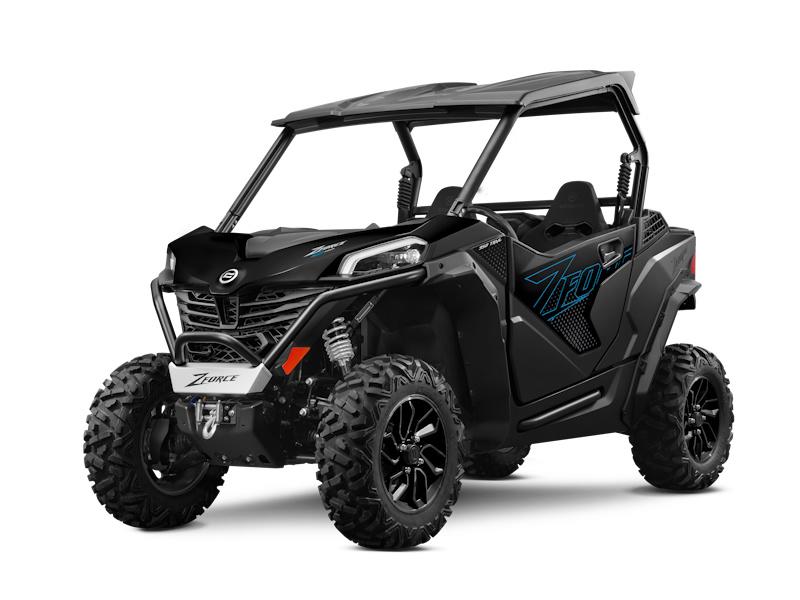
The 2026 CFMOTO ZForce 950 Trail is built around a compromise most sport side-by-sides no longer make: it is only 50 inches wide. That single dimension opens gates and regulated trail systems that turn away 60- and 64-inch machines. CFMOTO then gives the narrow chassis an 83 hp V-twin, adjustable piggyback shocks, electronic power steering, a roof, half doors and a winch for $14,999.
This is not a miniature utility cart and it is not a wide sport machine squeezed onto narrow tires. The 950 Trail has a 90-inch wheelbase, weighs 1,314 lb dry and carries two people in bucket seats. Its purpose is specific: deliver serious recreational performance where access is governed by width.
That focus makes it unusually easy to understand. If the best trails near you are marked 50 inches, the ZForce deserves a close look. If they are not, a wider machine will usually provide more clearance, lateral stability and suspension room. The important question is not whether 50 inches sounds agile. It is whether 50 inches gets you somewhere a wider UTV cannot go.
Fifty inches is the reason to buy it
CFMOTO lists the ZForce 950 Trail at 121 inches long, 50 inches wide and 72 inches high. Its 90-inch wheelbase is long enough to calm the chassis without turning it into a crew vehicle. The proportions suit wooded routes, gate openings and switchbacks better than the broad stance of a desert-oriented sport UTV.
Width restrictions are not universal, and the sign at a trailhead is only the start of the homework. Rules can apply to the widest physical point, not the number in a brochure. Offset wheels, wider replacement tires, mirrors and poorly chosen accessories can push a nominal 50-inch machine beyond the allowed limit. Measure the finished vehicle and check the current land-manager rule before traveling.
The narrow stance also has a cost. A 50-inch UTV has less lateral footprint than a 60-inch sibling, so off-camber ground, abrupt steering and side slopes deserve more respect. The driver should use smooth inputs and read the trail rather than relying on horsepower to fix a poor line. Narrow access is a capability, not a promise of wide-machine stability.
At 10 inches, ground clearance is adequate rather than extravagant. The 26-inch tires and arched front A-arms help preserve useful space beneath the chassis, but the Trail sits two inches lower than the current 950 Sport in CFMOTO’s brochure. On deeply rutted routes, the narrow vehicle may fall into tracks that a wider machine straddles. A careful line matters more than the marketing label.
An 83 hp engine in a 1,314 lb chassis
The 963cc engine is a liquid-cooled, four-stroke SOHC V-twin with eight valves and Bosch electronic fuel injection. CFMOTO rates it at 83 hp at 7,500 rpm and 63 lb-ft at 5,000 rpm. In a vehicle weighing 1,314 lb dry, those figures promise more urgency than an entry-level trail UTV without chasing the extreme output of a turbo platform.
The 2026 ZForce 800 Trail uses the same basic 50-inch dimensions in CFMOTO’s current brochure but is rated at 58 hp. The 950 therefore adds 25 hp while adding only 24 lb in the official table. That is a meaningful performance step, especially on climbs, at elevation or with two adults and gear aboard.
Electronic throttle control provides NORMAL and SPORT modes. NORMAL should make the pedal easier to meter on rocks, roots and low-grip surfaces. SPORT sharpens response for open sections where an immediate engine reaction is useful. The modes do not change the engine’s maximum rating; they change how quickly a given pedal movement requests it.
That distinction matters in a narrow chassis. The most aggressive response is not always the fastest way through a rough wooded section. A smoother pedal can keep the tires connected and reduce unwanted body movement. SPORT mode is a choice, not a badge the driver needs to defend.
CVT, four-wheel drive and steering
A CVTech automatic CVT handles the transmission duties with park, reverse, neutral, high and low ranges. The drive system provides 2WD, 4WD and locked 4WD. Low range remains the right choice for extended slow climbing, deep terrain and situations that would otherwise make the belt work too hard at low vehicle speed.
Selectable drive modes let the driver avoid unnecessary front-axle engagement on easy ground, add 4WD when the surface loosens and use the lock for the sections that genuinely need it. Full lock can increase steering effort and scrub, so it should not become the permanent setting simply because the trail is unpaved.
Electronic power steering is standard, and CFMOTO describes it as dual-mode EPS. Assistance matters on a 50-inch trail machine because the whole point is frequent direction changes in restricted space. The system should reduce kickback and fatigue, though buyers should still drive over broken ground to judge how much feedback remains at the wheel.
Suspension is better than the price suggests
The front uses dual arched A-arms with 10 inches of wheel travel. The rear has dual A-arms, an adjustable toe-control link and 12 inches of travel. CFMOTO fits high-pressure gas shocks with piggyback reservoirs and three-position compression adjustment at both ends.
That hardware gives the owner useful tuning without presenting a wall of clickers. A three-position adjuster can make sense on a recreational machine: start in the standard setting, firm it when repeated impacts or a heavier load demand more control, and soften it when traction and comfort are more important than resisting bottoming.
Adjustment cannot create width or clearance. The Trail has less suspension travel than the current 60-inch 950 Sport, which CFMOTO lists at 12.1 inches front and 13.1 inches rear. The narrow machine can move quickly, but its safest pace over large holes and cross-ruts will be lower than a wider chassis with more room for wheel motion.
Front and rear sway bars help control body roll. They are valuable on a narrow vehicle, though they also link left and right suspension movement. The result should be judged on the terrain that matters to the buyer: smooth handling on a fast forest road and articulation through uneven rocks do not ask the suspension for exactly the same thing.
Tires, brakes and protection
The ZForce uses 26 x 8-14 front and 26 x 9-14 rear tires on 14-inch cast aluminum wheels. The tire size helps keep the package compact and contributes to the 10-inch clearance figure. Owners considering larger tires should account for gearing, steering load, clutch heat, fender clearance and the possibility of exceeding a 50-inch trail limit.
Hydraulic disc brakes work at all four corners, with a mechanical parking brake listed in the brochure. A 1,314 lb dry machine will be substantially heavier with fuel, two riders and trail equipment, so brake feel should be evaluated with realistic load rather than during an empty roll around a showroom lot.
Protection and recovery equipment are unusually complete at this price. A 3,500 lb winch with synthetic rope, half doors, roof, HDPE skid plate, fender flares and front bumper are standard. Those parts are not decorative extras on a narrow trail. The winch can resolve a bad line, the skid plate protects the underside where clearance is finite, and the roof and doors make a long wet ride less punishing.
Cockpit and everyday usability
The driver gets an adjustable seat and a tilt steering wheel. The two bucket seats are more appropriate for brisk trail use than a utility bench, but seat comfort is personal. Taller drivers should check knee clearance, pedal angle and whether the steering wheel can be placed without blocking the display.
A five-inch LCD is specified for 2026. It is not a giant infotainment screen, and that is not necessarily a weakness in this setting. Speed, drive status, fuel and warnings need to be legible at a glance. RideSync compatibility through the T-Box adds phone-connected functions, while USB and 12-volt outlets cover device power.
LED headlights, taillights and backup lights are standard. The cargo area has a cover, and the equipment matrix lists a two-inch receiver and an electrical bus bar. CFMOTO does not provide a U.S. towing-capacity number for the ZForce 950 Trail in the 2026 brochure, however. A receiver is a mounting point, not permission to invent a trailer rating. ATVPedia therefore records towing as not rated.
The fuel tank holds 9.8 gallons. Range will vary widely with throttle use, terrain, elevation and load, but the capacity is generous for a compact two-seat trail machine. Owners should still plan around actual consumption rather than assuming the last segment of the gauge represents a fixed distance.
2026 CFMOTO ZForce 950 Trail specifications
| Specification |
ZForce 950 Trail |
| Engine |
963cc liquid-cooled SOHC 8-valve V-twin |
| Output |
83 hp at 7,500 rpm; 63 lb-ft at 5,000 rpm |
| Fuel system |
Bosch electronic fuel injection |
| Throttle / modes |
Ride-by-wire; NORMAL and SPORT |
| Transmission |
CVTech CVT; P/R/N/H/L |
| Drive system |
2WD / 4WD / locked 4WD |
| Steering |
Dual-mode electronic power steering |
| Front suspension |
Dual arched A-arms; 10 in travel |
| Rear suspension |
Dual A-arms with adjustable toe-control link; 12 in travel |
| Shocks |
Piggyback high-pressure gas; three-position compression adjustment |
| Brakes |
Front and rear hydraulic discs; parking brake |
| Tires |
26 x 8-14 front; 26 x 9-14 rear |
| Wheels |
14-inch cast aluminum |
| Length x width x height |
121 x 50 x 72 in |
| Wheelbase |
90 in |
| Ground clearance |
10 in |
| Dry weight |
1,314 lb |
| Fuel capacity |
9.8 gal |
| Seating |
Two bucket seats |
| Winch |
3,500 lb with synthetic rope |
| Towing capacity |
Not published in the 2026 U.S. brochure |
| Display |
5-inch LCD; RideSync compatible |
| Base MSRP |
$14,999 |
ZForce 950 Trail versus ZForce 800 Trail
Both 2026 Trail models share the 121-inch length, 50-inch width, 72-inch height, 90-inch wheelbase, 10-inch clearance, 9.8-gallon tank, 26-inch tires and 10/12 inches of wheel travel in CFMOTO’s current brochure. This is not a choice between two different-size chassis. It is a choice about power and shock hardware.
The 950 makes 83 hp and 63 lb-ft, versus 58 hp and 50 lb-ft for the 800. The 950 also receives the compression-adjustable piggyback shocks; the 800 uses spring-preload-adjustable oil-damped shocks. Dry weight rises from 1,290 to 1,314 lb. Riders who regularly face steep grades or want stronger acceleration have a clear reason to select the 950. Riders who value a calmer power delivery and lower purchase cost may not need it. Compare the two ZForce Trail models.
ZForce 950 Trail versus Polaris RZR Trail
The 2027 Polaris RZR Trail is another true 50-inch, two-seat machine. ATVPedia’s verified Sport-trim data lists 75 hp, a 79-inch wheelbase, 1,255 lb dry weight, 11 inches of clearance and a $16,999 MSRP.
The CFMOTO costs $2,000 less, claims eight more horsepower and includes a roof, aluminum wheels and winch. The Polaris is 59 lb lighter, 11 inches shorter between the axles and has an extra inch of clearance. That makes the RZR the more compact package, while the ZForce presents a strong included-equipment argument. Dealer support, cockpit fit and real suspension behavior should decide more than the badge. Compare the ZForce 950 Trail and RZR Trail.
ZForce 950 Trail versus Can-Am Maverick Trail 1000
ATVPedia’s existing 2025 Can-Am Maverick Trail 1000 is also 50 inches wide and uses a 90.6-inch wheelbase. Its recorded $16,499 MSRP is $1,500 above the CFMOTO, while its 1,350 lb weight and 10-inch clearance are close.
The Can-Am is the more established name in this narrow sport class. The CFMOTO answers with a 3,500 lb winch, roof and adjustable piggyback shocks in the base equipment list. Because model years and trim naming differ, buyers should compare current dealer quotes and manufacturer sheets rather than assuming every historical specification carries forward. Compare the ZForce and Maverick Trail.
Who should buy it
Buy the ZForce 950 Trail when local access genuinely rewards a 50-inch machine and recreational performance matters more than cargo or towing. It suits wooded public routes, narrow private trails and riders who want stronger acceleration than an entry trail UTV without moving to a wider chassis.
Skip it if the riding area allows 60 or 64 inches and rough-terrain speed is the priority. A wider sport machine can offer more stability, clearance and suspension travel. Skip it as a work vehicle if pulling trailers and carrying material are regular jobs; the receiver does not replace a published U.S. towing rating or a utility bed.
Before buying, confirm the actual finished width, sit in both seats, operate the drive controls with gloves and ask the dealer about normal service parts. Trailer dimensions matter too. A narrow UTV is easier to transport than many modern sport machines, but its real loaded weight is well above the 1,314 lb dry figure.
Verdict
The 2026 CFMOTO ZForce 950 Trail makes a disciplined case for itself. It does not pretend a 50-inch chassis can behave like a wide desert car. Instead, it puts useful power, legitimate adjustable shocks and a generous equipment list into the dimensions required by many trail systems.
The deciding factor is access. Where a 60-inch machine fits, the Trail’s lower clearance and narrow stance are compromises. Where the gate stops at 50, they are the price of admission, and the 83 hp engine means admission does not have to feel slow. At $14,999 with EPS, roof, half doors and a synthetic-rope winch included, it is a focused and convincing value. Browse more CFMoto models, explore trail UTVs, visit the 2026 model-year hub, or create another matchup in the comparison tool.