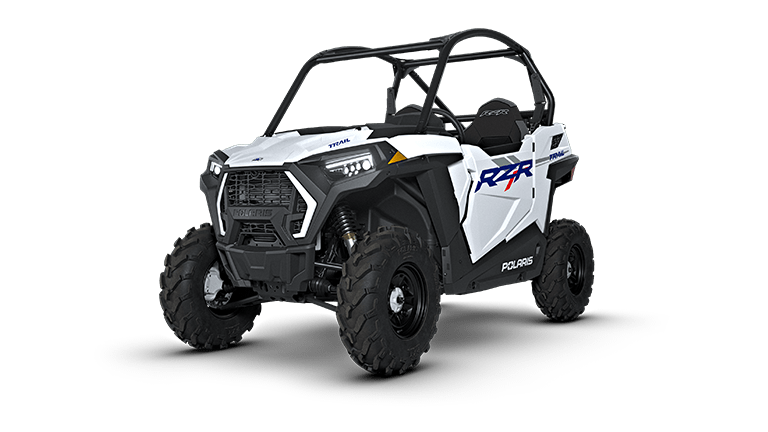
The 2027 Polaris RZR Trail is built around access, not excess. At exactly 50 inches wide, it can enter narrow side-by-side trail systems that exclude nearly every modern sport UTV. The two-seat Sport combines that slim body with a 75 hp twin, a compact 79-inch wheelbase, standard power steering, solid half doors, LED headlights, and a real 1,500-lb tow rating.
Its $16,999 base price sits well above the value-focused CFMoto ZForce 800 Trail and just above the older Maverick Trail 1000 already in the ATVPedia database. Those rivals expose the Polaris’s tradeoffs neatly. The RZR does not win the horsepower or bargain contest, but it is lighter, shorter between the axles, useful with a trailer, and packaged specifically for tight turns and restricted gates.
Price and trim choice
Polaris charges $1,145 destination on top of the Sport’s MSRP, putting the advertised subtotal at $18,144 before setup, tax, registration, accessories, and dealer charges. A roof is not standard, and neither are a winch or underbody protection package, so a realistic purchase budget should include the equipment your terrain actually requires.
The $19,999 Ultimate is $3,000 more before destination. It adds a poly sport roof, FOX 2.0 Podium X shocks, aluminum wheels, VersaTrac Turf Mode, RZR Fang accent lighting, a seven-inch RIDE COMMAND display, rear camera, and Rockford Fosgate Stage 2 audio. That is a coherent bundle rather than a cosmetic trim. Buyers who already want navigation, a camera, audio, roof, and better shocks should compare installed totals before trying to recreate the package later.
Sport remains the honest mechanical choice. It includes the same 75 hp engine, 50-inch chassis, ten inches of suspension travel, EPS, LED headlights, half doors, cargo box, and hitch. Its simpler cockpit and ZF shocks keep the entry price down without removing the features that make the vehicle a RZR Trail.
A 50-inch chassis with a short wheelbase
The factory width is exactly 50 inches. That number is the reason this model exists: many public systems place a 50-inch limit on side-by-sides, while the RZR Trail S, RZR XP, and wider sport models cannot legally pass the gate. Local rules still take precedence, and wide mirrors, wheel spacers, non-stock tires, or other accessories can undermine the advantage if they extend beyond the factory envelope.
The 79-inch wheelbase is unusually compact beside the ZForce 800 Trail’s 90.5 inches and Maverick Trail 1000’s 90.6 inches. That should help the Polaris change direction and negotiate tight switchbacks. The other side of that geometry is a livelier response to bumps and weight transfer than a longer chassis. Smooth steering and throttle inputs matter on a narrow machine, particularly when the trail is off-camber.
Overall length is 110.9 inches, height is 67.9 inches, and ground clearance is 11 inches. The 1,255-lb estimated dry weight is lower than either direct rival in the current database, but it is not the number to use blindly for a trailer. Fuel, spare tire, tools, roof, winch, occupants’ equipment, and tie-downs all add weight.
Engine and driveline
The 875cc, liquid-cooled DOHC parallel twin uses electronic fuel injection and produces a factory-rated 75 hp. An automatic PVT provides park, reverse, neutral, low, and high ranges. True on-demand AWD sends drive forward when the rear wheels lose traction, while 2WD is available when extra front-axle traction is unnecessary.
Seventy-five horsepower is a sensible output for a machine this size. It gives the RZR a useful power-to-weight advantage over lower-cost trail UTVs without turning every narrow corner into a test of restraint. Use low range for sustained slow work, steep climbs, or towing; high range is not a substitute for mechanical sympathy when belt speed is low and load is high.
The Sport does not include selectable drive modes or Turf Mode. Turf Mode arrives with the Ultimate and allows gentler turning on sensitive surfaces by changing rear-differential behavior. That feature matters around maintained property, but it is less important to a buyer focused exclusively on wooded trail riding.
Suspension, tires, and braking
Dual A-arms and stabilizer bars are used at both ends, with ten inches of wheel travel front and rear. The Sport’s ZF twin-tube shocks are conventional non-electronic units. They do not have the Ultimate’s FOX 2.0 Podium X hardware, but the common suspension geometry and travel figures mean the base vehicle still has the core ability to absorb roots, ruts, and moderate trail impacts.
The tires are 26x8-12 front and 26x9-12 rear, with three-ply construction and stamped-steel wheels. Three-ply tires help keep rotating mass and steering effort manageable, though riders in sharp rock country may prioritize more puncture resistance when replacement time comes. Any tire change should preserve actual width and clearance rather than accidentally turning a 50-inch machine into one that no longer fits the gate.
Four-wheel hydraulic discs use dual-bore front and rear calipers. EPS and adjustable tilt steering are standard. Together with the short wheelbase, those details support the RZR’s tight-trail brief more directly than a large touchscreen or headline tire size would.
Cargo and towing are genuine advantages
The Lock & Ride cargo box measures 20.7 by 37 by 7.9 inches and carries up to 300 lb. Polaris lists a 740-lb payload rating, 1,500-lb towing capacity, and standard 1.25-inch receiver. That makes the RZR Trail more useful around a campsite or property than narrow sport machines with no published tow rating.
Capacity figures are limits, not permission to max every rating simultaneously. Passenger weight, cargo, accessories, hitch load, slope, surface, and braking distance all affect the safe operating envelope. The small box also makes this a recreation-first UTV with occasional utility, not a substitute for a Ranger or another bed-focused work model.
2027 Polaris RZR Trail Sport specifications
| Specification |
2027 RZR Trail Sport |
| Engine |
875cc liquid-cooled, fuel-injected DOHC parallel twin |
| Factory-rated output |
75 hp |
| Transmission |
Automatic PVT; P/R/N/L/H |
| Drive system |
True on-demand AWD/2WD |
| Seating |
2 bolstered bucket seats with individual adjustment |
| Estimated dry weight |
1,255 lb |
| Overall size |
110.9 x 50 x 67.9 in |
| Wheelbase / ground clearance |
79 / 11 in |
| Fuel capacity |
9.5 gal |
| Payload / cargo-box capacity |
740 / 300 lb |
| Towing / hitch |
1,500 lb / standard 1.25 in receiver |
| Tires |
26x8-12 front; 26x9-12 rear; three-ply |
| Wheels |
12 in stamped steel |
| Suspension |
Dual A-arm with stabilizer bars; 10 in travel front and rear |
| Shocks |
ZF twin-tube |
| Steering / brakes |
EPS and tilt wheel / four-wheel hydraulic discs |
| Standard cabin equipment |
Solid half doors; four-inch LCD with analog dials |
| Base MSRP / destination |
$16,999 / $1,145 |
How it compares
The 2026 CFMoto ZForce 800 Trail is the value rival. Both are 50 inches wide and have standard EPS. The CFMoto costs $11,999 in the current database, saving $5,000, and its 11.4 inches of clearance slightly beats the Polaris. The RZR answers with 75 versus 62 hp, a much shorter wheelbase, lower dry weight, a larger fuel tank, and a published 1,500-lb tow rating. Compare RZR Trail and ZForce 800 Trail →
The 2025 Can-Am Maverick Trail 1000 is the horsepower choice. Its 976cc V-twin makes 100 hp and the database price is $16,499, $500 below the 2027 RZR Sport. The Polaris is 95 lb lighter, has one extra inch of clearance, carries a tow rating, and shortens the wheelbase by more than eleven inches. Choose the Can-Am for output and the RZR for compact maneuverability and broader light-duty usefulness. Compare Maverick Trail and RZR Trail →
The 2026 Honda Pioneer 520 also fits a 50-inch route, but approaches the job as a compact utility UTV. Its geared five-speed transmission, tilting cargo bed, and modest output suit slower property and hunting work. The RZR’s 75 hp, bucket-seat cockpit, and longer-travel suspension make it the recreational choice. Compare Pioneer 520 and RZR Trail →
If width restrictions do not apply, the 2027 RZR XP 1000 Sport brings 114 hp, 20 inches of usable travel, 29-inch tires, and a 64-inch stance for $3,000 more. Its extra capability is compelling on wider routes, but it cannot replace a true 50-inch machine where access is the deciding rule. Compare RZR Trail and RZR XP →
Verdict
The 2027 Polaris RZR Trail Sport earns its place by fitting where most side-by-sides cannot. It combines exact 50-inch width with 75 hp, standard EPS, ten inches of travel, a compact wheelbase, useful cargo space, and a legitimate tow rating. That is a more balanced specification than the narrow body alone suggests.
Its weak points are price and base-trim equipment. The CFMoto is dramatically cheaper, the older Maverick Trail offers more power, and the Sport still needs a roof for many owners. Yet neither rival combines the RZR’s short chassis, light weight, current factory specification, and utility ratings. If your routes enforce a 50-inch limit, this is a focused and credible answer. If they accept 60 or 64 inches, measure the value of narrow access carefully before giving up the stability and suspension room of a wider machine.