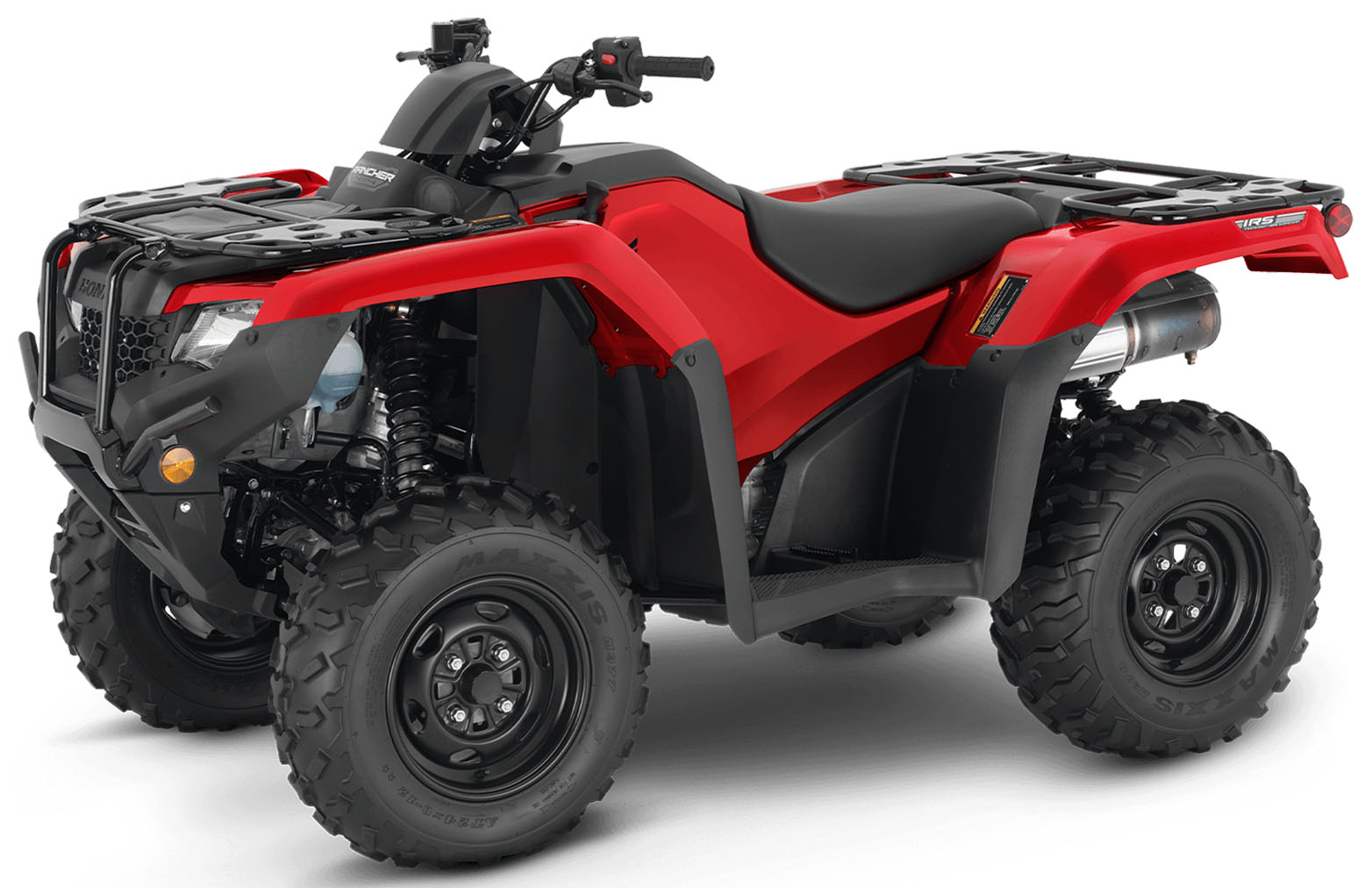
The 2027 Honda FourTrax Rancher 4x4 Automatic DCT IRS EPS is the Rancher to choose when the basic version’s low price is no longer the whole story. At $9,149 before Honda’s $620 destination charge, it is a premium one-rider utility ATV with automatic DCT shifting, EPS, independent rear suspension, four-wheel disc brakes, and a locking front differential. That is a substantial step up from the $6,299 two-wheel-drive Rancher, but it is also a more usable machine on rough ground and on a long day of chores.
The point of this trim is not to make a 420cc ATV feel like a larger Foreman or Rubicon. It is to make the Rancher easier to live with. The DCT removes clutch work, EPS takes some sting out of ruts and rocks, and IRS is the meaningful comfort upgrade. Buyers who only need a dependable rack-and-trail ATV should decide whether those three things solve real problems before paying the difference.
Honda lists a $9,149 base MSRP and a separate $620 destination charge. That makes $9,769 before taxes, registration, dealer setup, accessories, and any local pricing. It is worth writing that number down before comparing a deal to a less expensive Rancher, because the same destination charge applies across the family.
This is a single-rider ATV, not a two-up tourer, and it is not sold with the implied equipment of a fully accessorized dealer photo. Honda offers more than 20 accessories, including Pro-Connect cargo items, but a winch, plow setup, extra protection, and storage additions should be priced as additions. A clean base price is more useful than an attractive monthly-payment figure with those costs hidden.
DCT: automatic convenience without a CVT belt
The Rancher’s 420cc longitudinal single uses a five-speed automatic Dual-Clutch Transmission with reverse. It is a geared transmission that shifts automatically, rather than a belt CVT. For riders who alternate between low-speed work, gates, backing a trailer, and trail riding, that is a genuine convenience. Honda’s single-lever reverse is especially welcome when a task involves repeated forward-to-reverse moves.
The engine uses liquid cooling, OHV two-valve heads, and PGM-FI through a 34mm throttle body. Honda does not state horsepower, so treating any online number as a factory rating would be misleading. The 28-hp value in the vehicle card is an ATVPedia estimate; the useful factory facts are the 420cc displacement, fueling, transmission, and the way this trim is equipped.
There is no need to pretend the Rancher is a sport ATV. It has enough engine for its intended work and ordinary trail use, but riders seeking high-speed open-country performance should be looking at a larger-displacement utility ATV or a sport model. The DCT helps this Rancher feel orderly and controlled; it does not turn it into something it is not.
IRS and EPS are the reasons this trim costs more
This trim has independent double-wishbone front suspension with 7.3 inches of travel and independent dual-arm rear suspension with 8.5 inches. It also has 9.6 inches of ground clearance. That rear suspension is the central distinction from the less expensive Ranchers with a swingarm rear axle: it keeps the tires in contact more effectively over uneven terrain and reduces the sharp, choppy feeling that becomes tiring after a few hours.
Honda’s EPS is speed- and torque-sensitive. In plain terms, it lightens low-speed steering effort and helps reduce kickback when the front tires find rocks or ruts. It is not a substitute for choosing a sensible line, and the 686-lb curb weight still matters when a loaded ATV gets off camber. But it is the kind of feature a rider notices every time the trail gets rough or the day runs long.
The Rancher measures 47.4 inches wide with a 51.0-inch wheelbase. That is a useful compact footprint for woods and property trails, but measure gates and trailer space rather than relying on a category label. Its 24-inch tires and modest 9.6 inches of clearance are appropriate for farm trails, woods, snow-duty accessories, and general recreation—not for pretending every route is a boulder course.
4WD, towing, and racks: practical capability, clearly bounded
The drivetrain has selectable 2WD/4WD, direct front and rear driveshafts, and a torque-sensitive locking front differential. That gives the Rancher a proper low-speed traction tool for a muddy approach, a snowy lane, or uneven working ground. Engage it when the terrain calls for it; it is not a license to use momentum where careful tire placement would be safer.
Honda rates the Rancher to tow 848 lb. The front rack is rated for 66 lb and the rear rack for 133 lb, totaling 199 lb. Those are useful, specific numbers for tools, fencing supplies, a sprayer, or hunting gear. They are not permission to load the racks carelessly: high weight makes steering heavier and changes the ATV’s balance quickly, especially on slopes.
All four corners use disc brakes on this IRS Rancher—dual 193mm discs up front and a 170mm rear disc. It also has a 3.9-gallon fuel tank and a one-year transferable limited warranty. The basic ownership proposition remains pleasantly straightforward: shaft drive, fuel injection, mechanical 4WD hardware, and an accessory system designed around removable cargo racks.
2027 Honda FourTrax Rancher DCT IRS EPS specifications
| Specification |
2027 FourTrax Rancher 4x4 Automatic DCT IRS EPS |
| Engine |
420cc liquid-cooled, longitudinal OHV single; PGM-FI |
| Factory-rated output |
Not published by Honda |
| Transmission |
Five-speed automatic DCT with reverse |
| Drive system |
Selectable 2WD/4WD; torque-sensitive locking front differential |
| Seating |
1 |
| Curb weight |
686 lb, including standard equipment, fluids, and a full tank |
| Width / length / height |
47.4 / 84.5 / 47.2 in |
| Wheelbase / clearance |
51.0 / 9.6 in |
| Fuel capacity |
3.9 gal |
| Towing |
848 lb |
| Rack capacity |
66 lb front / 133 lb rear / 199 lb combined |
| Suspension travel |
7.3 in front / 8.5 in rear |
| Brakes |
Dual 193mm front discs / 170mm rear disc |
| Base MSRP / destination |
$9,149 / $620 |
How it compares
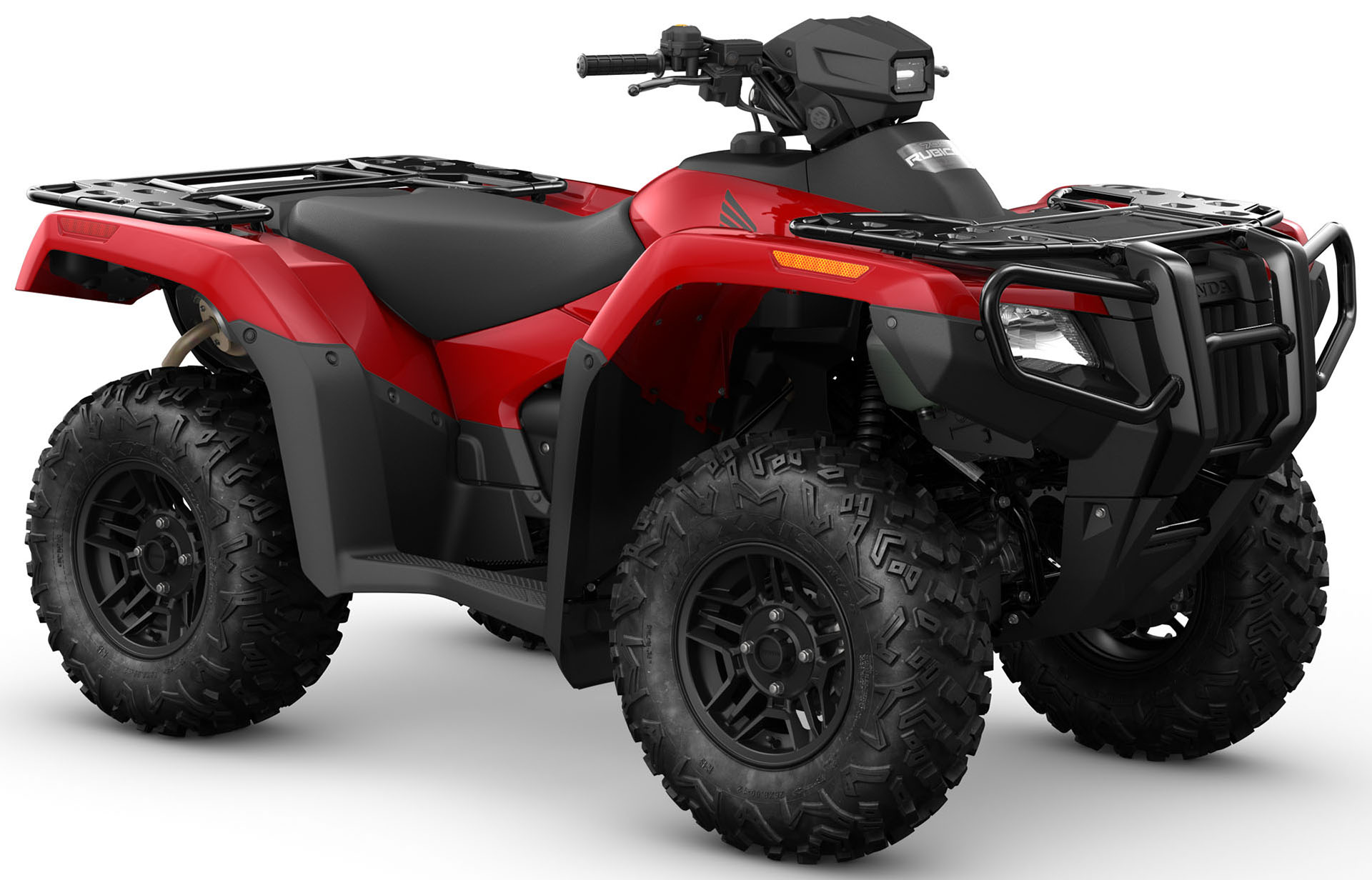
The 2027 Honda FourTrax Rubicon 700 4x4 Automatic is the larger-displacement, automatic Honda alternative. It shares the 848-lb towing rating and independent suspension, but Honda has not set its 2027 base MSRP. It is the better comparison for a buyer who values the 675cc platform more than the Rancher’s known price. Compare them →
The 2027 Yamaha Grizzly EPS is another premium one-rider utility ATV, with a larger 686cc single, 26-inch tires, more clearance, and Yamaha’s three-position 2WD/4WD system. It starts higher at $10,599 before its $700 destination charge, while Yamaha also does not publish horsepower. Compare them →
The 2027 Can-Am Outlander 700 has a much lower MSRP and a published 50-hp, 650cc Rotax single. Its $7,749 base trim omits EPS and a winch, though, so it is not a like-for-like comfort comparison. For a rider choosing between price and the Rancher’s DCT/IRS/EPS package, the equipment list matters more than engine size alone. Compare them →
The 2025 Honda FourTrax Rancher 420 is the relevant used or leftover reference. It can be a good value, but verify its exact trim. A lower sticker can mean two-wheel drive, a manual transmission, solid rear suspension, no EPS, or some combination of those omissions. Compare model years →
Verdict
The 2027 Honda FourTrax Rancher 4x4 Automatic DCT IRS EPS is easy to recommend to the buyer who will actually benefit from the upgrades. Its DCT, EPS, IRS, four-wheel disc brakes, 848-lb towing rating, and compact 47.4-inch width make it a thoughtful all-purpose one-rider ATV for property work and trail riding.
It is less compelling if its premium equipment would go unused. The base Rancher remains much cheaper, and the DCT IRS EPS is still a 420cc ATV with 24-inch tires and 9.6 inches of clearance. For a rider who wants comfort, no-clutch operation, a compact footprint, and Honda’s practical rack-and-shaft-drive setup, however, this is the Rancher that makes the most sense.